
Email marketing revenue statistics: How email drives real business growth


Every modern, internet-driven organization poised for big-time success leverages email in its marketing campaigns. Marketing professionals all over the business world segment their audiences, personalize content marketing efforts, invent compelling email subject lines, invest heavily in email design and email marketing software, take pains to improve email deliverability by avoiding spam filters, and optimize their messages for mobile devices.
But how can you be sure that your email marketing budget isn’t a sheer waste of money? Only by looking at the latest email marketing statistics, which showcase the email marketing revenue parameters (primarily return on investment (ROI)) achieved by companies across multiple industries. Let’s dig deep into these email ROI indices.
Top 10 email marketing revenue statistics you should know
What are the most general numbers representing email marketing ROI statistics?
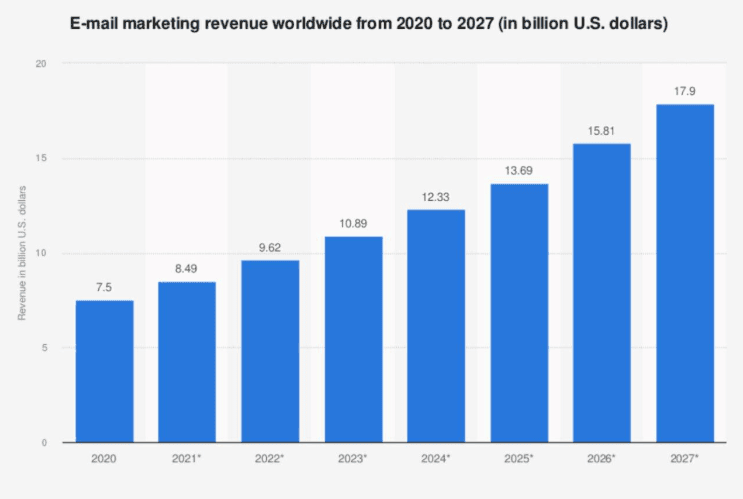
- Next year, the global email market is projected to reach almost $18 billion (a more than twofold increase over the 2020 figure), displaying a vibrant CAGR of 13+%.
(Source: Statista) - On average, companies earn $40 for every dollar they spend on email marketing campaigns.
- 18% of organizations report a 70-to-1 revenue ratio from marketing emails.
- Email marketing accounts for a quarter of all revenues enterprises receive.
- Email is the most effective marketing channel, yielding 4 times more money than other digital tools (social media marketing, paid advertising, mobile marketing, etc.).
- People who buy something through an email spend 138% more than those who aren’t targeted by promotional emails.
- Email automation enables companies to generate returns 30 times higher than those from standalone marketing emails or campaigns.
- A/B testing employed by email marketers enhances ROI by 83%.
- If you test your emails against spam filters, email marketing ROI can grow by nearly 40%.
- 28% of companies report an increase in revenue attained through recipient segmentation.

Having reviewed these general email marketing statistics, let’s focus on the figures that describe concrete revenue metrics.
Revenue-focused metrics for personalized email marketing campaigns
Personalized emails drive higher engagement and conversion rates, improved subscriber experiences, reduced unsubscribe rates, and greater open rates, especially when entrepreneurs in the travel and retail industries leverage subject-line personalization.

(Source: Invespcro)
What about revenue? Some key email marketing metrics will help you recognize the financial impact of your personalization efforts.
1. Return on investment
You can calculate ROI by subtracting campaign costs from generated revenue and then dividing the result by those same costs again. On average, personalization enhances ROI by 5-15%.
2. Revenue per email
This is a snapshot of efficiency. It measures how much money is earned by each email sent with personalized content.
3. Revenue per recipient (RPR)
RPR gauges the value that each email recipient generates. For standard campaigns, PRP fluctuates around 10 cents, whereas automated workflows can raise it to almost two dollars.
4. Average order value (AOV)
With this metric, you can track the average amount of money spent by customers whose purchases are triggered by an email. As email marketing stats prove, personalized subject lines and recommendations can boost AOV by an astounding 369%.
Email marketing revenue and customer loyalty
When consumers stick with a brand indefinitely, they ensure a stable stream of revenue into the company’s coffers. Which major customer loyalty parameters can be improved by email marketing?
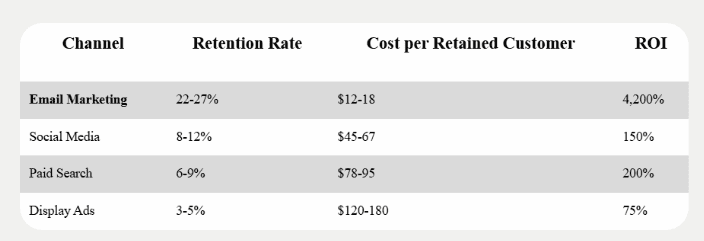
- retention rate. According to different estimates, email has a 22-27% retention rate, which is significantly higher than that of other marketing channels;
(Source: humanswith.ai) - customer churn rate. Churn rate varies greatly by vertical but typically ranges from 25-30% a year;
- redemption rate. This index reflects the percentage of participants in email-powered loyalty programs who use their rewards. A benchmark number to aim for is 1% to 5%;
- repeat purchase rate. Again, this is very industry-specific. On average, however, a healthy index of this kind hovers around 20%.

eCommerce email revenue statistics
The specifics of this niche are captured in the following figures:
- an average email ROI in the eCommerce domain is 4400%;
- 96% of top eStore retailers are convinced that an email marketing strategy generates more ROI than other tools;
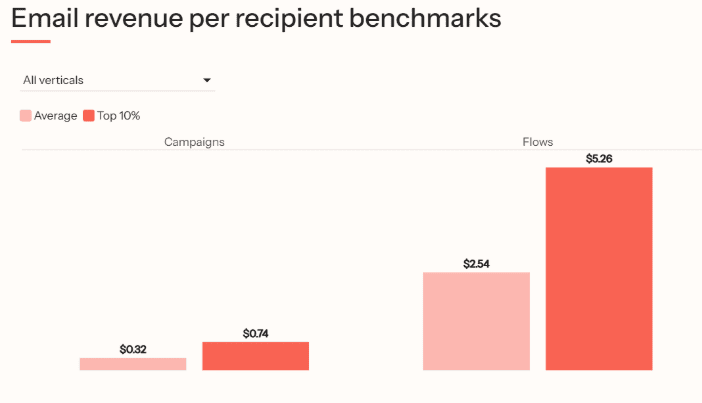
- the average campaign revenue per recipient is $0.32, but this figure can be increased eight times by leveraging flows;
(Source: Klaviyo) - a single cart abandonment email generates $3.8 million, and three of these messages yield 6.5 times more ($24.9 million).

Email automation campaigns and revenue growth
How does embracing automated emails increase ROI?
- the basic marketing stats for this approach to email campaigns are staggering. Automated messages have a 332% greater click-through rate and a 52% higher open rate than non-automated emails;
- welcome messages, browse abandonment, and abandoned carts account for 87% of all automated emails;
- top email campaigns earn $0.95 per recipient, while their automation enables entrepreneurs to reach $16.96 per recipient;
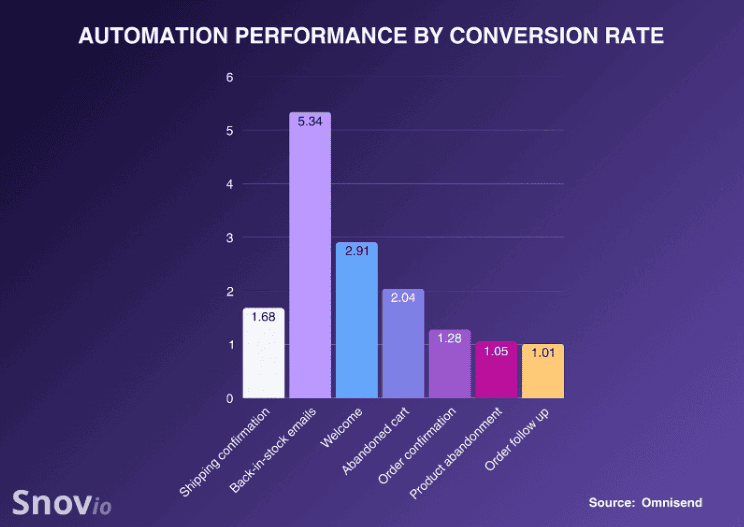
- automated back-in-stock messages are the most effective conversion rate boosters.
(Source: Snov.io)

Mobile email revenue performance
Since smartphones are the go-to devices in the overwhelming majority of our everyday routines, companies can’t ignore their impact on email-generated revenues:
- mobile devices account for the lion’s share of email usage statistics, with three-quarters of email users worldwide opening messages on them;
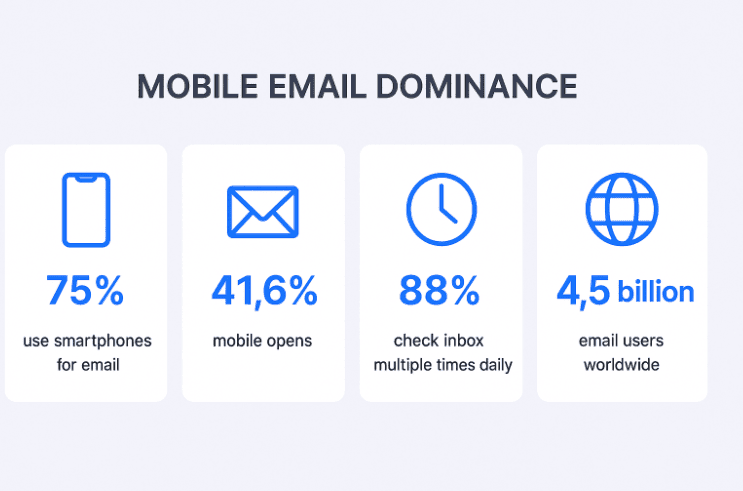
(Source: Salesso) - one-fifth of all email-generated revenue comes from mobile devices;
- B2B email marketing is doing extremely well in the mobile realm, as 90% of buyers who have had a positive B2B experience are likely to make repeat purchases;
- while 31% of buyers use a desktop and 24% use apps, 50% of consumers make purchases on the mobile version of the website.

Email frequency and revenue impact
How do these two parameters correlate in email marketing statistics?
- 28% of email recipients welcome relevant messages twice or even thrice a week;
- once-a-week communications are a rule of thumb for 12% of email marketing strategies, whereas 22% opt for two or three times a week;
- as Campaign Monitor claims, a car insurance agency reported 48% more insurance quotes, 304% more unique clicks, and, as a result, 45% growth in email revenue after gradually increasing email frequency;
- sending frequent promo messages is a great email marketing strategy, but overdoing it can backfire: almost 44% of subscribers dislike overly obtrusive emails.
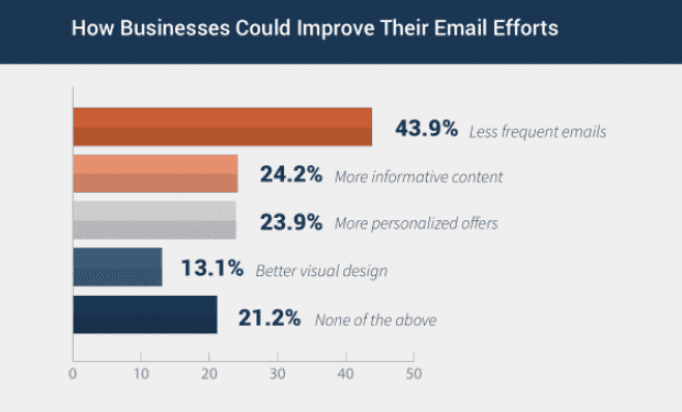
(Source: Campaign Monitor)

Email design and copy elements that drive revenue
How can workmanlike message crafting translate into greater revenue?
- subject-line personalization remains the major high-revenue email copy element, reportedly leveraged by 65% of marketers;
- given the variety of devices people use to view emails, you should design your emails to be compatible with all types of gadgets;
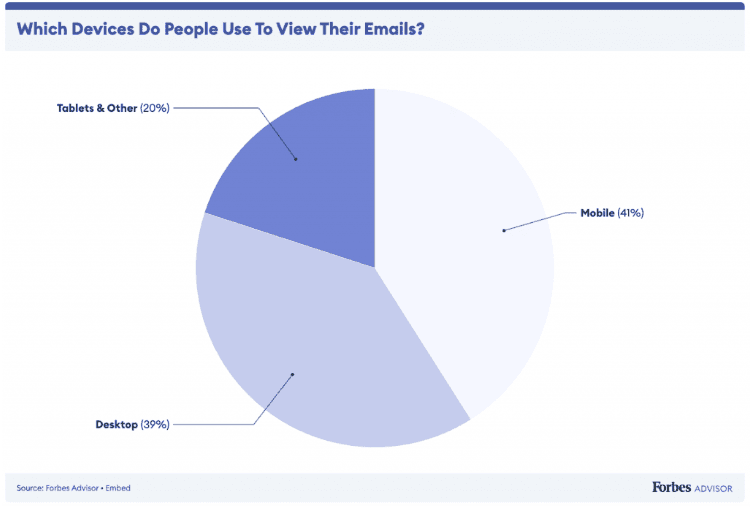
(Source: Forbes) - messages containing dynamic content deliver 258% more ROI than messages with static content;
- email marketing tools that leverage behavioral triggering and segmented targeting yield 77% of email-generated ROI.

Revenue attribution models for email marketing
A revenue attribution model determines which touchpoints used by email users should be credited for a sale by tracking the customer actions that lead to its closure. Experts employ several models to get a complete picture of revenue sources. The most popular models in the email marketing sector are as follows:
Last touch (click) attribution
Leveraged by 41% of marketers, this model enables them to measure direct campaign ROI and gives revenue credit to the final email the customer clicks on before making a purchase.
First touch (click) attribution
Conversely, this model identifies the first email interaction as the driver of initial interest. It is employed by 44% of experts.
Multi-touch attribution
This more comprehensive model, used by three-fourths of analysts, includes several subtypes:
- linear attribution, in which credit for the purchase is distributed evenly across all email interactions;
- U-shaped attribution, where the first and last interactions each get 40% of the credit, and the remaining 20% is split among the intermediate steps in the customer’s journey;
- time decay attribution, which gives more credit to interactions immediately preceding the final purchase.
Future trends in email marketing revenue
To maximize the revenue your email campaigns generate, keep an eye on both old and new trends in this niche.
AI-powered personalization
As various experts forecast, this year will witness a spike in the use of AI personalization-focused mechanisms across 75-89% of all email operations. AI-driven email marketing is expected to boost revenue by 41%.
Lifecycle automation
Today, companies leverage automation tools to send 47% of welcome messages, 46% of promotional emails, and 28% of transactional emails. At least 35% of marketers are determined to send more automated emails down the line, focusing on lifecycle email series that encompass product onboarding, customer retention programs, re-engagement flows, and more.
Interactive content
Polls, surveys, sliders, and carousels work well not only in social media ads or as drivers of website traffic. They are also very effective tools in email marketing, especially in the B2C domain. Using these interactive elements, you can increase click-to-open rates by up to 73% and improve customer engagement by 70%, thereby boosting your revenue.
Privacy and consent-first marketing
As a recent study by Deloitte revealed, 52% of people trust brands whose data use policies are transparent and upfront. Moreover, 24% of marketers claim that consent-first emails improve their long-term relationships with subscribers. Upon discovering these statistics, some high-tech behemoths revised their approaches. Apple’s mail privacy protection scheme and other data security initiatives aim to live up to consumers’ expectations.
Wrapping up
The versatile statistical data this article contains is the best proof of email marketing’s considerable revenue-generating power. However, to make the most of this potential, you should master and employ proper software. Stripo offers a range of easy-to-use, no-code tools that will let you craft compelling emails that drive maximum revenue.


0 comments