How eCommerce brands earn the second order: Geneviève Masioni on retention and email strategy

Retaining customers and turning first-time buyers into repeat ones without relying on discounts sounds like a dream for any eCommerce business. Yet with a well-built retention strategy, it's achievable, and email is one of the most effective channels for it.
To find out what actually drives repeat purchases, we talked to Geneviève Masioni, a retention and email conversion strategist and former Shopify/Klaviyo developer. We discussed why post-purchase flows often fail to drive a second order, what customer reviews reveal that sales data can't capture, and how AI and privacy changes are reshaping eCommerce retention.
For a deeper dive into her approach, check out Geneviève’s talk at the RARE conference 2026, “Beyond the First Order: A 3-Step Method to Build Post-Purchase Flows That Actually Drive Repeat Purchases.”
Key takeaways
- Post-purchase emails should guide customers toward their next purchase. Order confirmations and shipping updates alone aren't enough.
- Retention strategies should reflect where customers are in their journey. Customers' needs and motivations after their first and fifth purchases differ, so brands should adapt their messaging to reflect each customer's experience with the brand.
- Customer reviews and support tickets reveal insights that sales data can't. Analyzing this feedback helps brands understand what motivates customers to buy and then build relevant messaging around those insights.
- Loyalty can be built without relying solely on discounts. Rewards should align with the brand's positioning and what customers actually value.
- AI can help analyze data, but strategic decisions still require human expertise. AI can process data faster, but strategists need to validate its insights and consider brand context, customer behavior, and the team's technical capabilities.
Expert

Geneviève Masioni is a retention and email conversion strategist who helps sustainable DTC brands on Shopify grow repeat sales through retention strategies and automated email flows, without relying on discounts.
A former Shopify and Klaviyo developer, she combines technical expertise with a strategic approach grounded in buyer psychology. Her focus is the post-purchase journey: helping brands turn first-time buyers into loyal repeat customers. Having started on the build side of email, she now helps brands decide what's worth building in the first place.
From developer to strategist: Why knowing what to build beats building fast
Stripo: You started your career in software engineering and later moved into eCommerce retention and email strategy. What got you interested in email marketing and customer retention in the first place, and why did you decide to build your work around it?
Geneviève: I decided to become an email strategist once I got tired of implementing the same recycled strategies too many brands were paying hundreds of thousands to big-name agencies for.
As a developer by trade, I spent over 5 years building the technical foundations behind eCommerce customer journeys. I had a front-row seat at hundreds of email strategies designed by in-house teams, freelancers, and agencies alike.
Leading the technical implementation for so many email marketing programs trained me to spot the patterns of a good email strategy: is it technically feasible? Will it resonate with the brand's audience? And will it stand the test of time?
I realized my tech skills were a huge competitive advantage as an email strategist.
Stripo: Retention work sits at the intersection of technical implementation and marketing strategy, and most specialists end up picking a side. With AI codegen, modular components, and no-code flow builders making the technical side easier to handle, does deep technical skill still give a retention strategist a real advantage? Where do you notice that difference in practice?
Geneviève: The truth is that AI makes it easy to deploy bad ideas and never challenges its users because it doesn't have the lived experience to know how to do so.
Despite the rise of AI, deep technical knowledge is sought after more than ever in my 8 years in the eСommerce industry. AI has sold the illusion that high-performing programs depend on technical complexity. It leads too many brands to deploy bloated flows that end up costing them a lot of money, and they don't have the expertise to know why or to fix it.
The speed at which you can build a flow isn't what's important.
My tech background changes how I design email strategies in the first place. I want to understand the customer data, the business, and what's already happening before deciding what we should build. Beyond wondering if an idea is feasible, I ask: what will this require from the team? What happens when we scale it? Is it worth the time and cost? And can the business actually support it?
So AI and no-code tools absolutely make implementation easier, but they don't replace the value of understanding what should be built in the first place, what shouldn't be, and, most importantly, WHY.
Geneviève Masioni,
After the order confirmation: Guiding customers to their next purchase
Stripo: Many eCommerce brands have basic post-purchase flows in place but still struggle to convert first-time buyers into repeat customers. When you audit a retention program, what usually explains that gap? In your RARE talk, you break the problem into three steps.
Geneviève: The biggest and most common reason why brands struggle to turn first-time buyers into repeat buyers is not setting up emails that actively guide customers to their next purchase. The majority of post-purchase flows consist of transactional emails only: order confirmation, shipping updates, and maybe a review request.
To turn customers into repeat buyers, I follow three simple steps:
- WHO needs help advancing to the next order? I identify where customers are stuck in the order progression to create a strategy dedicated to making the transition easier.
- WHEN do they need help? I figure out the best timing and frequency to reach out to those customers with a message that'll help them make a buying decision.
- WHAT do they need to hear to take action? I build the messaging around the objections, hesitations, and benefits customers highlight in their reviews and in customer support tickets.

(Source: Geneviève Masioni's presentation from the RARE conference)
Those three questions are the foundations of a post-purchase flow that directly impacts the bottom line.
Stripo: Customers do not all move from one order to the next in the same way. What shows up in the data when you look at Order 1 → 2, Order 2 → 3, and later purchases separately, and what do you do with that?
Geneviève: What shows up is different expectations and objections depending on where someone is on the customer journey. The stakes are different: we want to gain the trust of early-stage buyers and turn repeat buyers into brand ambassadors.
First-time buyers are figuring out if the product is even any good for them to re-order, while customers who've bought 5+ times wonder how they could benefit from all the recommendations they make to people around them.
They need different messaging to move further, so I create dedicated post-purchase paths to send the right message to the right buyer profile.

Stripo: The motivation behind a second purchase can be very different from the motivation behind a fourth or fifth purchase. How does that show up in the email itself? What can you say to a second-time buyer that wouldn't work once they already know and trust the brand?
Geneviève: I observed that, generally, the more orders someone has placed, the more they behave like an ambassador of the brand and a less-frequent direct buyer.
In practice, it looks like this: a customer with five purchases may be less sensitive to an offer encouraging them to buy for themselves, like a coupon code. They're more likely to react positively to offers that make gifting easier or reward them for recommending the brand to those around them.
So, long-term customers are more sensitive to the quality of customer service (how the brand handles issues that go wrong), loyalty and referral programs, exclusive content, and VIP treatment that show they're valued and part of a community.

Listening to customers: What reviews and quizzes reveal that sales data can't
Stripo: Sales data can show what customers did, while customer reviews can help explain why they did it. What can reviews tell you that sales data cannot?
Geneviève: Mining reviews is very useful for making sure the emails we send actually help customers move past the objections, hesitations, and frustrations that are stopping them from making a purchase.
Customers convey valuable insights in their reviews and support tickets: they explain their decision-making process, what positively and negatively influenced their purchase decision, and how their relationship with the brand changed over time. That's something we can't guess or gather from sales data.
Geneviève Masioni,
Without review mining, we end up with emails that all say the same thing, indistinguishable from one brand to another, and always end with a coupon code when the subscriber doesn't react. You simply can't write emails that resonate with subscribers without doing voice of customer research!
Stripo: Zero-party data is the industry's answer to losing behavioral signals, and quiz funnels have become the default way to collect it. How much weight should marketers give to what customers say they want compared with what they actually buy?
Geneviève: A quiz is an evolving sales tool, so it should be informed by existing customer behaviors, then changed based on how those behaviors evolve.
The answers a visitor gives to a quiz inform the first set of recommendations we send them. It helps us narrow the focus on their current problem. But people's needs change, so I encourage brands to have customers update their quiz results so the quiz serves as a personalization tool that evolves with them.
I use as many sources as possible to make smart recommendations. Quiz results are one source, combined with actual purchase behavior.
Note from Stripo
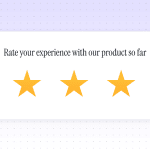
Geneviève recommends building data collection into the post-purchase journey. With Stripo widgets, you can add a quiz, an NPS survey, a multiple-choice survey, or a product review request to your emails in just a few clicks.
Each widget comes with the design, interaction, and fallback already built in: drag it into your email, tell the AI Assistant what to change, and save it to reuse in other templates. No coding required.

Rewards customers actually want: Retention without discounting
Stripo: The case against discount-driven growth is well made by now, but brands still compete in markets where discounts are everywhere. When does a no-discount approach become difficult to sustain, and which types of brands or margin structures still need discounts in the mix?
Too often, I see brands give in to discounts because they feel like it's inevitable. But just because discounts are common doesn't mean you have to rely on them. For me, it's less about whether discounts are good or bad and more about your brand positioning and the type of buyer you want to attract.
Geneviève Masioni,
Geneviève: If you want to be the low-cost, financially accessible option, discounts are an important signal to people actively looking for accessible pricing. That's a legitimate positioning, but those aren't the brands I work with. If you want a reputation built on quality manufacturing, ethical sourcing, and fair wages, steep discounts work against that image.
That being said, it gets harder when customers are already trained to expect deals, when margins are very thin, or when a brand is new and needs to earn first purchases. And even no-discount brands occasionally use a discount, for example, to clear inventory. But I treat that as a deliberate, limited tactic, not the default.
There are commercially successful low- to no-discount brands in every industry. What matters is that a brand is fully aligned on whether to use discounts and, if so, how much. It's a spectrum. And I want every founder or marketing director to know that you can succeed without relying on them, as long as you don't position your brand to compete on price.

Stripo: Loyalty and referral programs are often presented as alternatives to discounting, but some end up working much like discounts. What makes a loyalty program actually improve retention rather than give customers another reason to wait for a reward? Are there loyalty mechanics you'd tell brands to drop altogether?
Geneviève: The success of a loyalty program depends on whether customers actually want the rewards. It's too often just a series of delayed discounts because brands assume people won't care about anything other than saving money.
As a university student, I worked several retail jobs where I'd invite customers to join the loyalty program, and they'd always ask, “What do I get if I join?” You'd be surprised how many shrugged and declined when they heard it was discounts. A grocery store I worked at went back to a gift-based structure after trying a discount-based one because customers preferred choosing a small gift from a selected list of items over reducing their bill.
That matters even more for brands that don't compete on price. Their buyers care about quality and are willing to pay more for it, so these brands can't just copy the price-led tactics of low-cost brands. I understand that it's harder to think of what would entice those buyers because price-based tactics are so prevalent online. But that's the work I do: finding rewards that feel valuable and fit the brand, such as early access, gifts, or exclusive products.
So I'd tell brands to drop any mechanic that is just a discount in disguise, like points that only convert into a percentage off, as well as spend tiers that feel out of reach, because that also discourages people.

Proving it works: Measuring the real impact of post-purchase flows
Stripo: Post-purchase flows are the easiest place in the stack to take credit for revenue that would have happened anyway. How do you work out whether a flow actually drove an additional purchase when reporting retention results to a client?
Geneviève: My approach is to never give email full credit because multiple factors play a part in winning a sale. For example, a replenishment email can get credit for a customer who was already due to re-order.
So when I can, I run the new post-purchase flow against the old one at the same time and randomly split new customers between them. That way, seasonality, promotions, and ad spend affect both groups equally. So the difference between them is much more likely to come from the emails. No customer goes without emails, and the old flow acts as the control.
I also measure the outcome in Shopify order data, not just the email platform's attribution: second-order rate and revenue per customer in each group once the testing windows have closed, usually at 60 and 90 days from first purchase, but they can be longer depending on shelf life. I set the sample size and duration beforehand so we don't call a winner too early.
When reporting retention results, I show platform-attributed revenue next to the estimated lift over the previous flow using the split-based method.
For smaller brands, a split can take too long to reach a meaningful sample, and their existing emails often convert so little that running them costs sales, so I may go for a simple flow swap. In that case, I'm upfront that the result is directional: I compare like-for-like time windows and take into account any promos or seasonal changes in the period. I also prefer launching in an off-season quarter, not right before BFCM (Black Friday/Cyber Monday), so the results reflect evergreen performance.
Here’s how Geneviève compares the two approaches:
|
Split test |
Flow swap |
|
|
When to use |
When a brand has enough new customers to reach a meaningful sample |
When a split test would take too long to reach a meaningful sample, and the existing flow converts poorly |
|
How it works |
New and old flows run at the same time, with new customers randomly split between them. The old flow acts as the control |
The new flow replaces the old one |
|
How to compare |
Second-order rate and revenue per customer in Shopify order data, measured at 60 and 90 days after the first purchase (longer for products with a long shelf life) |
Like-for-like time windows, accounting for any promos or seasonal changes in the period |
|
What to plan ahead |
Sample size and test duration, so you don't call a winner too early |
Launch timing: an off-season quarter, not right before BFCM |
|
How reliable |
More reliable: seasonality, promos, and ad spend affect both groups equally |
Directional |
|
How to report |
Platform-attributed revenue alongside the estimated lift over the old flow |
Results presented openly as directional |
Where retention is heading: AI, trust, and what to stop doing
Stripo: AI is now generating lifecycle copy, variants, and entire flow structures. Where do you see it making a real difference in retention work, and where does it still struggle with real-world customer data and platform logic?
Geneviève: AI has made it much easier and faster to analyze customer data for the retention strategies I create. Retention work relies heavily on customer research, which means hours spent organizing and mining unstructured data like reviews, support tickets, and survey responses. AI saves me time in that early processing and can surface patterns that are hard to spot manually.
But it can't be trusted on its own. It's quite bad at sentiment analysis, so I still read the data line by line to pull out the objections, hesitations, criticisms, and wishes that feed my messaging.
On a recent project for a brand that struggled to get customers past the second purchase, AI highlighted the loudest patterns, the ones with the most data points. But the clues that actually mattered for the post-purchase flow were quieter, and I would have missed them if I'd just run with the AI analysis.
Very often, AI lacks context about the brand, the audience, and buyer psychology, so it may surface insights that won't drive repeat purchases. I've noticed that it can also merge reviews from different customers into one and draw conclusions nobody actually made, so when I anonymize the data, I make sure to keep an identifier on each record so they're treated as separate.
That's why I don't think AI replaces a good strategist. Without the discernment that comes from experience, it can lead you astray, and you wouldn't know it. I use it for ideas and data analysis at best, and the flow structure, copy, and creatives stay human.
Geneviève Masioni,
On privacy, I don't use consumer AI tools on client data. If and when I use AI, I use the brand's own tools under their corporate license, like Gemini in Google Workspace or Shopify's Sidekick.
Stripo: Beyond AI, which shift will most redefine eСommerce retention over the next 3–5 years: changing customer expectations, first-party data, or another shift? What should teams be preparing for now?
Geneviève: I think the biggest shift in eСommerce retention is trust, and first-party data is how brands respond to it.
Customers are more skeptical because of AI-generated content everywhere and tighter budgets. In my experience, that means they take longer to make a buying decision.
At the same time, it's getting harder to measure engagement. Apple's Mail Privacy Protection, which came with iOS 15, already made open rates unreliable. Now France's data protection authority requires consent for most open tracking, and other EU regulators are moving the same way. Yet customers still expect relevant, personalized communication. So we're far beyond judging engagement from a single tracking pixel.
That means brands need first-party data that customers knowingly share, and they have to earn it by offering something in return, like a quiz, a preference center, or a post-purchase survey. Then they have to use it well: send the right message to the right person at the right time.
So here's what I'd tell teams to prepare now:
- Move from measuring engagement with opens to clicks, conversions, and revenue per recipient, checked against order data and on-site behavior.
- Build consent and data collection into signup and post-purchase.
- Connect their data sources, such as Shopify, the email platform, and social channels, so they can read engagement across multiple signals and reach people on the channel where they're most active.
- Stay consistent and honest in their messaging because trust is built over time.
Stripo: What are three non-obvious things experienced eCommerce marketers should stop doing today if they want to improve customer retention and lifecycle revenue?
Geneviève: Three things to stop:
- guessing what customers need to hear;
- taking inspiration only from eСommerce;
- proposing ideas without checking they're technically feasible.
First, stop guessing what your customers need to hear. Mine your customer reviews and support tickets instead, and look for the hesitations and objections people have before buying, and how those change the more they buy from the brand.
I'm surprised it's such an underrated method, because reviews and support tickets are gold. They tell you what customers need to hear to take action. It's also a faster and cheaper way to collect voice of customer than surveys and focus groups, which aren't always possible. And if a brand doesn't have many reviews or tickets yet, you can mine its competitors' public reviews to see what the target audience cares about or complains about.
Second, stop looking for inspiration only inside eСommerce. Working online, it's very easy to lose track of the human element and deploy strategies that sound good in theory but don't excite anyone enough to act.
My retail jobs helped me put faces on customers and see firsthand how people react to different offers. I still take notes on how the grocery store, the museum, hotels, or airlines try to retain and re-engage me as a customer. Most of my creativity comes from translating practices from an unrelated industry into eСommerce.
Third, stop designing strategies without checking they're technically feasible. Even if you don't own the implementation, you need to know what your tools can or can't do.
My background as a developer helps me build strategies grounded in reality: they come from customer and sales data I extract from the store and the CRM, they can be implemented smoothly because I know the platform's capabilities and limits, and they're easy to maintain because I make sure the internal team can handle the complexity, even when I'm no longer involved.
Wrapping up
We want to thank Geneviève Masioni for sharing her insights on building customer loyalty, encouraging repeat orders, and using feedback to shape more effective email strategies.
Her advice highlights how brands can rethink their use of discounts, create more relevant post-purchase communication, and use AI to support data analysis while keeping strategic decisions grounded in human expertise. Much of this starts with listening to customers. A simple first step is to read through your latest reviews and support tickets and note the hesitations people mention before buying: that’s what your next post-purchase email should answer.
In the end, you don't win the second order with bigger discounts or more complex flows. You earn it by building trust: understanding what customers need to hear and telling them at the right moment.
0 comments