Hotel email marketing statistics 2026: Benchmarks, ROI & lifecycle performance


After the global pandemic has subsided, the hospitality industry has experienced a revival, with millions of tourists rediscovering once-popular routes and destinations. Resorts, hotels, and other organizations in the sector intensely leverage email marketing alongside a range of strategies for generating leads and attracting customers. But how effective is email marketing for hotels and various hospitality venues? Only hard figures can answer this question.
Top 10 hotel email marketing statistics for 2026
To understand the current role of email marketing in hotels’ promotion, let’s look at the most general numbers first:
- Over 700,000 hotels operate worldwide, with almost 120,000 in the USA alone.
- Currently, 6,195 hotels with 1.1 million rooms are under construction worldwide, and 3,840 hotels are scheduled for construction in the next 12 months.
- This year, the international hospitality market has exceeded $5,800 billion and is expected to reach $7475.3 billion within five years, displaying a steady CAGR of 6.4%.
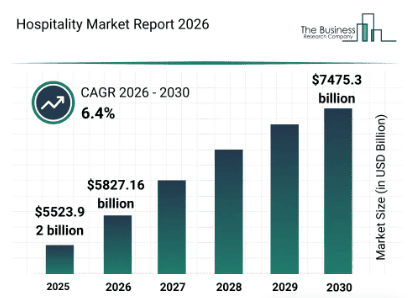
(Source: The Business Research Company) - 81% of hoteliers rely on technology as the staple of their pipeline operations.
- 77% of marketers in the industry report an increase in email engagement over the previous year.
- The hospitality industry maintains a high average email delivery rate of over 98%.
- Almost 60% of travelers prefer email as the major channel for receiving trip-related offers.
- The brand’s environmental responsibility is a factor that influences 70% of tourists to prefer it when booking accommodations.
- Among social networks, the highest engagement rate for the hospitality domain is achieved by Instagram ads (1.39%) and the lowest by TikTok ads (0.64%).
- Manual email collection practiced by hotels yields 20-45% of invalid addresses and results in significant bounce rates.

Hotel email benchmarks: Open rate, CTR, & conversion
What are the core performance benchmarks for hotel email marketing campaigns?
Average open rate in the hospitality industry
This parameter, often considered the key email efficiency indicator, hovers around 25% but may fluctuate by season and even month.

(Source: Benchmark)
Click-through rate (CTR) and click-to-open rate (CTOR)
On average, CTR for one-time campaigns in the hospitality realm stays around 2.37%. If they are leveraged recurrently and automated, this figure could increase by more than 6 times, reaching 15.17%.
As for CTOR in the domain, it is 8.7%, somewhat lower than the industry mean of 10.5%.
Conversion rate
For hotels, the conversion rate is calculated as bookings made through email. This index is 2% on average, and curiously, the more luxurious a hotel is, the lower its email conversion rate.

(Source: Hotel Benchmark)
How to read these benchmarks after Apple MPP
The Mail Privacy Protection (MPP) feature introduced by Apple for its devices has altered the significance of the open rate for gauging the efficiency of email campaigns. Since the system counts an email as opened after analyzing pixels, it can even register an open without actually opening the email, so the open rate a company sees in its statistics is, in fact, inflated by 10-30%.
Hotel email marketing ROI: What every dollar earns
Return on investment is a key profitability metric that any business tracks. What about hotel email marketing ROI?
The $42 per $1 number, and where it comes from
In fact, $42 is the top number hotels aspire to reach, whereas the average figure is around $38. Highly targeted lifecycle campaigns can significantly outperform industry averages, with some brands reporting substantially higher returns up to $100 or even $200.
Why hotels often outperform the cross-industry average
In some industries (such as media, SaaS, B2B, and non-profit), ROI is much lower. How come? There are three major reasons for this. First, repeat guests tend to have higher lifetime values, boosting ROI considerably. Second, a very high email delivery rate in the sector (98.6%) shows that almost all pre-stay, in-stay, and post-stay messages hotels send reach their intended recipients. Third, email allows service providers to avoid hefty commissions charged by online travel agencies (OTAs).
Revenue per recipient (RPR): The metric that beats ROI
Many hoteliers believe that RPR in email marketing is more telling than ROI. Why? Because while ROI displays the overall profitability of the entire campaign, RPR is more granular and reflects the financial value each recipient generates.
RPR varies depending on the email strategy you leverage.

(Source: Klaviyo)
Automated & lifecycle email benchmarks
To maximize the efficiency of your campaigns, they should accompany the client throughout their entire customer journey as lifecycle initiatives.
Pre-arrival emails: The upsell engine
Simple booking confirmations and pre-arrival guides won’t take you far in terms of profit. Highlight the convenience and benefits of room upgrades and additional services (e.g., restaurant reservations or SPA appointments) to increase your sales. While doing this, you should consider your business’s geography, as it affects the KPIs for your emails.
Welcome emails timed to guest check-in
The check-in day is the best engagement touchpoint when excited guests are the most susceptible to anything you send (local recommendations, activity lists, dining reservations, etc.). You can’t miss this opportunity since the open rate on this day reaches 50% and the CTR can be as high as 13%.
Transactional/booking confirmation emails as a marketing surface
If you were impressed by the figures above, prepare for even stronger performance metrics: Confirmation emails have a staggering open rate of 65-70% and an 85% higher CTR than regular emails. Why? Customers are more likely to trust them because they contain anticipated information. In fact, almost two-thirds of consumers consider them the most important email type. This is why hotels should leverage them not only as informational but also as promotional and marketing tools.
Win-back, “we miss you”, and birthday emails
Guest databases decay at a rate of 25-30% a year. You can bring dormant customers back by evoking the emotions they felt during their previous stay at your hotel with a photo of the property or by congratulating people on their birthday (with a small credit or a complimentary upgrade included). After all, lifecycle messages are all about emotions.
Segmentation: The single biggest performance lever
Today, consumers expect a personalized approach from businesses, so a one-size-fits-all approach is a relic of the past in hotel email marketing as well.
The +20%/+70%/+73% uplift
These are the numbers a hospitality organization can achieve through database optimization, behavioral segmentation, message personalization, and targeted communication. If you manage to combine such best email marketing practices in your email campaigns, their open rate will increase by 20%, click-through rate will grow by 70%, and RPR will climb by 73%.

What data drives hotel email segmentation
The data used by hotels for customer segmentation comes from five major sources:
- property management systems (PMS). They serve as central hubs for client data, such as reservation date, stay type, booking channel, and geographic origin;
- booking engines and add-on sales. From them, hotels learn about the size of the travel party, dining packages, SPA treatments, etc.;
- CRMs and guest loyalty platforms. These sources contain the information declared by guests themselves (pillow preferences, dietary restrictions, email frequency choices, and more) as well as the results of post-stay surveys;
- on-property point-of-sale (POS) systems. They can supply the customer’s profile with information on their spending habits and preferences;
- website and campaign analytics. They provide benchmark metrics like open rates and CTRs. Also, businesses learn from them about the links clicked and the pages visited.
The five segmentation cuts that matter most
Brands that segment report 101% higher CTRs and 14.31% more open rates. Want to emulate their success?
Then, learn what segmentation cuts are crucial for the success of your hotel email marketing efforts:
- by booking channel. Find out who booked directly and who came to you through OTAs;
- by travel purpose. Stay duration, booking windows, ordered services, and other details largely depend on whether the person has a business trip or a vacation;
- by geographic origin. It’s not only about local vs. international. The latter category can be further subdivided according to several criteria;
- by guest lifecycle. First-time visitors and repeat/loyal clients require different marketing strategies, communication frequency, promotional incentives, etc.;
- by on-property behavior. People differ in their gym or SPA use, in-room dining, pet friendliness, and other habits and preferences.
Segmentation pitfalls
When performing customer segmentation, it is vital to avoid the following:
- over-segmenting. By creating too granular groups (e.g., leisure guests who booked a suite with a Jacuzzi in July), you make your campaigns unmanageable;
- under-segmenting. Batching and blasting are the opposite extreme, which doesn’t allow you to focus on specific guest strata;
- relying only on demographics. Behavior-based segmentation is more rewarding;
- data hoarding. Stop amassing tons of zero-party information you will never use;
- forgetting exclusion lists. If a person has just left your hotel or has stopped reacting to your messages for a long time, peppering them with promotions is a bad idea.

Direct booking vs. OTAs: Why email is your most profitable channel
Aiming to increase bookings, some hotels enlist the services of OTAs. Is the game worth the candle?
How OTA commissions cost hotels (15-25%)
Typically, OTAs build a comprehensive hotel inventory by establishing direct relationships with hotels, using affiliate networks, or launching their own booking engines. In this way, more potential customers learn about what a hotel offers. However, this publicity comes at a price. The commission fees OTAs charge hotels for their services range from 10% to 30% of the booking value but usually fall within a 15-25% margin.
How email shifts revenue from OTA to direct
If you want to save this 15-25%, think email marketing. Hotels can establish direct contact with travelers by using consent-based data collection, automating lifecycle campaigns, and introducing email-driven, direct-only loyalty programs.
What works in OTA win-back emails
How can you steer OTA-acquired clientele to your direct booking channels? Emphasize the advantages of direct booking by providing an incentive (for instance, a code-activated discount) and offering a best rate guarantee. If you automate such efforts, you are likely to see a dramatic improvement across important KPIs.

(Source: Revinate)
Apple MPP and the new rules for reading hotel email data
In 2021, the well-established scheme for evaluating email metrics suffered a severe blow from Apple.
What Apple MPP actually changed
The purpose of MPP was to improve the safety of email users and give them greater control over their personal data. However, it also distorted email open rates. Before the advent of MPP, statistics counted an email as opened only after the recipient actually opened it. Now, the system preloads images and tracks pixels (especially those in HTML email templates), creating false open reporting across several metrics, including open rates, send time, and geo-targeting.
Why hotels are hit harder than other industries
While most recipients liked the new security policy, almost a quarter of them thought Apple MPP is taking it too far.

(Source: Sellcell)
Hoteliers are surely among the latter category. The industry has always relied on localized engagement, hyper-segmented lead nurturing, and time-sensitive promotions. In the post-MPP environment, they discovered that their time-send optimization became less reliable, geo-targeting was broken, and loyalty rewards based on the last open date were skewed.
Which metrics to trust now
Apple MPP hit hard not only traditional promotional strategies but also the indices used to measure email campaign performance, rendering open rate and CTOR highly questionable, if not useless. That is why many organizations have veered toward CTR, conversion rate, unsubscribe rate, revenue per email, RPR, deliverability rate, and customer lifetime value as efficiency benchmarks.
How to recalibrate your benchmarks
The first thing to do is to create parallel segments for Apple users and non-Apple users and calculate open rates only for the latter, ditching it altogether for the former. Second, start treating CTOR cautiously, focusing on its dynamics rather than its numerical value. Then, establish a new baseline steering by conversion rate, CTR, and revenue per email as intent-based metrics. Finally, update your workflows and automations by removing “open” triggers and replacing them with “clicks.”
Regional benchmarks: North America, EMEA, & APAC
In the hospitality domain, email marketing efforts should take into consideration geographical peculiarities and local trends.
North America
The United States of America and Canada command 35% of the hotel email market share. These countries have a comparatively high average click rate (1.18%) and unsubscribe rate (0.14%) and trail only France and Japan in average open rate (27.69%).
EMEA
Since this acronym encompasses numerous and diverse countries of Europe, the Middle East, and Africa, it is hard to provide umbrella statistics for the entire region, which accounts for 38% of the global hotel email market. Moreover, different parts of EMEA tend to vary significantly in hotel email marketing indices. For instance, the average open rate in Europe (26.10%) is much higher than in Africa (15.42%) and the Middle East (16.39%). As for the average click rate, the Middle East leads (0.89%), followed by Europe (0.62%) and Africa (0.54%). At the same time, the average unsubscribe rate is the lowest in Africa (0.10%) and the Middle East (0.09%).
DACH-specific findings
It makes sense to mention the German-speaking nations of Europe separately since their metrics differ greatly from those of the rest of the continent and the world, manifesting much higher engagement numbers.

(Source: Revinate)
APAC
Asia-Pacific possesses a fifth of the global hotel email market share. Here, basic email statistical parameters also differ by country, but, on average, the open rate is 26.48%, the click rate is 1.54%, and the unsubscribe rate is 0.16%.
Send frequency, days, and timing
Half of the success of your email marketing initiatives depends on choosing the right moment to approach your clientele with messages, promotions, and offers.
How often should hotels send marketing emails
There is no universally recommended frequency that works wonders. After all, bothering people too often is worse than forgetting to remind them about your services once in a while.
Best days of the week
These differ considerably across regions.

(Source: Revinate)
However, on average, Wednesday is when hotel emails perform best, with an open rate of 22.83% and a CTOR of 16.75%.
Best send time by booking window
If you have studied the booking patterns of regular guests, you can send them a relevant seasonal offer 2-3 months before their visit. However, since most reservations (34%) are made up to 6 days before the stay, it makes sense to squeeze your promotions, reminders, newsletters, and upselling pitches into this window. Smart timing choices improve CTR by 22%, and you can’t ignore this figure.
Frequency cap rules of thumb
Modern email software allows recipients to set a frequency cap, regulating how often messages are sent to each customer.
There are several life hacks hoteliers should remember when handling frequency caps:
- frequency should be calculated for each guest separately on a rolling basis, depending on the day the last email was sent;
- 1-2 emails per week is the golden mean, triggering high engagement and building trust;
- you may send new customers more frequent messages (say, 3-5 within the first ten days), while, for repeat clients, a weekly campaign plus triggered offers is just what the doctor ordered;
- transactional emails, customer feedback surveys, and one-to-one emails aren’t included in the frequency cap.
Mobile email behavior in travel
The spread of mobile devices has radically changed hotel email marketing routines.
Half of all hotel emails are opened on a phone
50% is the lowest number sources give. If leisure and recreation are grouped with sports, mobile email opens account for 60%.

(Source: EmailMonday)
What this means for hotel email design
As smartphone users admit, 75% delete emails that aren’t optimized for mobile devices. To avoid such an outcome, hotels should provide a mobile-friendly design of their emails. This is done by switching to single-column layouts, opting for scannable text (at least 16 px), including compressed images, and placing thumb-friendly CTAs.
Common mobile rendering mistakes
The inability of image-heavy hotel emails to scale or format properly on mobile gadgets is caused by the following:
- reliance on image-only messages for booking announcements or headers;
- using tiny fonts and text walls;
- small CTA buttons that are placed too close together;
- putting important pre-arrival and on-property information (for instance, check-in instructions or the hotel’s address and phone number) at the bottom of a lengthy layout;
- automatic inversion of colors in the dark mode, so fonts and logos get lost against dark backgrounds.
Database health, deliverability, & compliance
Disregarding these factors may result in lower efficiency or even complete failure of hotel marketing emails.
Why list quality beats list size
A good customer database isn’t one that contains millions of names. It should be properly segmented and enable seamless navigation so that employees can quickly and easily find and reach out to the person they need through promotional initiatives. Such lists significantly improve email marketing KPIs.

(Source: Scrap.io)
Gmail and Yahoo sender requirements
On April 1, 2024, the two behemoths among ESPs issued a list of standards that apply to anyone sending emails to their subscribers. These rules are particularly strict for bulk senders (5,000+ messages per day).
Hotels that email their clients with Gmail and Yahoo inboxes should:
- configure sender policy framework (SPF) or DomainKeys Identified Mail (DKIM);
- implement domain-based message authentication, reporting, and conformance (DMARC);
- keep spam complaint rates below 0.30% (ideally under 0.10%);
- maintain valid forward and reverse domain name system (DNS) records;
- use transport layer security (TLS)-encrypted transmission;
- provide a clear, one-click unsubscribe link;
- process unsubscribe requests within two days.
Deliverability impact for hotel senders
A hotel should ensure its email deliverability rate is never lower than 89% and aim for 95%. Other delivery-related indices to watch for are the inbox placement rate, bounce rate, unsubscribe rate, and spam complaint rate.
Wrapping up
In the contemporary hospitality landscape, which is oversaturated with offers, competition is fierce. You can outperform your rivals in the industry only if you are armed with knowledge of what works and what doesn’t in email marketing efforts. The figures in this article serve as the source of this knowledge and should be used by forward-looking hoteliers as guidelines to help them avoid common mistakes and achieve business success.
FAQ
1. What is a good open rate for hotel email marketing?
It depends on many factors, including subject line, brand trust, timing, and even season. Since the average open rate for emails sent by hotels is 25.54%, anything above that is a good percentage.
2. What’s the average ROI of hotel email marketing?
Most sources report an average index of $38 per invested dollar, and first-rate hotels manage to reach $42.
3. How often should a hotel send marketing emails?
Authorities differ, but 1-2 emails per week is the golden mean. If you pepper customers with messages more often, they will find it annoying or intrusive, and sending emails less often won’t get you far promotion-wise. In both cases, clients may choose to opt out.
4. What’s the best day to send hotel marketing emails?
The middle of the working week is when people are the most susceptible to business offers. Emails sent on Wednesday have a 22.83% open rate and 16.75% CTOR.
5. Do automated emails outperform broadcasts in the hospitality industry?
They do. On average, automated hotel marketing emails have 56.6% open rates and 15.17% CTRs, whereas manual, one-time blasts display much inferior indices: 32.2% open rates and 2.37% CTRs.
6. How does Apple Mail Privacy Protection affect hotel email metrics?
By all accounts, Apple’s MPP feature inflated the open rate by 10-30% and made CTOR accuracy highly questionable for any email-driven business. In addition, hospitality organizations faced another setback as the novelty complicated or even closed the door on their localized marketing, time-sensitive promotions, and hyper-segmented lead nurturing.
0 comments