Email blast statistics: Benchmarks, open rates, and ROI data for 2026


In 2026, email remains a top earner of digital revenue. Recent data shows that while many brands have shifted toward hyper-segmentation, 64% of businesses still rely on large-scale email blasts to maintain consistent reach and top-of-mind awareness.
In this article, we gathered stats to help you understand how blast email campaigns affect customer engagement, conversions, and loyalty compared with more targeted campaigns.
What is an email blast? Quick definition
An email blast is the practice of broadcasting a single message to a large group of recipients at once. In general, it serves as a high-volume broadcast tool for sharing general announcements, company-wide updates, or site-wide promotions that apply to an entire audience.
-
Email blast vs. triggered email: key differences
While an email blast is scheduled and sent manually to a broad group, a triggered email is an automated message sent to an individual in response to a specific action, such as a purchase or a sign-up. The primary distinction lies in the delivery logic: blasts prioritize massive reach at a single point in time, whereas triggered emails focus on immediate relevance to a single recipient’s behavior.
|
Feature |
Email blast |
Triggered email |
|
Audience |
Entire list or large segments |
Individual subscribers |
|
Timing |
Scheduled by the marketer |
Triggered by recipient action |
|
Goal |
Broad awareness or mass sales |
Personal relevance and conversion |
|
Setup |
Manual campaign creation |
Automated workflow |
-
Why marketers still use the term in 2026
The term “email blast” is still widely used because it’s clear and familiar. It refers to a single message sent to a broad audience, which helps distinguish it from automated emails and ongoing flows. Even with more advanced targeting, there’s still a need to send one-off campaigns to a full list. A reliable email blast template remains a simple way to execute that type of send.
If you’re ready to move from theory to execution, check out our guide to effective email blast examples to see these strategies in action.
Top 10 email blast statistics every business should know
These statistics from 2025 and 2026 show how email blasts perform now:
- Email marketing delivers ~ $36-$42 for every $1 spent: While reports often generalize the return to a range of $36–$44, the actual profit varies by industry. Retail and eCommerce brands often see the highest returns, while large-scale corporate campaigns typically see slightly lower margins due to higher overhead.
- The average email open rate is 21%-42%, but that number is misleading: Apple MPP and aggressive bot filtering now artificially inflate these numbers, often padding results by 15%–20%. Because of this, a high open rate doesn’t guarantee that a human saw the message.
- Automated emails generate 332% more revenue than batch sends: These messages make more money because they hit the inbox at the exact moment a customer is active. An abandoned cart or a welcome note is a response to something the recipient just did.
- 392 billion emails are sent every day worldwide: The sheer volume of mail means you have about 2 seconds to catch someone’s eye before they press delete. With 4.6 billion people using email every day, the reach is unmatched, but the competition for attention is constant.
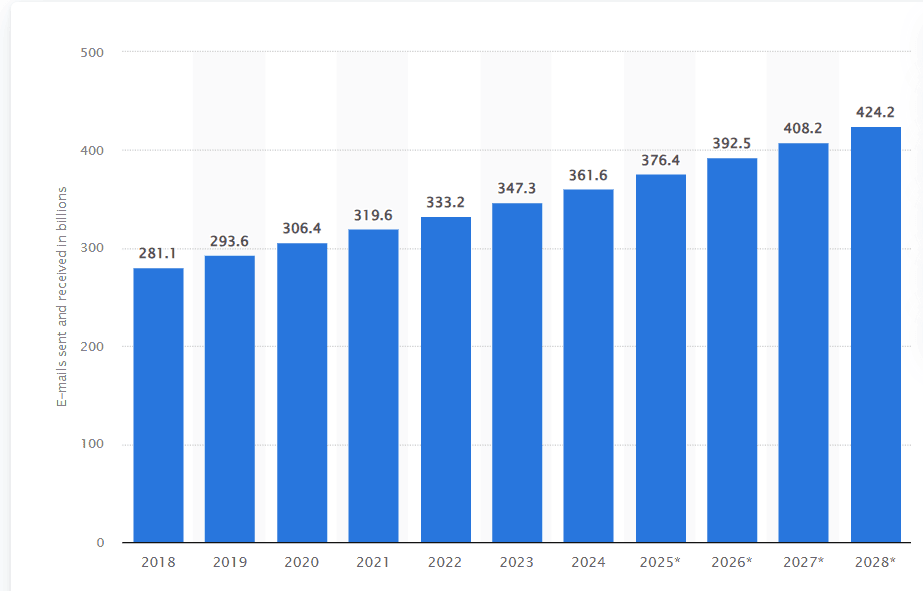
(Source: Statista) - Welcome emails achieve a 69%-80% open rate: This is the highest level of attention you will ever get from a subscriber. Use it to give them exactly what they asked for (such as a discount or a download link) before their initial interest cools off.
- 77% of email ROI comes from segmented, targeted campaigns: When you break your audience into smaller groups based on what they actually like, revenue per email increases. People stay subscribed longer when the content feels like it was meant for them specifically.
- 41.6% of all email opens happen on mobile devices: If your layout is hard to read on a phone, you are effectively ignoring nearly half your audience. People check mail in short bursts throughout the day, often on small screens. If they can’t tap a button or read the text easily, they just move on.
- Personalized emails boast an open rate up to 35%: Modern personalization uses a customer’s actual behavior (for example, products they recently viewed) to make the email relevant. When the content matches what a person is already thinking about, they are much more likely to engage with it.
- 57% of Gen Z prefer being contacted by brands via email: Gen Z tends to treat social media for friends and their inbox for commerce. They like having a searchable record of receipts and brand updates that doesn’t clutter their social feeds.
- The average email is viewed for just 8 seconds: This tiny window of attention means your most important information and the main button must be visible immediately. A clean email blast design with a clear visual hierarchy helps the recipient understand the value of your message before they head back to their inbox.

Core email blast statistics at a glance (2026)
These fresh benchmarks reflect how audience behavior and inbox technology have changed over the last year:
-
Average open rate for email blasts
The average open rate currently ranges from 21% to 42%, though these numbers are heavily inflated by Apple Mail Privacy Protection. Because automated systems now preload tracking pixels, a high open rate is often more a reflection of bot activity than human interest.
-
Average click-through rate (CTR)
CTR remains the most reliable indicator of real engagement, typically ranging from 1.2% to 2.6% for standard broadcasts. Since this metric requires a deliberate action from the recipient, it provides a much clearer picture of how well your content actually resonates with your audience.
-
Email conversion rate benchmarks
Most industries see conversion rates between 2.3% and 2.9% for manual blasts, while automated flows often hit 3% to 5%. While blasts are better for broad awareness, triggered emails consistently drive a higher percentage of recipients to complete a purchase.
-
Email marketing ROI: the headline number
Email continues to return between $36 and $42 for every $1 spent, making it one of the most profitable channels available. For high-performing US merchants, this return can even reach $68, proving that the low cost of reaching an owned audience still outweighs the rising cost of paid ads.

(Source: VerifiedEmail)
Email blast benchmarks by industry
See how email blast performance varies by sector:
Open rate, CTR, and bounce rate by vertical
As per the Industry Benchmark Report by Brevo, email marketing benchmarks by industry look like this:
- retail (71% open/7% CTR): Shoppers prioritize these for coupons and new arrivals, though a 3.09% bounce rate is common as personal email addresses shift;
- travel and hospitality (72% open/17% CTR): High-interest content, such as bookings, drives the industry’s best click rates, while the bounce rate remains low at 3.3% due to the transactional nature of the mail;
- SaaS and IT (31% open/4.4% CTR): These lists see steady clicks for technical updates, but a 4.26% bounce rate reflects the frequent turnover of professional B2B accounts;
- financial services (66% open/6% CTR): Account alerts ensure these must-read messages are opened often, maintaining a stable 4.6% bounce rate;
- nonprofit (35.7% open/4.1% CTR): Loyal donors drive consistent engagement, and high list hygiene typically keeps the bounce rate low at 2.8%.

(Source: Brevo)
Which industries have the highest email ROI?
High-intent sectors like retail and travel currently see the strongest returns, showing up to $44 for every $1 spent. Industries that rely on high-value, long-term relationships, such as financial services and real estate, also perform well, often reaching similar ROI peaks.
How to use benchmarks to set realistic targets
Benchmarks are better used as a compass than a rigid goal, especially with Apple’s privacy features. Instead of chasing a generic industry average, establish your own baseline by averaging your last 6 months of data and aiming for incremental growth in clicks rather than opens.
Email automation vs. batch blast: performance gap
See the difference between sending to everyone and sending at the right time:
-
Welcome email statistics
Welcome emails maintain an average open rate of 82%. It acts as the digital handshake that sets the tone for the entire relationship.
-
Abandoned cart email statistics
Abandoned cart emails achieve a 50.5% open rate, which is a 15% increase over standard promotional mailings. These reminders work because they are highly relevant to customers who have already expressed direct interest in a specific product.
-
Drip campaign statistics
Drip sequences are highly cost-effective, generating 80% more sales at a 33% lower cost than manual campaigns. They maintain an average open rate of 38.5% and a 6.3% click-through rate.

Batch sends vs. automation: side-by-side
Based on 2026 performance data, triggered flows achieve a 5.4% click rate compared to the 1.25% average for manual blasts, representing a calculated 332% higher click rate because these messages respond to actual recipient behavior.
|
Metric |
Automated emails |
Manual blasts |
|
Open rate |
48.5% |
25.2% |
|
Click rate |
5.4% |
1.2% |
|
Conversion rate |
33.0% |
5.0% |
Email blast ROI: What the numbers actually mean
In 2026, email remains the undisputed king of profitability, acting as a direct line to revenue that social media simply can’t match:
ROI by business size (SMB vs. enterprise)
For smaller brands, email is the primary engine for customer retention. 64% of small businesses use it as their primary communication channel, benefiting from personal connections and low overhead. Meanwhile, organizations with budgets exceeding $5,000 per month achieve a higher ROI of 4,400% ($44 for every $1 spent).
Email ROI vs. other channels
While social platforms fight for attention through shifting algorithms, email provides a direct, independent database. This independence results in a conversion rate of 4.24% compared to just 0.59% for social media.
Email delivers an average return of $42 for every $1 spent; nearly double the ROI of SEO ($22) and over 4 times the return of social media marketing ($10).

(Source: SearchLab)
How to calculate your own email marketing ROI
To calculate your ROI, compare your total revenue from email campaigns against your total costs. Subtract your costs from your revenue, then divide the resulting profit by those same costs. If the resulting number is positive, your strategy is generating a return on every dollar you invest.
Personalization statistics: the case for relevance
In a crowded inbox, a personalized touch is what makes the difference between a click and a delete:
Subject line personalization statistics
Emails with personalized subject lines are opened 26% more often than those with generic subject lines. In B2C, adding emojis can increase open rates by 56%, though they typically reduce B2B engagement by 4%.
Dynamic content and behavioral targeting
Emails using dynamic content see a 52% jump in conversion rates compared to static messages. Campaigns sent after a specific action perform 8× better than standard blasts, while advanced segmentation can drive a 760% increase in overall revenue.

(Source: Litmus)
AI-driven personalization: emerging stats
Predictive recommendations increase revenue per email by an average of 41%. As of 2026, 63% of marketers have already integrated these tools to manage everything from predictive analytics to churn prevention. Companies using AI-driven email strategies see up to 41% more revenue than those using traditional batch sends.
The Apple MPP problem: why open rates are broken
Open rate is a vanity metric. Privacy updates mean your dashboard is likely reporting machine activity rather than human interest.
How Mail Privacy Protection inflates open rates
Apple’s MPP automatically downloads tracking pixels on its own proxy servers before a recipient even touches the email. This records a fake open every time. With over 97% of iPhone users having this enabled and Apple controlling nearly 50% of the email market, your reported open rates are likely inflated by 15%-20% relative to actual human engagement.
What to use instead of open rate
To see the real picture, shift your focus to metrics that require deliberate human action: CTOR tells you if your content is actually relevant, while conversion rate remains the ultimate proof of success. In B2B, reply rate is your strongest signal of interest.

How to audit your open rate data for MPP inflation
Check your ESP for non-MPP filters to see engagement from Gmail or Outlook users who aren’t being proxied. You can also spot inflation by looking for machine timing; if a massive spike in opens happens seconds after hitting send, you’re looking at Apple’s servers, not your customers.
Email blast statistics by audience and demographics
Understanding how different generations interact with their inbox is the key to sending content that actually gets noticed.
Gen Z email statistics
Gen Z remains highly active in the inbox, with 81% checking their email daily. They show a surprising enthusiasm for marketing: less than 50% feel they receive too many emails, and nearly 50% rank promotional messages as their top inbox preference.
Far from moving away from the platform, 57% of Gen Z identify email as their preferred channel for brand communication.
Millennial and Gen X email behavior
Millennials and Gen X view the inbox as both a professional and a personal hub. 79% of Millennials name email as their preferred way to hear from brands, checking their messages three to five times per day.
Meanwhile, 72% of Gen X consider email the most personal way to receive brand communications.
Mobile email statistics
Mobile optimization is the baseline for success, as 42% of all emails are now opened on a mobile device. This trend is even more pronounced among younger subscribers: 67% of Gen Z and 59% of Millennials use mobile clients as their primary way to read email.
Send timing and frequency statistics
Finding the perfect send window is a critical part of any high-performing email strategy.
Best day and time to send email blasts
Midweek remains the most reliable window for engagement, with Tuesday through Thursday consistently seeing the highest open rates. For the best results, hit the inbox between 9:00 AM and 11:00 AM or during the afternoon lull from 1:00 PM to 3:00 PM.

(Source: Ediware)
The first-hour window: why speed matters
The first 60 minutes after sending an email are the most critical: 21% of all opens occur within this first hour, and this initial burst of engagement signals to ISPs that your content is high-quality.
Machine learning send-time optimization
By analyzing historical behavior, machine learning delivers emails at the precise moment a subscriber typically checks their smartphone. This individual timing increases revenue per email by an average of 41% by catching the reader when they are already active.
Email deliverability statistics
High deliverability ensures your campaigns reach inboxes rather than being intercepted by spam filters.
Inbox placement rates by region
Global deliverability is not uniform; where your subscribers live significantly impacts whether your message hits the inbox or the spam folder.
|
Region |
Inbox placement rate |
|
Europe |
89% |
|
North America |
83% |
|
Asia-Pacific |
78% |
|
Latin America |
74% |
(Source: Verified)
The high placement rate in Europe is largely attributed to strict GDPR standards. Conversely, North America sees slightly lower placement due to the sheer volume of commercial mail and aggressive filtering by major providers like Gmail and Outlook. In regions like Latin America, deliverability often faces hurdles from local ISP blacklisting and higher bounce rates from legacy data.
Bounce rate benchmarks (hard and soft)
A hard bounce occurs when an email is permanently rejected because the address is invalid or nonexistent, and this should stay below 0.4% to avoid ISP flagging. A soft bounce is a temporary delivery failure, often due to a full inbox or server issue, with a typical benchmark of under 0.7%. While individual campaign bounce rates may fluctuate, your overall bounce rate should never exceed 2.0%.
How sender reputation affects performance
Your sender reputation is the credit score ISPs use to determine if your emails land in the inbox or the spam folder. Maintaining a high score is essential for consistent placement and audience reach:
- a bounce rate higher than 2% is a major red flag for email providers;
- a solid sender score falls between 80 and 100, while a score below 70 signals significant delivery issues;
- scores below 50 typically mean your messages are being actively blocked or flagged as spam.
How to improve your email marketing blast performance: actionable takeaways
Small adjustments to your sending strategy can significantly change how many people actually see and interact with your messages.
-
Switch from batch to triggered sends
Moving away from manual, one-size-fits-all blasts toward behavioral triggers ensures you reach subscribers when they are already thinking about your brand. Automated messages sent in response to a sign-up or a purchase feel more like a conversation and less like an interruption.
-
Audit your open rate data for MPP noise
Apple MPP can make your engagement look better than it is by automatically opening emails in the background. To get an honest view of your performance, shift your focus to clicks and actual conversions, as these remain the only reliable indicators of a recipient’s true interest.
-
Segment your list before the next blast
Generic mailings are increasingly ignored because they lack personal relevance. Even a simple move like grouping your audience by their past interests or geographic location helps ensure that the content you send actually matches what the person on the other end needs to see.
-
Optimize for mobile first
Most people check their inbox on a smartphone while multitasking, meaning a cluttered email design will likely be deleted in seconds. Using predesigned email blast templates that are already responsive is the fastest way to hit these benchmarks without manually recoding every campaign.

Wrapping up
The data confirms that email remains a powerhouse of digital communication, provided you prioritize technical health and personal relevance. By balancing a strong sender reputation with automated, mobile-friendly content, you can ensure your messages consistently reach and resonate with your audience.
Now that you have the benchmarks to guide your strategy, head over to the Stripo editor to build your next high-performing campaign.
FAQ
Understanding how your metrics stack up against global benchmarks helps you spot where your strategy needs a quick fix.
1. What is a good open rate for an email blast?
A healthy open rate falls between 21% and 25%, though this varies by industry.
2. What is a good click-through rate for email marketing?
Most marketers aim for a click-through rate of at least 2.6%. If your content is highly targeted or automated, you might see this number climb toward 4% or 5%.
3. How many emails are sent per day worldwide?
Statista projects that the number of global email users will reach 4.7-4.8 billion by the end of 2026, with the number of emails sent daily expected to reach around 392 billion.
4. Is email marketing still worth it in 2026?
Email remains the most profitable digital channel available. Its ability to work alongside SMS and push notifications makes it the most reliable tool for a successful customer retention strategy.
5. What is the difference between an email blast and a newsletter?
An email blast is a single, focused message sent to a large group to drive a specific action, like a flash sale or an announcement. A newsletter is a recurring publication designed to build long-term relationships by sharing a mix of news, tips, and updates over time.
0 comments