
Email marketing for lawyers: Strategies to attract clients and build trust


How can a law firm strike the right balance between the conservatism still expected from the legal profession and the modern, client-friendly approach that today’s audiences value? Email marketing can be the answer. It is a flexible and convenient tool that can be tailored to your company’s needs and used to benefit your clients.
In this article, we take a closer look at what law firm email marketing is, how to build an effective legal marketing strategy, how to enhance that strategy through thoughtful email design, and how to use it to develop strong, trust-based relationships with prospective and existing clients.
Key takeaways
- Email marketing in the legal field is a powerful tool for maintaining relationships with existing clients and gaining new leads.
- To begin email marketing, you need to define your goals, build a contact list, create an email campaign, prepare content and design templates, analyze the results, and make changes to improve them.
- Lawyers can send clients various emails: introduction emails, case updates, documentation requests, legal change notifications, educational content, promotional and follow-up emails, etc.
- Key metrics to track in email marketing include open rate, click-through rate, conversion rate, bounce rate, and unsubscribe rate.
- In legal email marketing, it is extremely important to comply with legal regulations.
Email marketing for lawyers: What it is and how it supports client relationships
Email marketing is a communication strategy that allows law firms to connect with both potential and current clients through email. However, if your entire email marketing strategy is limited to sending holiday greetings and quarterly firm newsletters, you are missing valuable opportunities.
In the legal industry, email marketing can help law firms:
- increase brand awareness;
- build trusting relationships and improve the client communication gap;
- provide educational content through blog posts and videos;
- drive more client referrals;
- inform clients about new services;
- strengthen professional credibility.
Legal email marketing campaigns achieve an average click-through rate of 5.64%, outperforming many other industries. This highlights the effectiveness of email communication in the legal sector, so you shouldn't neglect this channel with clients.
How to get started with email marketing for lawyers
Below is a step-by-step framework for implementing email marketing in your law firm:
1. Define your goal and how you will measure it. Email marketing campaign goals may include acquiring new clients, re-engaging former customers, or increasing awareness of your legal niche.
2. Choose reliable email marketing tools. These include email marketing software and email service providers. Your platform should ensure data security, support CRM integration (if you use one), be easy to use, and meet the specific needs of your law firm. Today, there are many email marketing platforms available on the market, such as Mailtrap, Mailchimp, Moosend, HubSpot, and Constant Contact.
3. Add subscription forms to your website and social media channels. These are effective ways to build your email list. Existing clients who follow your social media accounts and visitors to your website are already interested in your firm and the services you offer. Give them the opportunity to subscribe to your email digest.
4. Build and segment your contact list. Once you’ve collected a sufficient number of email addresses, focus on segmentation. Clients should receive different types of emails depending on their legal needs, the stage of cooperation with your firm, and the timing of their inquiry. Set up your system to send targeted emails so that each recipient receives relevant and timely information. Recent studies have shown that email segmentation increases open rates by 14%, while advanced segmentation can drive conversion rates that are two to three times higher.
Thoughtful segmentation: Rather than sending broad, generic emails, we segment based on meaningful criteria, such as injury type, case progress, or location, to ensure the right people receive the right message at the right time.

5. Create an email campaign. Depending on the audience segment, you may send a welcome email, updates on legislative changes, or case updates.
6. Combine content and design. Use ready-made email templates from Stripo as a base for your future campaigns to ensure that your emails look professional and consistent. With Stripo templates, your production time can be reduced by more than 3.7 times.
7. Test and optimize. Test different email subject fields, send times, content types, and design variations. This will help you understand what works best for your audience and how to continuously improve performance.
You can learn more about what email campaigns are in this article and how to create your first email campaign in this guide.
Writing compelling subject lines to improve click-through rates
The subject line should grab the attention of your readers. Keep it short so it displays properly on mobile devices, and make sure it is clear and easy to understand. Research has shown that subject lines with 2–4 words generate the highest open rates (46%). Avoid spam-triggering words and phrases, as they can negatively affect email deliverability.
Keep these two email marketing tips in mind when writing subject lines:
- experiment consistently. Regularly test different subject lines and various approaches, such as using questions or numbers, varying lengths, and incorporating emojis for your audience. Preferences change over time, and the right subject line is the first step toward maintaining reader interest and encouraging opens and reads;
- be relevant. No matter what elements you test, always deliver what you promise in the subject line. Misleading subject lines are a poor choice for any email marketing strategy. Your message should be clear, valuable to your audience, and respectful of their time. Readers should feel confident that if they open your email, it will be worth their attention.
You can generate catchy subject lines for your emails in seconds with the AI subject line generator tool from Stripo. Just describe the core idea of what you need, and GenAI will provide you with multiple variants for you to pick from.
The best types of emails for lawyers: Case updates, legal changes, documentation requests, and more
Let’s take a closer look at the types of emails a law firm can send to its clients and how each serves a specific purpose.
1. Welcome email
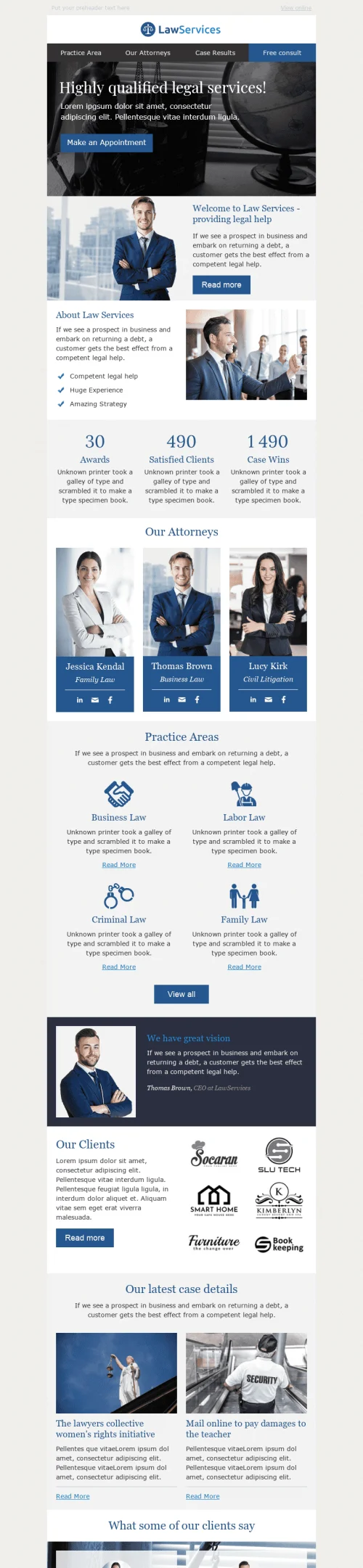
Has a potential client spent time on your law firm’s website, downloaded a lead magnet on a specific topic, and submitted an inquiry? This is a great opportunity to send them a welcome email and offer to book an appointment. In this email, you can share more information about your firm, highlight key facts and figures, and introduce the people who could work with the client, depending on their legal needs.
2. Case updates
Once you are working with an existing client, it is essential to keep them updated on the status of their matter in the legal process. Case updates can be delivered in the following way: provide an overview of recent progress in the case, highlight important details (such as court dates or meetings with opponents), outline the next steps in the case, and inform the client about upcoming tasks or deadlines.

(Source: Mailsoftly)
3. Promotional emails
Promotional emails are not just for promoting your legal services and talking about your company. You can also use them to share information on free consultations, upcoming webinars, and other law firm email marketing initiatives that may interest prospective clients.

4. Documentation requests
Here is an example of a document request email when additional paperwork is required from a current client.

(Source: Clio)
5. Follow-up emails
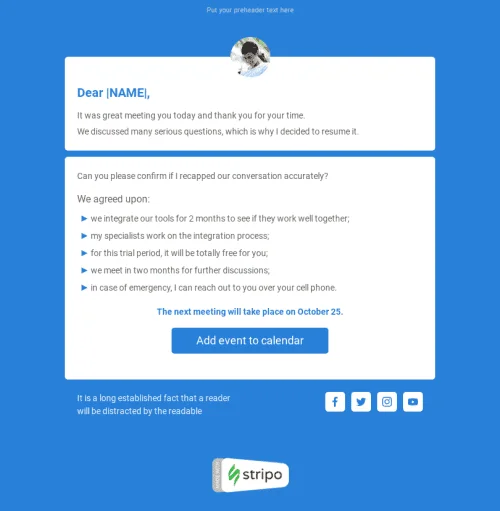
These can be reminders or written confirmations of agreements, deadlines, or next steps agreed upon with a new client. Such emails can also be sent to potential clients who have not yet ordered a legal service to stay in touch with them. You can provide basic answers, past client testimonials, and other types of information, depending on what you know about the client.
6. Educational emails
These types of emails allow you to educate your clients and build trust. By making this effort, you will help keep your firm top of mind when that need arises, even if they don't need legal services right now.

(Source: Milled)
7. Thank you emails
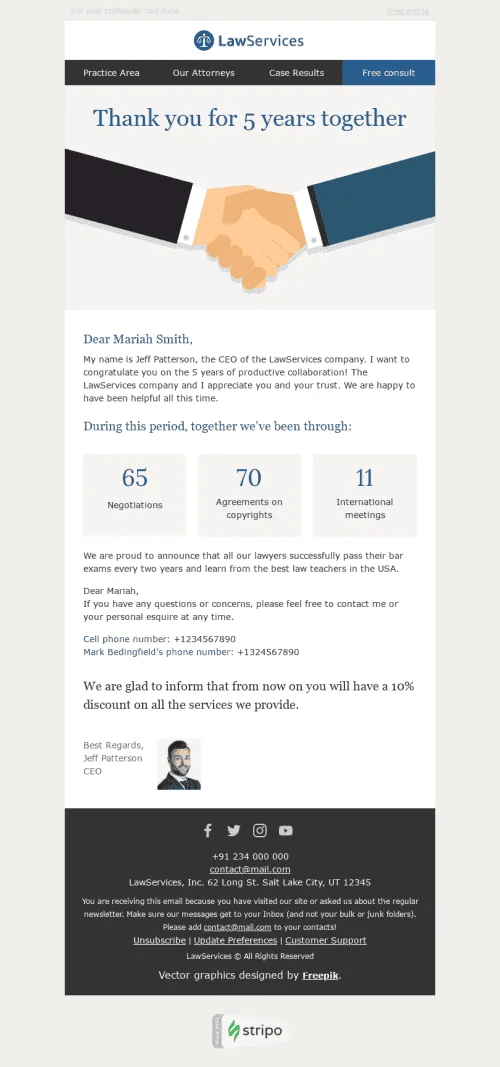
Even after your work with a client has ended, you can continue to nurture client relationships. Thank you emails can summarize the results of your collaboration and highlight key numbers, clearly demonstrating the time and effort invested in achieving the outcome. And if the client is satisfied, they are more likely to return in the future.
8. Legal changes
The legal industry is constantly evolving with ongoing changes in legislation. If you track these updates and share them with your clients, this can become a significant competitive advantage over other law firms. It is one thing when a client approaches you with a legal issue that you can resolve. It is quite another when you act proactively and provide valuable insights into how changes in the law may affect their business, helping them anticipate and prevent legal risks.

(Source: Natlawreview)
9. Introduction to the law firm and attorneys
Here is another email template that can be used to introduce readers to the legal professionals at your law firm and explain how they can assist clients in different situations.

10. Newsletter emails
Last but not least, this type of marketing email allows you to subtly share industry news and updates about your law firm with your recipients. When done correctly and sent at a reasonable frequency, a newsletter works well to increase brand awareness and build trust.

(Source: Milled)
This is not an exhaustive list of the types of emails a law firm can send to its audience. The variety of formats is one of the advantages of email marketing, which is an integral part of digital marketing.
Best practices for creating effective law firm email campaigns
To get the most out of your email marketing efforts, follow these tips.
Regarding contact lists:
- collect email addresses ethically: Use double opt-in and rely on organically built subscriber lists;
- work on your contact list: Create it, supplement it, keep it updated;
- add a call-to-action and use opt-in forms to subscribe to your newsletter on your law firm’s website and social media channels.
Regarding email design:
- use templates: A beautiful, branded email campaign sets your law firm apart from others in the market, and Stripo's templates for the legal industry save time;
- optimize law firm email campaigns for mobile devices: Data show that around 64% of subscribers check their emails on mobile devices, but more than 50% of recipients delete messages that are not optimized for mobile.
Regarding email content:
- write blog posts about complex legal topics in simple language, and your clients will appreciate it;
- make emails short and to the point. People are busy and have little time;
- protect client privacy when writing about cases or achievements. Seeing this level of care and protection, even in a newsletter, will be important for future clients;
- incorporate videos, images, and links into other media assets that provide practical guidance and boost engagement;
- craft emails with information that is so valuable that recipients will want to share them. And include a call-to-action for this;
- offer exclusive perks, such as unique subscriber access to a complimentary white paper, limited-edition discounts, or a tailored video from one of your partners. Consistent communication is a core part of lawyers’ email marketing that delivers results and helps build lasting client relationships;
- automate follow-ups after consultations and updates on the stages of a case and the client status. This will help you stay on top of key tasks and send clients timely messages about further actions, documents, meeting dates, etc.
Email marketing tip for lawyers: Always include your business name and office location in your emails. Learn how to create a professional lawyer email signature in this article.
How to measure email marketing campaigns: Click-through rates and analytics tools
Measure your performance and analyze what works and what doesn’t. Review the tactics you use and how they impact your email campaign metrics.
Law firms should track the following key metrics:
- open rate. How many people open your emails;
- click-through rate. How many people click on at least one link in an email;
- conversion rate. The percentage of people who open your email and do what you want them to do;
- device statistics. Insights into whether emails are opened on mobile, desktop, or tablet;
- bounce rate. The number of email addresses that do not receive your emails;
- unsubscribe rate. The number of recipients who opt out;
- spam complaints. How many people send your email to the spam folder.
While these metrics are basic, they provide valuable insights into whether your content resonates with recipients, whether readers click on links, which topics are most relevant, whether you are sending too many emails, and what percentage of email readers eventually become actual clients.
You can use analytics tools for measurement and analysis. To get started, you don’t need complex systems; built-in analytics provided by email marketing platforms will be enough.
Legal compliance: CAN-SPAM and GDPR
Legal compliance is crucial for legal professionals and law firms. Firms that provide legal protection and ensure regulatory compliance for others must adhere to these rules themselves.
Below are key recommendations for staying compliant in email marketing:
- clearly identify your company in the email signature and “from” field in emails;
- make sure your subject lines aren’t misleading;
- send emails only to new leads who have explicitly opted in to receive emails from you;
- include a clear and easy-to-find unsubscribe (opt-out) link in every email;
- promptly remove unsubscribed contacts from your mailing list;
- comply with all applicable regulations, including the CAN-SPAM Act and GDPR;
- protect your customers’ data privacy. Always get clear consent before collecting or using their data;
- share your office location address with recipients in every message.
Protect your firm’s reputation; it’s more crucial than ever in the legal field. Client trust and reliability drive success.
In the legal industry, protecting client information is non-negotiable. Ensuring full compliance with data privacy regulations like GDPR and HIPAA builds trust and safeguards the firm’s reputation.
Common email marketing mistakes lawyers face
So, you’ve prepared everything, set up your email campaigns, started sending them, and received the first results from potential clients.
Now, let’s look at the most common mistakes you should be aware of and avoid:
- not tracking and monitoring analytics. Metrics are what allow you to see results and improve them over time. Did unsubscribe rates increase after you raised your sending frequency? You can adjust that. Are educational emails showing a high click-through rate? You can build on that and use it to your advantage.
If there is one rule that can deliver the greatest impact, let it be this: always analyze your email campaign performance.
Our content is carefully curated, and we analyze performance based on newsletter topics to guide future articles.
- not segmenting your audience and sending the same emails to everyone. In law firms, clients differ across many dimensions: the area of law (civil, labor, intellectual property law), the stage of the case (consultation, litigation, mediation, and so on), client status (prospective clients or current clients), and more. It is clear that each of these groups is interested in different types of communication. Therefore, avoid mixing them together, and instead send clients in each segment content that is relevant and valuable to them;
- sending long emails filled with complex legal terminology. Clients have already trusted your law firm with their legal matters. Don’t undermine that trust by sending lengthy emails that are difficult to understand and may even feel intimidating. Keep your emails clear and concise. Simplify wherever possible. Focus not on looking smart in the eyes of the client, but on being easy to understand;
- failing to test links before sending emails. Every email you send is an opportunity to enter a client’s personal space, their inbox. You invest significant effort to ensure that your message is delivered, noticed, and opened. A broken or incorrect link can undo all that work and damage client trust. That’s why it’s always worth testing everything multiple times to make sure recipients don’t waste their time and can easily take the intended action (click a link, book a meeting, or complete the next step).
Wrapping up
I hope this article has shown you how email marketing helps law firms attract and retain clients. We covered the types of emails these firms can send to strengthen client relationships and grow your practice, how to launch effective campaigns, why tracking analytics matters, and common pitfalls to avoid in lawyers’ email marketing.
Start working on your email marketing, as it’s a powerful way to build trust, nurture relationships, and boost your law firm’s revenue.


0 comments