SMS vs. email statistics: What the numbers actually say in 2026


Email as a communication and marketing channel predates SMS by two decades. Does that mean it is doomed to extinction any time soon, giving way to a newer technology? Only hard numbers can give an answer to this question.
This article contains the latest SMS versus email marketing effectiveness statistics to help specialists in the niche choose a powerful instrument for reaching out to their clientele and promoting their products or services.
Top 10 SMS vs. email statistics every business should know
Let’s take a quick look at the stats for these two marketing channels:
- Last year, the global number of email users exceeded 4.55 billion; within two years, it is expected to reach 4.97 billion.
- In 2026, the number of emails people worldwide send every day is 392 billion.
- The daily number of SMS messages sent is much lower: about 25 billion (or 275,000 every second).
- More than half of all mobile phone users send and receive several SMS messages per day.
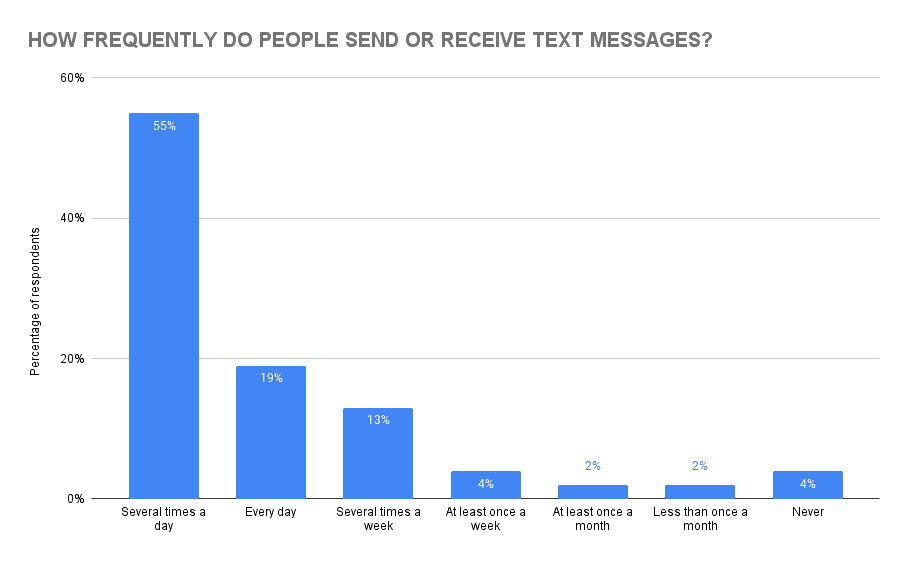
(Source: Sell Cell) - The U.S. has the highest number of SMS and MMS messages sent annually (2.2 trillion).
- America also ranks first in terms of the number of emails sent daily (9.8 billion).
- Over 50% of people read a text message within the first five minutes of receiving it, and over 30% do so within a minute.
- Texting is the most popular mobile activity for 78% of smartphone users.
- Generation X is the typical age group in the U.S. targeted by text message marketing (49%).
- The SMS response time is 90 seconds, which is 60 times shorter than the email response time (90 minutes).

SMS vs. email benchmarks side by side
Now, let’s do a head-to-head comparison of basic metrics. Note that reported SMS benchmarks are often higher than email benchmarks, but direct comparisons should be treated cautiously because platforms measure these metrics differently.
-
Reach and delivery
Almost two-thirds of the global population uses SMS, and its delivery rate reaches 97%. SMS has a broader mobile phone reach in many markets, while email has a larger global user base and is less expensive to scale. Email has 4.55 billion global users, representing around 57% of the Earth’s population; inbox placement is also lower: 83%-85%.
SMS can reach customers directly on their mobile devices, while email can support much larger and more cost-efficient subscriber lists. Delivery also needs to be evaluated differently: SMS platforms typically report delivery or failure rates, while email marketers must also consider bounces, spam filtering, authentication, and inbox placement.

Consider whether your target audience is reachable through the channel and whether your messages are consistently delivered to that audience. When evaluating your own programs, track delivery rate, bounce or failure rate, unsubscribe rate, and list growth for each channel, rather than relying on a single global reach statistic.
-
Engagement: CTR, CTOR, and response rate
Klaviyo’s 2026 data show an average SMS campaign click rate of 5.76% compared with 1.69% for email campaigns. However, automated email flows perform much better than standard campaigns, reaching an average click rate of 5.58%.
This comparison illustrates an important point: Campaign type matters almost as much as channel. A generic promotional email and a behavior-triggered SMS message aren’t equivalent communications, so comparing their raw click rates can produce misleading conclusions.
Furthermore, the click-to-open rate isn’t directly comparable across the two channels. Email platforms can calculate CTOR because they can register opens, although email open data have become less reliable because of privacy protections. Traditional SMS doesn’t provide an equivalent open-tracking mechanism, so SMS performance is better evaluated using click rate, conversion rate, or placed-order rate, revenue per recipient, and unsubscribe rate.
-
Outcomes: Conversion, ROI, and revenue per recipient
On average, SMS has much higher average conversion rates (21%-30% vs. 3%-15% for emails). However, in flows, the benchmarks are equal ($1-$3 for emails and $2.54 for SMS). In terms of ROI, email has a significant edge.

(Source: Mailmodo)
However, conversion and revenue benchmarks should be compared with particular care because platforms use different attribution windows, conversion definitions, and denominators.
ROI is harder to compare across channels because the calculation depends on which costs and revenue are included. Litmus reports an average email ROI of $36 for every $1 spent, while its 2025 survey found that most companies reported returns between $10 and $50 per dollar. These figures shouldn’t be treated as a universal email benchmark, much less as a direct comparison with SMS ROI.
The takeaway: Don’t decide that one channel is more profitable based on a single conversion or ROI statistic. Compare revenue, costs, attribution, and incremental lift using the same methodology wherever possible.
Why the same metric can have different numbers
When you compare different sources, you can spot variations in the same metric. How come?
ROI: $10, $41, or $76 per dollar?
You should carefully check which marketing channel this figure represents: For emails, it is normally higher. Moreover, even within the same channel, ROI may vary depending on automation maturity, company specifics, and send list quality. According to Litmus, 5% of marketers report an email ROI of $50, 30% report $36-$50, and 35% report $10-$36. This spread makes it difficult to pinpoint an average figure, but it allows Litmus to estimate a range of $42-$45 per dollar spent. Omnisend has its own sources, which show even bigger numbers ($76 per dollar).
These figures shouldn’t be combined into a single true email ROI. ROI depends on factors such as list quality, program maturity, industry, campaign type, automation, and which costs are included in the calculation.
SMS click-through rates are reported between 10% and 45%
This gap is explained by the way platforms measure clicks (unique or total), their attribution windows (they can vary from 24 hours to 7 days), opt-in quality of the lists (double opt-in audiences manifest higher CTRs), the consistency of list hygiene efforts, the use of link shorteners, and other factors.
SMS benchmarks depend on how a platform defines a click, which recipients are included, whether the data cover campaigns or automated flows, and how the platform handles attribution. Rather than choosing the highest number you can find, check the methodology behind each benchmark before using it in a comparison.
How to read any channel statistics
To get a more objective picture, compare:
- delivery and failure rates;
- click rates;
- conversion or placed-order rates;
- revenue per recipient;
- unsubscribe rates;
- total channel costs;
- attribution windows;
- and, where possible, incremental revenue.
Most importantly, compare like with like. A promotional SMS campaign shouldn’t automatically be compared with an automated email flow simply because both contain a link.
Your own historical data are also essential. Industry benchmarks can provide context, but your audience’s behavior is the more relevant baseline for deciding where to invest.
What the 98% vs. 20% comparison hides
This correlation is widely recognized in SMS open rate versus email open rate statistics. Don’t compare SMS’s supposed 98% open rate with email open rates. They’re not equivalent metrics. So, why should it be regarded cautiously?
Apple Mail Privacy Protection broke the email open rate
Apple’s Mail Privacy Protection prevents senders from reliably learning when a recipient opens an email by downloading remote content in the background rather than waiting for the recipient to engage with the message.
As a result, reported email opens can include activity that doesn’t represent a person deliberately opening or reading the message. This makes the open rate less reliable as a standalone measure of email performance.

SMS has the opposite problem: Traditional SMS platforms generally don’t have an email-style open-tracking mechanism at all. Therefore, the familiar “98% SMS open rate versus 20% email open rate” comparison shouldn’t be used to declare SMS the clear winner. The two figures aren’t measured in the same way.
SMS lists are a fraction of email list size
SMS lists are often smaller than email lists because consumers may be more selective about giving brands access to their phone numbers. This can create a highly engaged audience, but it also introduces selection bias into benchmark comparisons.
A brand’s SMS subscribers may already be more interested in its products than the average email subscriber. As a result, higher SMS engagement doesn’t necessarily mean that the SMS channel itself caused the difference.
SMS subscribers self-select, so they convert better by design
SMS subscribers make an active choice by explicitly opening the door for brands into their highly personal space, which is why SMS manifests such high open rates.
What each channel actually costs to run
Now, let’s talk dollars and cents.
-
Cost per message: SMS, MMS, and email
Email is generally cheaper to scale per recipient because many email platforms use subscription- or volume-based pricing. SMS usually carries a higher marginal cost because businesses may pay per message in addition to carrier or registration fees.
The actual difference depends on the provider, country, message type, list size, and pricing model. For that reason, a universal cost per email or cost per SMS figure can be misleading.
When comparing channels, calculate your own effective cost per delivered message and cost per conversion. This gives you a more useful picture than a generic industry price range.
-
Production and platform costs
SMS production is affordable because SMS messages contain only text. MMS messages and emails that include images incur template-coding overhead and higher upfront design costs. A platform’s monthly subscription fees vary significantly across vendors, but they are consistently higher for SMS and MMS ($20-$100 on average) than for email ($0-$50 on average).
-
Cost-adjusted return by list size
These are opposite for email and SMS. Since email is typically priced at a flat subscription rate, list growth reduces the cost per send. SMS bills on a per-message rate with the addition of carrier fees, so expenses increase as the list grows larger.

Which channel for which message
It is wrong to say that you should always prefer SMS over email or vice versa. Each channel has its own focus and use cases.
Consumer preference by message type
While 75% of consumers prefer to receive text messages from brands, fewer prefer to receive email (68%).
When SMS is the right call
SMS does well for time-sensitive offers, transactional updates, and event reminders. You should also opt for SMS if your audience consists of younger demographics.
When email is the right call
Email is great for personalized offers, nurture campaigns, educational content (especially videos and images), welcome series, product launches, and long-form storytelling.

(Source: Text Bolt)
Running both channels together
You can maximize the efficiency of your marketing campaigns by combining SMS with emails.
SMS-first sequencing
This marketing strategy opts for SMS as the initial touchpoint in communication with the consumer, triggered by a brief delay in their actions (for instance, cart abandonment and form submission). If there’s no response to the text message, emails come into play.
Email-first with SMS reinforcement
Here, the order is reversed. A customer receives an email, and if they don’t open it or click the link within a set time, an SMS message is sent to spur them into action.
Growing an SMS list from email, and email from SMS
When growing one channel from another, treat consent as channel-specific. An email subscriber isn’t automatically an SMS subscriber, and an SMS subscriber isn’t automatically an email subscriber.
Instead, use your existing audience to invite people to opt in to the second channel through a clear, separate consent mechanism. Requirements vary by jurisdiction, so check the rules that apply to your recipients before launching cross-channel acquisition.
Frequency capping across channels
Cross-channel coordination limits the total number of touchpoints (for instance, no more than three SMS and email messages combined) for each consumer within a given period (say, a week) and blocks any communications that exceed this limit. This prevents recipient fatigue and keeps engagement high.
Measuring both channels honestly
When combining emails and SMS in your marketing initiatives, you should gauge their performance properly.
Cross-channel attribution
When customers receive both email and SMS, avoid judging the channels solely by last-click revenue. A customer might receive an email, click it, receive an SMS reminder, and then purchase, making it difficult to assign the entire outcome to either channel.
Use consistent attribution rules and track channel-specific clicks, conversions, revenue, and costs. Where possible, supplement attribution with holdout or incrementality testing to estimate how many additional conversions or how much additional revenue the messages actually generated.
UTMs, unique links, and channel-specific promotional codes can help distinguish traffic and purchases, but they should be treated as supporting attribution tools rather than proof that one channel caused the conversion.
Holdout testing and incrementality
As a variation of A/B testing, holdout testing involves holding back a small group of clients (typically not more than 20%, but commonly 5%) from receiving SMS messages and emails for a set period (usually a month). Its implementation lets businesses gauge the lift (also known as incrementality), which is the net-new conversions or revenue generated by their messages that wouldn’t have occurred if they hadn’t reached out to their clientele with promotions.
Benchmarking your own numbers
Don’t rely on industry averages when evaluating your performance. Instead, track your own past campaigns to see how your audience responds to your initiatives and to determine internal efficiency standards across SMS and email.
Compliance costs that don’t show up in ROI
Compliance is part of the cost of running both SMS and email programs. The exact requirements depend on where your recipients are located, what types of messages you send, and whether the communication is promotional or transactional.
SMS: Consent and local messaging rules
Before sending promotional SMS, businesses need to determine which consent, disclosure, opt-out, registration, and messaging rules apply in the recipient’s jurisdiction.
Don’t assume that permission to email a customer automatically gives you permission to text them. Consent requirements can be channel-specific. For example, UK guidance states that consent for email marketing doesn’t automatically cover text-message marketing; consent should specify the communication method.
For U.S. messaging, businesses should also check current federal, state, carrier, and messaging-provider requirements before launching a program. Rules can differ depending on the message type and sending arrangement.
Email: GDPR, regional privacy laws, and anti-spam rules
Email marketing is governed by different combinations of privacy and electronic-marketing rules depending on the recipient’s location:
- GDPR covers EU-based individuals and requires opt-in consent to receive promotional emails;
- UK electronic marketing rules generally require specific consent for marketing emails and texts sent to individuals, subject to limited exceptions, such as the existing-customer soft opt-in;
- the CCPA, meanwhile, focuses on California consumers’ privacy rights, including the right to opt out of the sale or sharing of personal information;
- for U.S. email marketing, CAN-SPAM requirements also apply. Because penalties and regulatory requirements can change, businesses should consult the current guidance of the relevant regulator.

Message fatigue and unsubscribes
Compliance is only one reason for controlling message frequency. Excessive email or SMS communication can increase unsubscribes, complaints, and disengagement, even when every message is technically compliant.
Measure unsubscribe rates for both channels and coordinate their frequencies. A customer who receives three emails and three texts in the same week experiences six brand touchpoints, not three email messages and three SMS messages viewed separately.
SMS and email benchmarks by industry
Each channel has different KPIs across industries. Emails tend to have the highest open rates in the nonprofit, hospitality, and travel sectors, while CTRs and CTORs are highest in the nonprofit, SaaS, and B2B verticals.

(Source: HubSpot)
As for SMS, its adoption is the highest across the healthcare (83%), hospitality (80%), and finance (72%) domains. Hospitality SMS reigns supreme in conversion rates, leaving SaaS and technology far behind.

(Source: MessageFlow)
However, flash-sale apparel SMS and DTC subscription SMS lead the pack in terms of CTR.

(Source: Digital Applied)
What’s changing: RCS and AI
You can’t devise an effective SMS and/or email marketing strategy without embracing the latest trends in these fields.
RCS as a third option
Rich Communication Services (RCS) technology was launched in 2007 as a viable alternative to SMS, upgrading traditional text messaging with internet-based features. RCS messages are sent over Wi-Fi or mobile data, acting much like a chat app. This protocol lets senders see whether the recipient has read their message or is typing a reply. In addition to text, you can send high-quality photos and videos via RCS.
This technology is rising steeply today and is expected to reach 3.8 billion active users by the end of 2026 (a tremendous leap from 1.1 billion two years ago). RCS business traffic was estimated at 50 billion messages in 2025, and the global RCS market in 2026 is around $9-$10 billion (projected to exceed $28 billion within 10 years).
AI personalization
Together with automation, AI is a defining feature of contemporary email and SMS marketing.

(Source: Thunderbit)
AI personalization enables marketers to tailor messages to each recipient based on their interests, behavior, and past purchases. The outcomes are higher open rates, better conversions and sales, and increased customer engagement and loyalty.
Wrapping up
SMS and email aren’t only the two most popular communication channels but are also powerful marketing tools, enabling businesses to reach vast consumer audiences. Which one is better? There’s no universal answer because each channel does better in some use cases but performs worse in others.
SMS is most efficient for reminders, transactional updates, emergency alerts, and time-sensitive offers. Emails excel at onboarding sequences, content-rich campaigns, and long-form storytelling (such as case studies or detailed explanations).
Robust professional software can maximize your marketing efforts by utilizing both channels. For email, Stripo is one such high-end tool. This drag-and-drop email-building platform streamlines and facilitates the creation and administration of campaigns thanks to its intuitive interface, capabilities for producing interactive components, reusable modules, collaboration features, and an impressive roster of 90+ ESP integrations.
FAQ
1. Is SMS marketing more effective than email?
One isn’t better than the other, as they serve different purposes. Choose SMS when focusing on immediate responses and high engagement rates. Email marketing is the natural choice for companies poised for building long-term customer relationships and detailed storytelling.
2. How do I use email and SMS together?
You can start campaigns with SMS, followed and reinforced by email, or vice versa. You can use an existing email or SMS audience to invite subscribers to opt in to the other channel, but you shouldn’t assume that consent for one channel automatically covers the other. You should also implement frequency capping as a key cross-channel coordination measure to avoid recipient fatigue and dips in engagement.
3. Which software combines email and SMS marketing?
By leveraging Klaviyo, ActiveCampaign, Omnisend, or Mailchimp, you can view your SMS and email initiatives on a single interface, automate workflows, and run cross-channel campaigns. Visit their websites to discover which fits your use case, company size, and budget best.
4. How do I track ROI across email and SMS?
To discover which channel drives more ROI, assign distinct discount codes to each, set different attribution windows (for instance, one day for SMS and a week for email), and add unique tracking tags to links within emails and SMS. Specialized platform-level revenue tools help monitor ROI more efficiently.
5. When should I use SMS instead of email?
SMS has the edge over email when it comes to sending transactional updates (such as shipping notifications or order status), time-sensitive offers (for instance, expiring coupons or flash sales), appointment and payment reminders, and emergency communications (weather closure messages, urgent alerts, etc.).
6. Is a 98% SMS open rate real?
The commonly cited 98% figure should be treated cautiously because traditional SMS doesn’t provide an email-style open-tracking mechanism. Conventional SMS networks don’t track this metric the way email does, where mechanisms are in place to register pixels when the message is loaded. Instead, the index is derived indirectly from several SMS delivery confirmation signals. That is why more objective parameters for measuring SMS efficiency to steer by are CTR, conversion rate, and unsubscribe rate.
0 comments