Opt-in email marketing statistics: 2026 benchmarks and what they mean


A successful email campaign is a harmony of a well-thought-out structure, compelling subject lines, engaging content, workmanlike placement of the CTA, granular audience segmentation, personalization efforts, etc. The foundation of all these measures is email opt-in. How important is opt-in for email marketing, and can it become a game-changer in your email-driven workflows? To understand it, let’s examine the statistics that showcase the spread and efficiency of opt-in email marketing.
Top 10 opt-in email marketing statistics every business should know
Our first glance is at the most general figures related to email opt-in marketing:
- People send over 392.5 billion emails every day.
- One of the largest shares of daily emails sent (9.8 billion) is produced by US-based users.
- Email is a preferred communication channel with companies for 68% of consumers.
- For 81% of businesses, email is a staple of their marketing strategy.
- Email marketing brings enterprises one of the highest ROI compared with other channels.
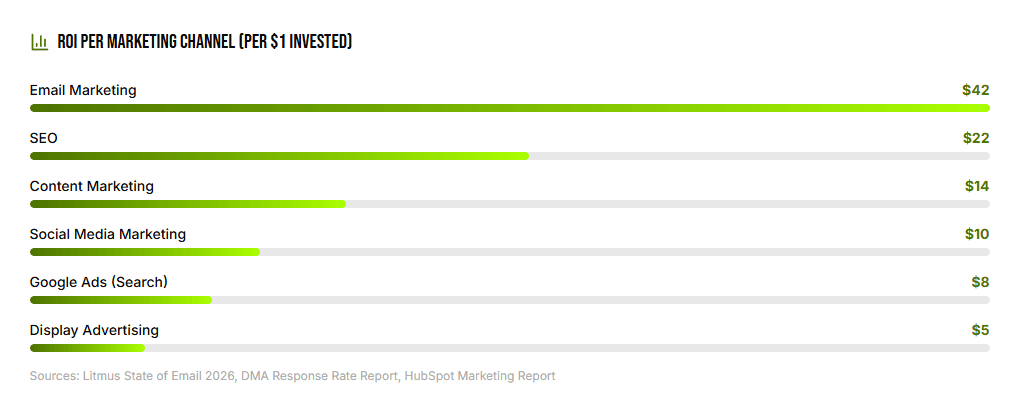
(Source: Searchlab) - Governmental and educational institutions enjoy the highest email open rate (42.1% and 40.7%) and click-through rate (3.2% and 3.5%), respectively.
- The average email opt-in rate is 2.1%, depending on form type, industry, and traffic source.
- Single opt-in lists generally generate 75% more spam complaints than their double opt-in counterparts because they are more likely to contain mistyped or fraudulent addresses.
- In North America, 54% of businesses use double opt-in, while in Europe, where the GDPR requires demonstrable consent, the share is 89%.
- Double opt-in is comfortable for 86% of Americans and 88% of Canadians.

What is opt-in email marketing?
Before we dive into specific numbers, it is necessary to find out what opt-in in email marketing means.
Opt-in emails are messages sent by businesses only to those recipients who explicitly agreed to receive marketing communications by providing their email address. Such a permission-based approach protects brands' sender reputation and improves email deliverability.
Opt-in vs. opt-out
Opt-in consent, enabled by checking a box or following a link, is contrasted with the opt-out approach. Companies adopting the latter automatically enroll people, and it is up to recipients to withdraw from receiving messages or to unsubscribe.
How do consumers assess the two strategies? Most of them believe that the opt-in model has an edge in terms of trust, privacy protection, and recipient satisfaction.

(Source: ResearchGate)
Single, double, and confirmed (COI) opt-in made plain
There are three types of opt-in emails:
- In single opt-ins, a subscriber is added to an organization’s email lists immediately after entering their contact information into a signup form.
- Double opt-ins work in two steps. Here, the subscriber not only submits a signup form but is also asked to click on the verification link in the email they receive on submission. It is only after this click that they are added to the email list.
- Confirmed opt-in (COI). Some providers use the term “confirmed opt-in” interchangeably with double opt-in, while others define it as an additional verification step beyond email confirmation. In this way, companies are 100% sure that the person is interested in receiving promotional messages.

Average opt-in conversion rate benchmarks
The mean opt-in conversion rate hovers around 3.2%. But to get a more comprehensive picture, it makes sense to view opt-in conversion statistics across several categories.
Opt-in rate by form type
Pop-ups demonstrate a 3-4 times higher conversion rate than embedded forms. But pop-ups themselves display different efficiencies depending on their trigger type and layout.

(Source: Prospeo)
Opt-in rate by industry vertical
The highest opt-in rates are observed in the media (64.4%), gaming and sports (60.4%), and automotive (57.6%) sectors. In contrast, the lowest are in the high-tech and telecom (49.8%) and energy and utility (50.6%) industries.
Mobile vs. desktop capture
Since 64% of people open emails on mobile devices, companies channel their efforts into optimizing their messages for mobile devices. And the statistics show that mobile capture rates dominate those on desktops. For instance, first-page views on mobile devices yield a 6% opt-in rate, whereas on desktops, it is half that.
Opt-in rate by traffic source
Organic traffic yields 2-5% of opt-in conversions, and paid social ads generate 0.4-1.1%. Given such low numbers, it is better to combine at least two sources to achieve higher indices. For instance, sending an email and then an SMS generates a conversion rate of 6.4%, whereas sending an email and SMS simultaneously increases opt-in conversions to 9.7%.
Does permission pay off? Opt-in vs. non-opt-in performance
At first glance, it may seem that whether you get the recipient’s permission to regularly send updates, messages, or newsletters doesn’t matter much. You can still reach random people and organizations with emails without bothering to ask them, right? Wrong.
As various surveys reveal, basic performance metrics for opt-in emails are significantly better than for non-opt-in ones. For instance, permission-based lists consistently outperform purchased or non-permission lists across engagement metrics. Open rates and click-through rates of opt-in messages also have an edge.

(Source: EmailOpShop)
So, opt-in emails work better. What about the two opt-in types?
Double opt-in vs. single opt-in: What the data says
There is no sweeping prevalence of opt-in usage across enterprises, yet close to half of businesses choose single opt-in email marketing.

(Source: ExactVerify)
Why so? Each type has its own merits and demerits. With single opt-in, the process is fast and instant, and the email list grows to a considerable size, which appeals to many businesses.
However, these upsides are offset by serious shortcomings. Such lists are of low quality, which increases the likelihood that messages will end up in the spam folder. So you will have to allocate time and resources for trimming the lists and take other steps to improve deliverability. On the other hand, double opt-ins allow marketers to build lists 20-30% slower but result in a verified, engaged audience and a low risk of emails being filtered out by anti-spam software.
Which strategy is better? It depends on your business type and its email marketing goals. Single opt-in is recommended for eСommerce and SaaS brands focused on quick lead generation and software onboarding. For B2B companies and organizations operating in jurisdictions with strict data privacy regulations, double opt-in emails suit better.
Opt-in form types ranked by conversion
Let’s look at the performance of different opt-in forms. The conversion rate is the highest for dedicated landing pages (6.47%), followed by pop-ups (3.77%) and flyouts (3.24%). Embedded forms display the lowest percentage (1.28%). What is truly amazing is how gamification, in general, and spin-to-win, in particular, perform. When properly leveraged, they can usher in a 10%-30% spike in the conversion rate.

Which incentives drive the most opt-ins
Poised for high conversion, businesses should realize which marketing instruments to use. What do the opt-in statistics say about their efficiency?
Discount-based offers
Customers can’t resist codes and coupons that let them pay less. Knowing this, eCommerce stores leverage this instrument very often. As a result, they achieve a 43% conversion rate. To emulate their success, be specific. “Special offers” don’t sell your products. “10% off your first order” does.
Giveaways and contests
People love fun and games, especially if they promise a relevant tangible reward at the end. Plus, they feel totally uncommitted since no purchase is required from them. Such incentives show a decent conversion rate of 11%. However, you should remember that contest-acquired clientele is more about subscribers here and now than long-term engagement, at which discounts excel.
Free shipping
Surprisingly, a promise of free delivery isn’t what attracts customers (a paltry 1% conversion rate) since most of them expect it as part of the deal anyway. It is better to combine it with other incentives (such as discounts) to engage shoppers.
What happens after opt-in
You can’t rest on your oars after a person opts in. You should keep the pot of their engagement boiling and capitalize on it. How do you do that?
Welcome emails and series
These are first-impression hooks that can persuade a person to stay with you. Such messages have a sky-high 83.6% open rate and a 16.6% click-through rate, yielding 240+% ROI.
Segmentation is non-negotiable
One-size-fits-all opt-in forms work poorly. So go the extra mile to craft different forms for several audiences: individuals, small business owners, enterprise clients, and different industries. Besides, you can ask segmentation questions to better know your new subscriber. It will be your first step toward tailored, personalized campaigns that significantly increase engagement benchmarks: a 14.31% higher open rate, a 100.95% higher click-through rate, and a 760% rise in ROI.
Email service provider matters
The platforms companies use for their email campaigns demonstrate somewhat different benchmarks.

(Source: ThreadPoint)
Why? Two major factors are at play. First, ESPs differ in deliverability tooling, authentication support, sending infrastructure, and customer base. Second, their user bases are different. Some of them (for instance, Klaviyo) are honed for eCommerce, while others (like Mailchimp) are more suitable for content creators and small businesses of various kinds.
B2B vs. B2C opt-in benchmarks
Email engagement metrics differ across the business models in which companies operate.

(Source: MailMonitor)
What about the conversion rates? The B2B sector usually displays lower conversion rates than the B2C domain (on average, 2.1% vs. 2.5-3%).
The post-opt-in engagement of B2B customers can be improved by enabling access to free assessment tools and ROI calculators (up to 50% increase), industry reports with original data (up to 30%), templates and checklists (up to 25%), webinars (up to 20%), and whitepapers (up to 8%).
Opt-in and compliance: GDPR, CAN-SPAM, CCPA
Most companies offer customer opt-in to strengthen their brand reputation and improve message deliverability. However, there are cases in which the recipient’s consent is not a choice but a legal requirement.
It is mandatory in many jurisdictions for organizations that collect personal data, send marketing emails to non-customers, or place non-essential cookies. If an individual gives their valid consent, commercial institutions have the right to send them promotional messages because they have knowingly and actively agreed to receive them.
All these processes are regulated by multiple legal frameworks that define data-handling practices. Curiously, they approach the consent principle differently. The General Data Protection Regulation (GDPR), adopted by the EU, requires opt-in consent. In the United States, the CAN-SPAM Act generally allows commercial email without prior consent, provided recipients can easily opt out. Privacy laws such as the CCPA impose additional requirements for personal data, but do not create a universal opt-in requirement for email marketing.

The cost of skipping opt-in: Deliverability, spam, unsubscribes
Despite the evident boons of opt-in email marketing, only 10.99% of senders implement it. How does this influence their campaign performance?
Deliverability
Organizations universally admit the importance of email deliverability for their business success.

(Source: Mailjet)
Deliverability is directly correlated with opt-in. In Europe, where it is legally mandated by the GDPR, inbox placement exceeds 89% (in Germany, it is 94.5%). In the United States, where the opt-out model is preferred, this figure is 85%. In the Asia Pacific, no such laws apply, so the inbox placement rate is just 78.2%.
Spam
If you pepper consumers with promotional messages, many of them file spam complaints. The critical spam complaint rate threshold for any organization is 0.3%. Permission-based lists are significantly less likely to exceed this commonly accepted spam complaint threshold. Non-opt-in messages are often viewed as junk and marked as spam by recipients, so all your further communications are sure to land in the spam bin.
Unsubscribes
These are vital for the opt-out email marketing model. The presence of a clear unsubscribe option is a quality differentiator for opt-out messages. If the email doesn’t contain it, recipients are likely to consider it spam and get rid of it, which prevents your other messages from reaching them and damages your sender reputation dramatically.
How to improve your opt-in rate
Like any other email performance metric, the opt-in rate requires a consistent growth strategy. What should you do to see your opt-in rate increase?
Provide a clear incentive
In our scam- and spam-abundant age, people are naturally distrustful and protective of their privacy and the safety of their inboxes. To persuade them to opt in, you should offer some value in exchange. Early access to sales, a discount, or exclusive content are lead magnets that go a long way.
Optimize placement and design
Opting in should be seamless and hassle-free. Forms should be mobile-friendly and ask for the absolute minimum of information. The longer a form is, the less conversion you will get. And don’t overwhelm people with pop-ups as soon as they open your landing page. Let them appear later; say, after the viewer has scrolled halfway down the page or is about to leave.
Speak transparent language
Nothing repels people more than vague promises or specialized jargon. You should clearly explain what they will get and how often it will happen. Bolster trust with social proof, customer testimonials, and security guarantees placed next to the opt-in form.
Use A/B tests to validate your strategy
You can never know what works better for the audience you aim to reach until you test different graphic elements, button styles, background colors, emojis, etc. You should experiment with one variable at a time and discover what resonates with your customers.
Wrapping up
Building a high-quality email list starts with earning permission, not simply collecting addresses. While opt-in rates vary across industries, traffic sources, and form types, one trend remains consistent: permission-based lists deliver better engagement, stronger deliverability, and more sustainable long-term results. Use these benchmarks as a reference point but focus on testing, optimizing, and refining your own opt-in strategy to build an audience that genuinely wants to hear from your brand.
FAQ
1. What is a good opt-in rate?
There is no unified benchmark, as this index varies widely across industries, form types, and sources. The average figure is 2.1%, although the results vary widely by form type, traffic source, and industry.
2. Is double opt-in better than single?
It depends on your industry type and business goals. If you are an eStore poised for quick lead acquisition or a SaaS brand aiming to step up software onboarding, single opt-in is your natural choice. For B2B companies focused on nurturing high-quality customers and gradually expanding a highly engaged audience, double opt-in will suit them better.
3. Is opt-in email marketing worth it vs. buying a list?
Purchasing email lists seems an attractive shortcut, but it is a bad call in the long run. Sending campaigns to such recipients incurs major penalties from ESPs, numerous spam complaints, deliverability failures, and irrelevance for recipients, since most lists for sale contain out-of-date information. Opt-in email marketing efforts undertaken by a company itself comply with data protection legislation and yield higher engagement benchmarks.
4. Is opt-in legally required?
In certain jurisdictions, it is. In the EU, GDPR requires organizations to obtain valid consent for many marketing activities, but does not explicitly require either single or double opt-in. Double opt-in is commonly used because it provides stronger evidence of consent. In the United States, CAN-SPAM and CCPA norms are based on the opt-out principle, so businesses can send emails to consumers without prior consent, provided they offer a clear unsubscribe option.
0 comments