Video email marketing statistics: 80+ data points for 2026


Video is becoming a standard part of email marketing. While text remains a solid way to communicate, adding a video play button often determines whether a person clicks or closes the tab. In 2026, many technical barriers have become easier to manage thanks to modern email builders and fallback methods.
Many brands use video to explain a feature or show a product in 3D to save the reader time. When someone opens an email on their phone while standing in line, they typically prefer a 20-second clip over scrolling through several paragraphs.
Understanding these shifts helps you decide where to spend your production budget and how to structure your next campaign. These figures highlight which video formats drive sales and which ones people tend to ignore.
Top 10 video email marketing statistics every business should know
These figures clarify how video performs in the current market:
- 93% of marketers admit that video is an important part of their marketing strategy.
- 37.1% of marketers plan to increase their investment in video marketing in 2026.
- Across digital marketing more broadly, 85% of people feel ready to buy a product or service right after watching a video. This means that a video in an email can strongly influence purchase intent.
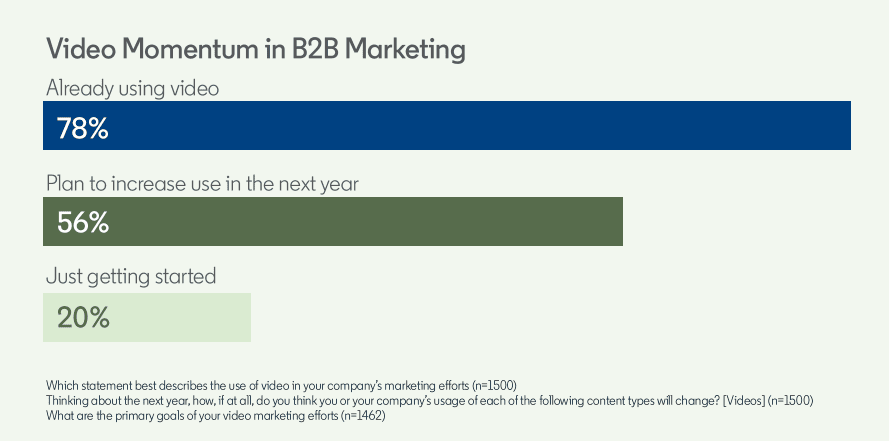
- Video continues to gain momentum in B2B marketing, with 78% of marketers already using it and 56% planning to increase their use.
(Source: 2025 B2B Marketing Benchmark) - Short-form social videos deliver the strongest ROI at 41%, while brand storytelling and customer testimonials also perform well, generating ROI for 38% and 34%, respectively.
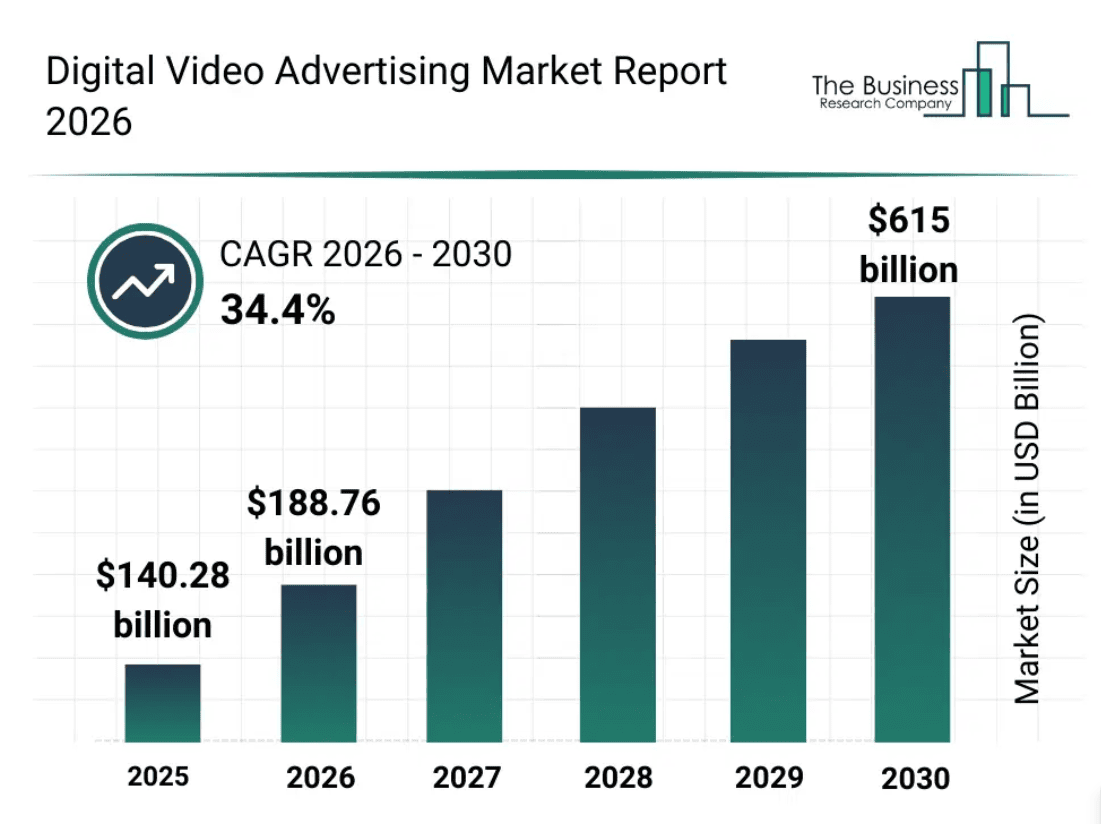
- The global digital video advertising market is expected to grow from $188.76 billion in 2026 to $615 billion in 2030.
(Source: The Business Research Company) - 48% of companies use email to share their videos, making it a key distribution channel for video marketing alongside social media and landing pages.
- The biggest factors shaping video choices are companies’ goals and objectives, cited by 61%, with launches close behind at 53%.
- About 51% of consumers use product videos to make more informed purchase decisions.
- Video ROI meets expectations for over 45% of marketers.


How video in email affects open rates and click-through rates
The success of a video email campaign starts before the recipient even sees a single frame. How you present the video determines whether people enter the experience or ignore it entirely.
Does the word “video” in subject lines really boost open rates?
Including the word “Video” in a subject line has become a standard way to signal visual content. It works because it sets a clear expectation. Data suggests that these labels can increase open rates by 7% to 13% compared to identical subject lines without them.
However, the novelty of the word alone is no longer enough. In 2026, transparency matters more. If the subject line promises a video but the email only contains a wall of text with a link at the bottom, engagement for future sends tends to drop. The lift in open rates is most consistent when the subject line describes exactly what the video shows, such as “Video: 3 ways to style your winter coat.”
CTR compared: Embedded video vs. thumbnail vs. GIF preview
- embedded video. Direct embedded video is risky because major clients like Gmail, Outlook, and Yahoo don’t support in-email playback reliably. However, emails with embedded videos still show better CTR and reply rate than those without video. Levitate’s Vidyard case study demonstrated that standard text emails achieved a 2.5% CTR and a 1.5% reply rate, while video emails reached a 17% CTR and a 6% reply rate;
- thumbnail. This is the most consistent performer for reliability. Emails using a high-quality static thumbnail with a visible play button average a 10.3% CTR, compared to just 6.1% for those using standard static images;
- GIF previews. While GIFs can catch the eye, research from the Nielsen Norman Group shows they often trigger negative reactions. Their studies found that 31% of users find animated emails “annoying,” compared to only 14% for static ones. Furthermore, adding animation was found to increase an email's negative reaction word count by 40% and decrease positive sentiment by 30%.
To succeed, the motion must be purposeful (like a brief product demo) rather than just a flashing loop designed to grab attention.

(Source: Nielsen Norman Group)
Conversion rates: Video emails vs. non-video emails
While open rates and clicks get people moving, video is particularly good at closing the deal. It’s easier for a customer to watch a 30-second demonstration of a complex software feature or a clothing fit than it is to piece that information together from several photos. When the email does the job of explaining the value, the landing page has a much easier time finishing the sale.
This impact is visible in the bottom-line metrics. Emails with embedded video average a 9.1% conversion rate, compared to 5.4% for non-video emails. A 69% lift that confirms the video’s ability to turn interest into action.
Which video types perform best in email?
Not every video serves the same purpose. While a creative brand story builds affinity, a well-placed product demo usually handles the core work of a sale. The recent data shows that the best video is the one that removes a specific roadblock in the customer journey.
-
Product demo and explainer videos
These remain the most effective for driving immediate revenue. About 93% of marketers say video has helped increase recipients’ understanding of their products, and 85% of people report being convinced to buy a product or service after watching a video.
After social media videos, explainer videos are the second most popular format overall: 68% of marketers create them to help audiences understand a product or feature. Product demo videos are also widely utilized, built by 39% of businesses to drive direct sales.
-
Customer testimonial videos
Brands that place testimonial videos on landing pages or in targeted emails have seen a 34% increase in conversion rates because they help reduce the perceived risk for new buyers.
57% of marketers invest in testimonial videos, making them the third most popular use case overall.
-
Welcome and onboarding videos
Welcome emails already produce naturally high open rates. Capitalizing on that attention by embedding an onboarding video helps a new subscriber find their first win with your software or product, cutting down on early-stage confusion and account abandonment. To maximize this impact, personalized welcome videos from the BHuman platform hit 20-30x higher response rates compared to text-based approaches.
The initial phase after a signup or purchase is when most subscribers decide whether to stick around. Marketers are increasingly using video to stabilize these new relationships, with 23% of companies actively creating customer onboarding videos.
-
Re-engagement and cart abandonment videos
Cart recovery sequences require an immediate hook to win back distracted shoppers, and video provides a more compelling incentive to return. Brands are seeing significant returns by moving away from generic text reminders and placing video content directly into these automated triggers.
When looking at successful video email marketing examples, eCommerce brand Crystal Ninja recorded a video specifically for cart abandonment and one for post-purchase. By personalizing each send, the brand achieved an 80x ROI.
BHuman reports that its first personalized video cart recovery campaigns delivered 3x response rates vs. standard follow-up sequences. Re-engagement campaigns using short testimonial videos see conversion lifts of 15.3%, vs. 8.9% for static reviews: nearly double the lift.

(Source: Wyzowl)
Video email marketing ROI and cost statistics
Integrating video assets into your outreach requires balancing the potential conversion lift against the hard costs of production. Evaluating these metrics will help you justify the creative spend to stakeholders.
ROI benchmarks: Video campaigns vs. image-only campaigns
While video remains a high-performing asset, market maturity is changing how teams see returns. In 2025, 93% of marketers reported that video gave them a good ROI. However, this satisfaction rate fell to 82% in 2026. More teams rush to create video content, but the data suggests that not all of them are producing high-quality material.
Despite this shift, broad marketing data shows strong baseline satisfaction: more than 45% of marketers say they are satisfied with the ROI of video, 20% are very satisfied, and 6% are extremely satisfied.
When deployed specifically within email, the financial gap between video and static assets is clear:
- the ROI gap. Marketers using video in email report an average ROI of $41 for every $1 spent, while those using only images report $28 per $1, representing a 46% ROI gap on the same channel and the same list;
- the open rate lift. Campaigns utilizing autoplay video previews average a 12.1% open rate, compared to 9.6% for static image thumbnails.
To maximize these returns, focusing on format length is critical. Short-form video remains the highest-ROI format for 49% of marketers.
With limited time and attention to work with, short-form content has emerged as an effective format for capturing attention quickly. According to data tracking, which video content drives the highest ROI, short-form social videos lead the market at 41%, providing a quick and credible format.

(Source: The Business Research Company)
Video production cost for email marketing
To meet growing audience demand, companies produce more videos, and most would have created even more if resources allowed. This momentum is likely to continue as 37.1% of marketers plan to increase their investments in video in 2026. While internal resource constraints are the primary barrier, cost remains a significant secondary obstacle, holding back 44% of marketing teams from producing more video content.
Still, annual spending habits show that video creation doesn’t always require an enterprise-grade budget. Almost 40% of companies spent under $5,000 producing videos last year, while just over 30% spent more than $5,000.

(Source: Wistia)
Lead generation impact: How much video changes the pipeline
Video acts as a consistent driver for filling the sales pipeline, maintaining a steady track record over multiple years. 88% of video marketers said video helped them generate leads.
This pipeline impact is driven by a mix of marketing volume and sales execution:
- lead volume and quality. Among marketing teams, 24.5% state that their lead volume significantly increased over the past year, while 50% said it somewhat increased. On the qualification side, an overwhelming 93.8% of marketers stated that their lead quality improved;
- format dominance. Short-form video was the most-used content format by marketers in 2025, used by 60% of marketers, outpacing both long-form video and traditional blog posts. This remains the highest-ROI content format, a trend expected to continue into 2026;
- sales enablement. Almost 60% of sales professionals now integrate video directly into their sales process, with nearly half reporting that video actively increases close rates. Additionally, 74% report they have been able to maintain or increase their daily productivity by using video tools.
How to add video to an email: Delivery methods compared
The baseline infrastructure of email clients dictates how your media will render, making it essential to compare available deployment strategies:
-
Embedding video directly in the email body
True HTML5 video embedding allows recipients to play the clip seamlessly inside the inbox without clicking out to an external browser. Broad client support is missing. Embedded HTML5 video code functions properly in iOS Mail, Apple Mail, Outlook for Mac, Samsung Mail, and Thunderbird.
However, major email service providers like Gmail, Yahoo Mail, and desktop Outlook don’t support this script, which can result in a completely blank block or broken layout for those subscribers.
To bypass manual coding errors, you can work directly with specialized video email templates that handle responsive design out of the box. Simply insert an HTML embed code block into Stripo builder, which automatically packages the script so that supported applications display the playable video stream immediately, while simultaneously generating an integrated fallback link (directing to platforms like YouTube or Vimeo) for clients like Gmail or Yahoo, ensuring no subscriber sees a broken layout.

-
Thumbnail + link: The most widely adopted approach
This method avoids inbox code restrictions entirely by utilizing a static background image styled to look like an interactive player. Setting up individual graphics with play button overlays and matching target links for every new campaign adds repetitive production steps and creates opportunities for broken links or missing image alt text.
The dedicated Video block in Stripo builder allows you to drag and drop a standard element into your template layout to add a video to an email, requiring only a pasted video link from YouTube, Vimeo, or TikTok.
-
Animated GIF and autoplay video previews
Extracting frames from video files to generate external GIFs takes separate editing software, and improper optimization can inflate file sizes, causing deliverability problems or clipping in mobile applications.
In Stripo builder, you can build custom motion triggers directly inside the workspace layout using a built-in AI GIF maker. When configuring a video preview, the editor converts the underlying file frames into a compact, eye-catching GIF animation to draw attention to the play prompt, keeping file sizes low and eliminating the need for third-party design apps.
ESP and email client compatibility: What works where
Before finalizing your layout design, you must map out which technical formats your subscribers' preferred inbox applications support. Understanding these restrictions ensures you can properly configure fallback elements so that no recipient experiences a broken layout.
|
Delivery method |
Supported environments |
Non-supported fallbacks |
|
HTML5 embedded video |
Apple Mail, iOS Mail, Outlook (Mac), Samsung Mail, Thunderbird |
Displays as a blank section or broken code block unless paired with manual fallback parameters. |
|
Static video thumbnail |
Universal (All clients, including Gmail, Yahoo, Outlook Desktop/Web) |
Fully stable; acts as a standard hyperlinked graphic layout. |
|
Animated GIF preview |
Most modern clients (Gmail, Apple Mail, Yahoo). Note: Older desktop Outlook versions only render the static first frame. |
Plays the brief animation loop automatically or holds firmly on the opening frame. |
Video email marketing statistics by industry and audience
The performance and application of video within email marketing change significantly depending on your business model, vertical, and overall company size.
B2B vs. B2C: Key performance differences
B2B and B2C organizations scale their email video marketing workflows to address entirely different customer behaviors and buying cycles:
- B2B pipeline impact. In B2B cycles, professional buyers prioritize clarity and feature validation. Approximately 70% of B2B buyers actively watch video content during their purchase decision process;
- B2C engagement dynamics. While B2B focuses on long-term evaluation, B2C campaigns use video to drive immediate action. Across general digital touchpoints, 87% of consumers say that they are ready to purchase a product or service immediately after watching a related video layout.
Benchmarks by vertical: SaaS, eCommerce, retail, healthcare
The intent and engagement profile of your audience dictates how video performs across specific verticals.
The type of video content you deliver (and the specific pages you target) directly shapes your interaction rates:
- SaaS & technology. Complex software products rely heavily on educational assets to drive conversions. Because 93% of marketers report that video successfully increases user understanding of a product or service, tech companies lean into video to break down intricate features. Audiences interacting with tech content typically operate in research mode, making mid-length video clips between 3 and 30 minutes the top-performing format for moving prospects deeper into the validation funnel;
- eCommerce & retail. The retail landscape relies on high-impact visual cues to prompt direct sales. Short-form video under 1 minute drives the highest audience engagement for eCommerce and retail brands at 54%. Because these companies focus heavily on discovery and brand awareness, brief video previews maximize clicks before mobile shoppers swipe away, as engagement drops to 44% for clips lasting 1 to 3 minutes and down to 39% for videos in the 3 to 5-minute range;
- healthcare & wellness. Audiences navigating healthcare and wellness communication prioritize credibility and deep trust. While the retail sector optimizes for sub-minute discovery loops, health-related content requires a thorough educational footprint. Short-form content under 1 minute captures strong initial engagement at 51%. However, health companies sustain viewer focus well compared to other industries across longer formats; engagement holds steady at 43% for videos lasting 1 to 3 minutes and stays at 39% for detailed 3 to 5-minute breakdowns.

(Source: Wistia)
How company size affects adoption and results
The company's operational scale directly shapes its available resources, annual budget, and chosen production model, creating distinct variations in how teams execute their video email marketing strategies:
- enterprise. Companies at this operational scale increasingly rely on video to anchor both global infrastructure and customer outreach. The global enterprise video market reflects this deep integration, with projections showing expansion from $27.97 billion in 2026 to $42.23 billion by 2031 at a CAGR of 8.6%;
- SMBs and small businesses. Smaller companies face distinct resource limits, as adoption scales down to 84% for businesses with 10-50 employees and falls to 68% for micro-businesses with under 10 employees. While these teams run on a modest average monthly video budget of $3,500, the rapid market democratization of text-to-video and editing tools fundamentally changes how they scale creation. Using automated software, small marketing operations save up to 80% of their time and budget compared to traditional production, allowing 50% of small businesses to adopt AI tools to close the resource gap and compete with larger players.
Video email at every funnel stage
Strategic deployment of video throughout the subscriber lifecycle moves prospects from initial awareness to long-term brand loyalty. Matching the right video format to the recipient's current funnel stage maximizes the performance of your automated sequences.
-
Welcome and onboarding emails
The initial touchpoint sets the tone for the entire subscriber relationship. Welcome emails establish brand identity, while onboarding sequences lower subscriber entry barriers to drive immediate adoption.
New subscribers frequently ignore lengthy, text-heavy welcome emails, which often causes early drop-offs or poor feature adoption. To prevent this, you can deploy a dedicated email marketing video via the Stripo block builder to boost engagement from the start.

Dragging this element into your design allows you to paste a link from YouTube, Vimeo, or TikTok to humanize the brand with a message from your CEO. Alternatively, you can feature a quick walkthrough video to show subscribers exactly how to get started and unlock immediate value.
-
Nurture and product education emails
Mid-funnel marketing requires building deep product trust and validating complex features for prospects who actively research solutions.
Explanations of intricate workflows, product updates, or SaaS features through static images require multiple screenshots and heavy blocks of text that overwhelm busy recipients. In the Stripo drag-n-drop builder, you can easily add a dedicated Video block into automated nurture templates to deliver clean tutorials or product launch highlights.

Because 91% of people watch explainer videos to learn about a product, these blocks allow you to link narrative brand stories, detailed feature breakdowns, or case studies.
-
Cart abandonment emails
High-intent abandonment sequences target customers who add items to a cart or browse specific solutions but leave before checkout. Standard cart recovery emails that only display a static item thumbnail may fail to address recipient hesitation. You can upgrade these standard transactional structures by adding dynamic customer proof directly below the cart items.
The Stripo email template builder streamlines this process through its native Video block integrations. When you drop the block into your cart template and paste a link to a customer success story, an unboxing clip, or a product walkthrough, the editor automatically generates a clean thumbnail preview and overlays an interactive play button.
You can also use Stripo’s built-in AI Assistant tool to instantly generate highly precise alt text for the preview based on the video's title to build immediate, accessible social proof.
-
Re-engagement campaigns
Win-back sequences target inactive subscribers who stop opening emails, clicking links, or interacting with your platform over a set period.
Dormant subscribers easily develop inbox blindness to standard promotional headlines and static imagery, so re-engagement emails slide unnoticed into the archive folder. To disrupt this pattern, you can place the word “Video” in your subject line to lift open rates and draw eyes straight to your win-back message.

Once the subscriber opens the email, an interactive animated play button configuration or an annual brand review video block in the Stripo builder creates immediate motion above the fold. This visual cue captures interest, reminds subscribers of your brand's value, and prompts a fresh website click.
Technical barriers to video in email
Deploying video inside an inbox requires navigating a complex web of coding restrictions, data caps, and security protocols. Let’s see the primary technical barriers that impact delivery, performance, and tracking:
Email clients that block video: Gmail, Outlook, Apple Mail
Embedded video in email faces major technical limitations because key clients don’t reliably support HTML5 video playback. Gmail, Outlook.com, Outlook mobile apps, and older desktop Outlook versions completely block embedded video, while Apple Mail remains one of the few major environments where native playback functions.
This specific client landscape drastically limits reach. According to Litmus’ February 2026 email market-share data, Gmail accounts for 23.54% of all email opens, while desktop Outlook captures another 5.67%. Because nearly 30% of your audience uses clients that block native media, running a video campaign requires you to configure fallback images or linked landing pages to ensure all recipients can view your content without encountering a broken layout.

(Source: Litmus)
File size, load speed, and deliverability impact
From a deliverability standpoint, attaching raw video files to marketing emails is risky because large attachments increase message size, may exceed mailbox limits, and can raise filtering or security scrutiny.
Major providers commonly limit attachment size. For example, Gmail personal accounts list a 25 MB attachment limit, while some enterprise Gmail environments may allow higher limits. For bulk marketing senders, authentication is also a baseline deliverability requirement: Gmail requires senders to authenticate mail and says non-compliant messages may be limited, blocked, or marked as spam.
In addition, Gmail may clip marketing emails when the HTML message exceeds roughly 102 KB, hiding part of the content behind a “View entire message” link. Because of these constraints, video is usually safer when hosted externally and linked through a thumbnail, GIF, or landing page rather than attached directly.

Privacy and video view tracking compliance
Measuring video interaction inside the inbox is increasingly limited by privacy controls in Apple’s email and browser ecosystem. Apple’s Mail Privacy Protection prevents senders from learning certain Mail activity by downloading remote email content in the background by default, regardless of whether the recipient engages with the email.
It also routes remote content through separate relays, limiting the sender’s ability to connect the recipient’s IP address with the email content. As a result, open tracking pixels can generate machine-driven opens, making open rates less reliable as a measure of real human engagement.
The MPP continues to create machine opens and makes open tracking unreliable for campaign measurement. In parallel, Apple’s tracking protections can remove known tracking parameters from URLs in Safari Private Browsing, while Link Tracking Protection can complicate attribution from Mail and Safari clicks.
Because of these limitations, video email performance should rely less on opens and raw URL parameters and more on click-based signals, server-side redirect tracking, dedicated campaign landing pages, and video completions on the landing page or video platform.
Video email marketing trends for 2026
Personalized video email at scale
Instead of producing one static video clip for your entire mailing database, integrations between subscriber databases and automated video engines allow you to customize visual content in real time. Data shows that 82% of marketing professionals already rely on some type of customization, and 80% agree that personalized marketing directly improves the customer experience.

(Source: Plainly)
While a lack of budget stops 41% of teams from investing deeper into these workflows, the financial returns remain clear: more than 90% of marketers report a higher ROI thanks to personalization.
This clear benefit changes how companies plan their upcoming adoption strategies across the industry:
- real-time awareness. Around 86% of marketers know that video assets can be personalized, while 78% are aware that automated software can generate these versions;
- targeted delivery. While 80% of personalizing marketers currently focus their efforts on social media ads, 52% already apply personalization directly to their email marketing campaigns;
- future investment plans. To capture these higher engagement rates, 64% of marketers plan to begin investing in personalization over the next 6 months, and 64% of that group will start specifically by personalizing their email marketing flows.
AI-generated video in email campaigns
Integrating AI directly into the creation pipeline completely alters asset output, making daily video producers 58% more likely to utilize these tools. This technology acts as a productivity multiplier: AI users are 57% more likely to produce 50-100 videos annually, and twice as likely to hit a high-volume output of 100-250 videos.
This efficiency baseline expands adoption across corporate workflows, as 63% of video marketers now use AI tools to create or edit their marketing media. While 64% of teams rely on ChatGPT during pre-production for planning, scripting, and ideation, they also use generative tools to build the actual video assets, scale up product videos by 27%, and expand promotional ad production by 52%.

(Source: Wistia)
Interactive email and AMP video
While industry data confirms that short-form video dominates the media landscape across B2C, B2B, and non-profit sectors, alternative formats like interactive content struggle to gain traction, pulling a minimal 9.8% engagement share among marketing professionals. Because advanced layouts demand dedicated coding resources, interactive video remains a largely secondary channel that only 31% of marketing teams globally attempt to utilize.
Despite these technical limitations, analyzing the specific features that actually make it through to production reveals a clear conversion hierarchy. When brands successfully deploy interactive video, benchmark data shows that simple annotation links yield a minor 2% click-through rate, while standard CTAs drive a 15% rate, and embedded lead generation forms pull ahead with a 19% click-through rate.
Advanced styling formats and AMP for Email components can technically structure minimal code blocks to let recipients select specific chapters, toggle audio tracks, or browse multi-video product galleries inside an email client.

(Source: Wistia)
Wrapping up
Video continues to reshape email marketing by improving engagement, simplifying product education, and increasing conversion rates across industries. While technical limitations still exist across major inbox providers, modern fallback methods, thumbnail previews, and optimized landing page experiences make video far more accessible than it was a few years ago.
The most effective campaigns focus less on adding motion for its own sake and more on using video strategically throughout the customer journey. Brands that combine relevant video content with strong segmentation and mobile-first design will be in the best position to drive higher ROI from email.
FAQ: Video email marketing
1. What is video email marketing?
Video in email marketing is the strategic practice of integrating video content into email campaigns to boost subscriber engagement, improve product understanding, and drive conversions. Marketers execute this either by embedding playable video code directly into the email body or, more commonly, by featuring an optimized video thumbnail or animated GIF preview that links out to an external landing page, video host, or social channel.
2. Does video in email actually improve results?
Yes, video consistently outperforms static text and image assets across major metrics. Including an autoplay video preview can elevate open rates to 12.1% compared to 9.6% for static options.
3. How do I add a video to an email?
The most reliable approach is using an email builder like Stripo, for example, which simplifies the technical configuration by converting video URLs into inbox-friendly design elements. It also allows you to drag and drop a dedicated video block directly into your template layout and paste a link from hosting networks like YouTube, Vimeo, or TikTok.
4. Which email clients support embedded video?
True native HTML5 video playback only works in a few environments, like Apple Mail, iOS Mail, Outlook for Mac, Samsung Mail, and Thunderbird. Major providers like Gmail, Yahoo Mail, Outlook.com, and Outlook mobile apps completely block embedded playback.
5. What is the ideal video length for email?
The optimal runtime depends heavily on your industry vertical. Short-form video under 1 minute drives the highest audience engagement for eCommerce and retail brands at 54%, as buyers favor quick discovery cues. Conversely, complex SaaS and technology products require deeper feature validation, making mid-length clips between 3 and 30 minutes the top-performing format, while healthcare audiences maintain steady attention spans up to 5 minutes to establish deep trust.
6. Does adding “video” to subject lines really increase open rates?
Yes, including the word “Video” in a subject line sets a clear visual expectation that can increase open rates by 7% to 13%.
0 comments