Plain text vs. HTML email statistics: Benchmarks, and what the data shows


In the modern, digitally driven business landscape, a thoroughly planned and meticulously executed email campaign is a go-to tool that enables organizations to nurture leads, increase customer engagement, drive conversions and sales, attract web traffic, improve brand awareness, and enhance customer loyalty.
When designing and launching their campaigns, marketers should decide how to arrange the content of their messages, which means revisiting the ongoing email format HTML vs. plain text debate. The easiest way to determine which has the edge is to look at plain-text email vs. HTML statistics. This is what we will do in this article.
Top 10 email plain text vs. HTML statistics and facts every business should know
Let’s start with the most general figures symptomatic of these two email formats:
- Plain text emails dominate in readability, while HTML ones outperform in terms of dynamic features.
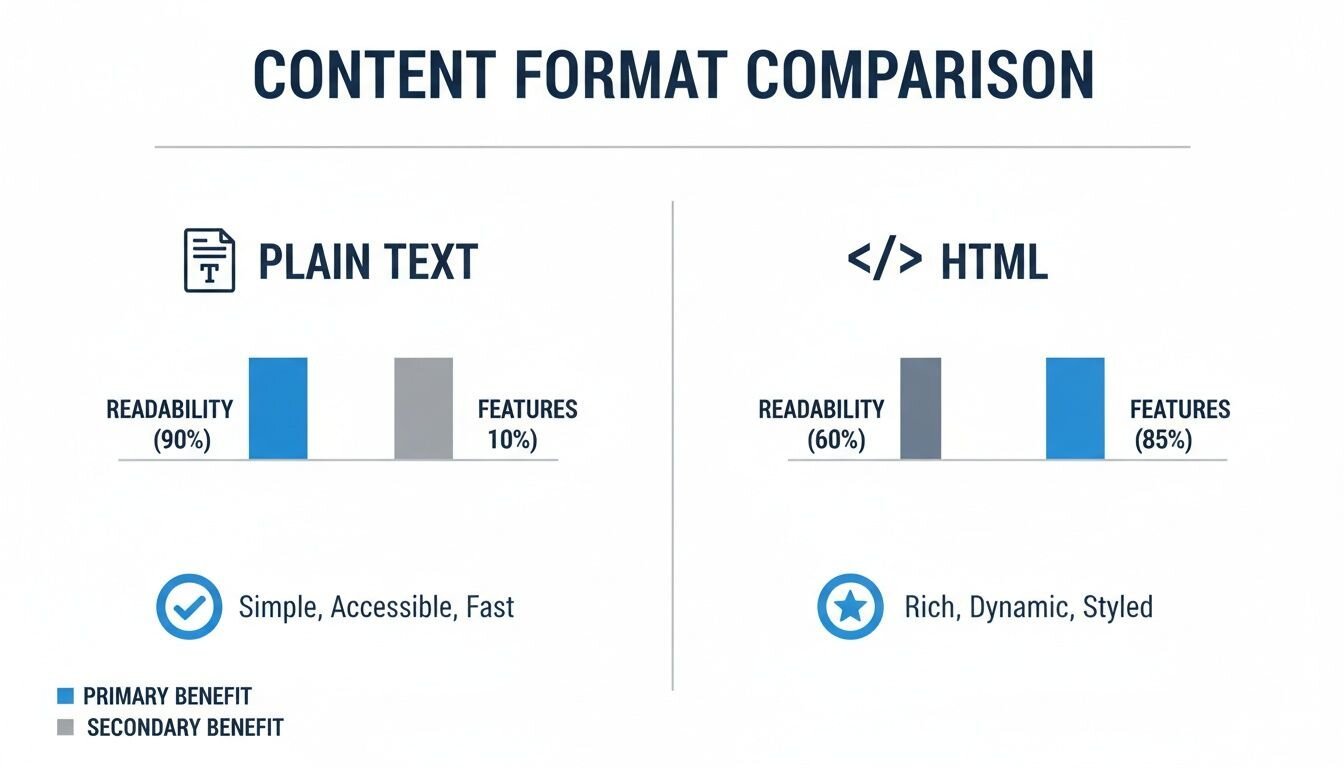
(Source: Breaker) - The optimal text-to-image ratio in HTML emails ranges from 40% to 60%.
- Readers spend 2.5 times longer reading HTML emails than their plain-text counterparts.
- If you include the company logo in your HTML email, its open rate is likely to increase by 10%.
- A transition from HTML-reliant newsletters to personally tailored plain texts results in a 22% growth in open rates.
- The most significant issues faced by HTML emails arose in the 2000s, due to limited compatibility between clients and service providers, and in the 2010s, due to the widespread use of smartphones for email.
- Interactive elements within HTML emails can increase click-to-open rates by 73%.
- Adding videos to HTML email content boosts clicks by 300%.
- Age strata differ in their email format preferences. Senior users favor text, whereas younger ones prefer HTML emails.
- Over 45% of HTML emails are found to be malicious, forcing high-security organizations in the finance or government sectors to automatically block them or remove their formatting.

Now, let's dive into more specific data regarding email marketing HTML vs. plain text comparison.
Email format usage statistics: What marketers actually send
First of all, it is necessary to understand which format marketers prefer:
- today, a pure format is hard to come by. Only 20% of experts in the field send HTML emails, and 16% prefer plain text. Thus, almost two-thirds opt for a hybrid approach with emails containing both text and various HTML elements (images, hyperlinks, specific font sizes, logos, tables, etc.);
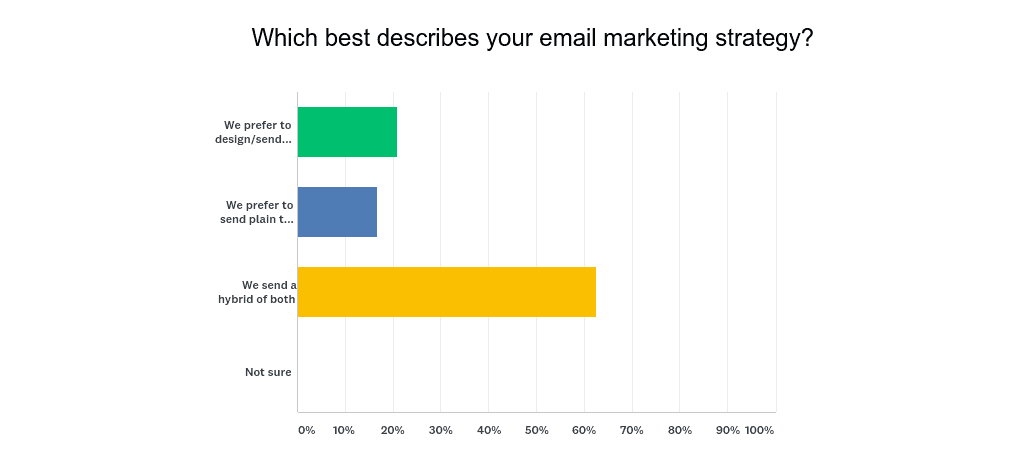
(Source: Databox) - the data shared by specialists is somewhat misleading, as many still use HTML emails widely, considering them essential for tracking KPIs, branding, visual appeal, interactivity, personalization, and promotions;
- since plain text works better for personal and direct communication, it is mostly used in the B2B, legal, and finance industries. HTML emails, which excel at visual product and brand promotion, are more often utilized by the retail, eCommerce, travel, automotive, and fashion sectors.

Open rate statistics: HTML vs. plain text email
What do the open rate numbers tell us?
- the average open rate drops by 37% when a GIF is added to plain text;
- images inserted into the message instead of plain text decrease open rates by one-fourth;
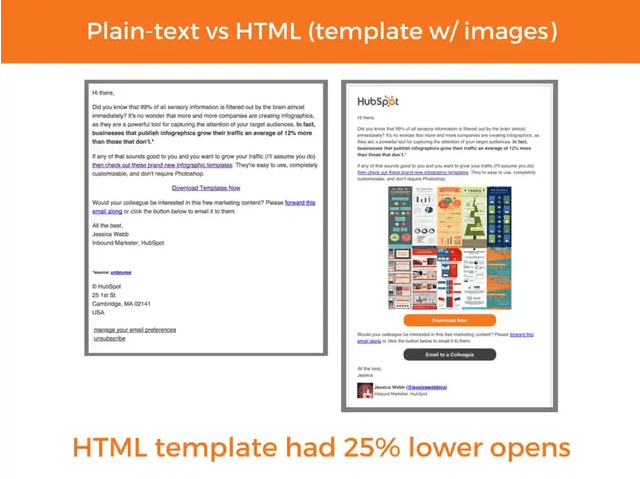
(Source: HubSpot) - an image-heavy HTML template reduces open rates by 23% in comparison with a template where images aren’t emphasized;
- while text email open rates differ slightly across major email service providers, on average, they are 42% higher than HTML open rates.

Click-through rate (CTR) statistics: Plain text vs. HTML
CTR is another important email metric that shows the percentage of recipients who followed the link in the email. How do HTML and plain-text emails perform in this respect?
- the more images an email contains, the lower its CTR;
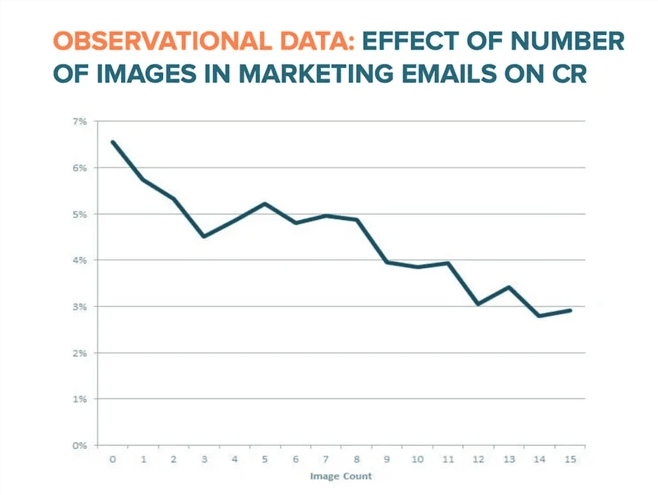
(Source: HubSpot) - plain text emails have a 2.3% higher CTR than messages containing a GIF;
- HTML templates earn 21% lower CTR than plain text;
- the combined click-through and open rates are 42% higher for plain text.

Conversion rate statistics: What format drives more action
If your email campaign is poised to win as many customers as possible, choosing the format is mission-critical. Studies have shown that plain-text emails generated 60% conversion among current customers and 49% among newcomers.
Evidently, you should leverage different types of emails when targeting different audiences. New prospects are better converted by HTML emails, whereas existing customers are ready to make a decision after receiving a text-only email.
A/B test statistics: Head-to-head format benchmarks
A/B testing is the best way to determine which email format leads to better results:
- HubSpot ran a series of tests, confirming that simpler emails with plain text outstrip HTML-saturated emails across all basic performance indices, from open rates and CTR to conversion metrics;
- the same pattern was observed by Litmus, whose plain-text webinar registration campaign achieved a 60% conversion rate;
- on average, plain-text emails in A/B tests earn 21% greater click-to-open rates than their HTML counterparts.
Deliverability statistics: Spam filters and inbox placement
Your emails are only effective if they can dodge spam filters and reach the addressee. Does the email format impact message deliverability?
- recent studies prove that plain-text emails, which look like personal messages to service providers, are less likely to be marked as spam than HTML-rich emails, which are viewed as marketing content by filtering mechanisms and will likely end up in the spam folder;
- 33% of Gmail users enable tabbed inboxes, and 60% use the promotions tab that stops HTML-heavy messages from reaching the recipient;
- high-quality HTML emails have a better chance of landing in the inbox than plain-text emails;
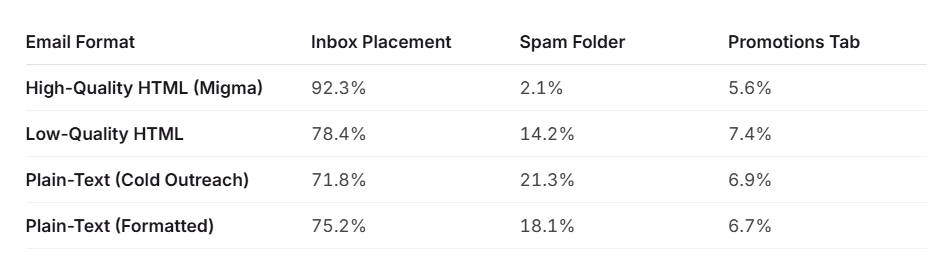
(Source: MigmaAI) - if you send an HTML-only email and fail to include a plain-text fallback for its content, known as MIME (Multipurpose Internet Mail Extensions), filters are sure to block it or direct it to the spam bin. So don’t forget about the MIME configuration that correctly tags an email as multipart.

Email accessibility statistics: The hidden cost of HTML
Accessibility is another vital parameter that may determine the choice of email format:
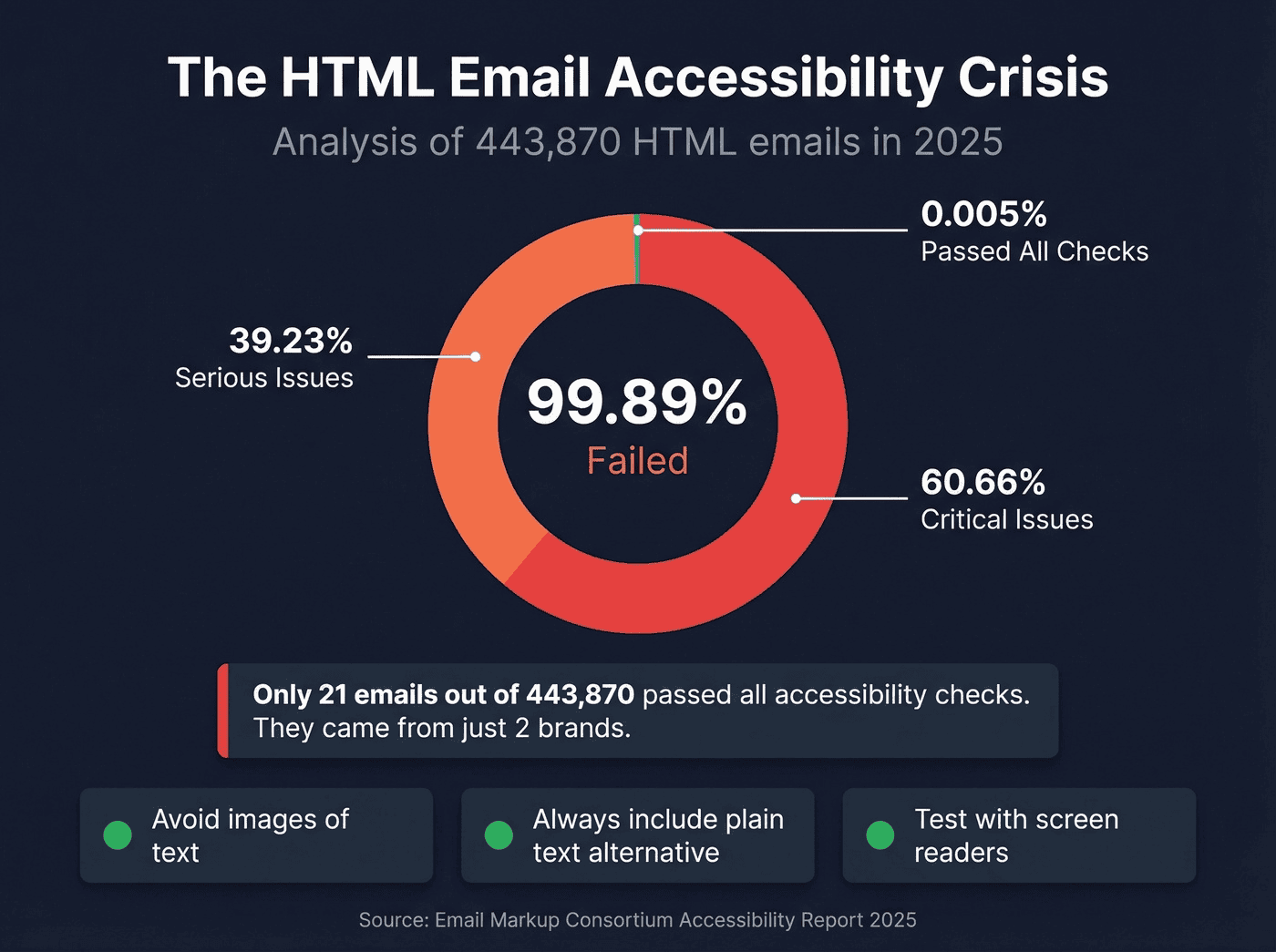
- a 2025 report claims that of 443,585 HTML emails, only 21 (0.11%) passed WCAG accessibility checks;
- over 60% of accessibility issues experienced by HTML emails are classified as critical, and almost 40% as serious;
(Source: Prospeo) - 71.6% of visually disadvantaged recipients who use screen readers rely on headings to discover information on a webpage, which is only possible if the latter has an HTML structure. However, experts assess their experience as “universally poor.”


Tracking statistics: Apple MPP and the open rate problem
The Mail Privacy Protection (MPP) mechanism introduced by Apple in 2021 has radically transformed the way emails are received and opened. What do the numbers say?
- Apple (with its MPP), Gmail, and Outlook account for almost three-fourths of the email client market share;
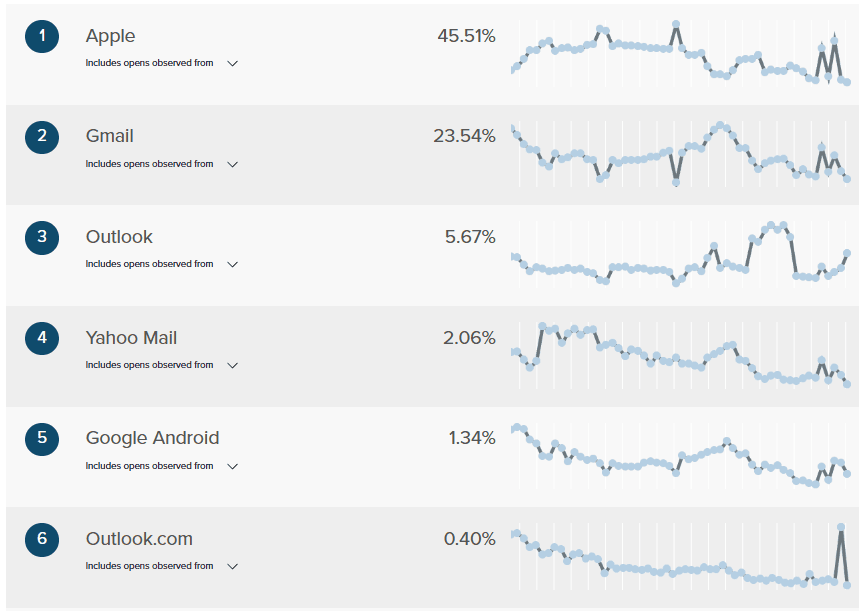
(Source: Litmus) - in the post-MPP email industry, machine-generated opens amount to 55-60%;
- the advent of MPP significantly impacted the reliability of the fundamental email efficiency index, the open rate, inflating it by 10-30%. The reason lies in the software’s tracking approach, which counts pixels and designates an email “open” whether or not it was actually read. Thus, open rates have become a directional parameter rather than a precise one, forcing companies to employ CTR as the primary benchmarking metric to gauge the success of their email marketing efforts.

Wrapping up
The plain-text vs. HTML email statistics presented in this article are compelling but far from complete. Why?
First, there are no vertical-specific data revealing basic figures across B2B, eCommerce, non-profit, finance, and other industries on HTML vs. plain-text email performance. Second, most statistics bearing on the issue come from SaaS companies and marketing tool providers.
Of course, these organizations have the largest datasets at their disposal and the required infrastructure to track the necessary metrics. However, they use the insights they generate to promote their products, so we should bear in mind the agenda behind the reports they publish.
Given the questionable or insufficient nature of the available statistics, you should form your own opinion as to the most effective email format by running an A/B test. Here’s a simple roadmap.
1. Define your goal
Understand what metrics you are going to verify for the future test. Typically, marketers focus on deliverability, open rate, CTR, or conversion rate.
2. Create test variants
Craft two versions of the same message: one containing standard text without italics, bold, or images and the other with GIFs, branding, pictures, and formatted buttons.
3. Choose a tool
Popular platforms with built-in testing features include Stripo, Litmus, and Mailchimp.
4. Run the test
Divide your audience into two random groups of equal size, send both versions of the email simultaneously, and wait a couple of days until enough people open the message.
5. Assess results
Several tools manifest the performance of plain-text vs. HTML emails (WebPageTest, BlazeMeter, Uptrends, etc.). These tools let you compare loading times, content delivery correctness, open rates, CTRs, and any other parameters you set out to explore against each other and industry benchmarks.
FAQ
1. Which email format has a higher open rate: plain text or HTML?
Plain-text emails have the edge, displaying a 42% higher open rate. Moreover, the open rate is 37% lower for HTML emails with a GIF and 25% lower for HTML emails with images. And if the number of images is considerable, the probability that the recipient will open it drops by 23%.
2. Does plain text email really get a 21% higher CTR than HTML?
Yes, they do. Besides, the higher the number of images inserted into an HTML email, the lower the CTR. And if we take the combined CTR and open rate, the average figure is 42% higher for plain-text emails.
3. What is the conversion rate difference between plain text and HTML?
It depends on the type of customer being converted. For current clients, the plain-text conversion rate is 60%, whereas for non-customers who receive their first promotional email, the figure is lower but still significant (49%).
4. How does Apple MPP affect plain text vs. HTML email statistics?
The system tracks pixels within the email as soon as the server downloads the image in the background, thereby marking the email as opened even if the recipient never actually opened it. As a result, the open rate for HTML emails is distorted and appears higher than it actually is.
5. What percentage of marketers send plain-text emails?
According to surveys, marketers seldom choose either pure text or pure HTML email formats, with usage figures at 16% and 20%, respectively. The vast majority (62%) of messages companies send to their customers are hybrid, combining text and HTML-driven elements (images, hyperlinks, GIFs, CTAs, countdown timers, etc.).
6. Are HTML email open rates statistics still reliable in 2026?
Since Apple launched its MPP system in 2021, the open rate for HTML emails has been inflated by 10-30%. You should either bear this reservation in mind or apply other benchmark metrics (for instance, CTR) to obtain a more objective picture.
0 comments