Case study: How BE Email Marketing helps Anvanda turn creative ideas into high-performing email campaigns with Stripo


When eCommerce brands frequently run promotions or showcase products in their email newsletters, they risk audience burnout, where recipients lose interest in opening or engaging with the emails. The issue may not be the frequency of sends but rather the monotony that arises when every promotion follows the exact same template.
This is why it was crucial for Anvanda, a direct-to-consumer (DTC) accessories brand known for its functional products and vibrant personality, to strike a balance between driving sales and maintaining audience interest. BE Email Marketing, the agency responsible for every stage of developing and launching the brand’s email campaigns, made this a core part of their strategy.
In this case study, Anvanda and BE Email Marketing share how Stripo helps them stay creative in every email and boost engagement while maintaining high productivity.
Expert

Expert

Anvanda + BE Email Marketing: A six-year email partnership
Anvanda is a DTC accessories brand that started with bags and built its business around functional design, quality materials, and a distinctive brand voice. Its goals include growing direct sales, increasing repeat purchases, launching products successfully, and building a community around the brand.
Email is one of Anvanda’s most important direct marketing channels. It supports sales, product launches, and promotions while giving the brand a direct way to stay connected with its audience without relying entirely on paid media or social algorithms.
BE Email Marketing has been working with Anvanda since 2020. The agency has more than nine years of experience in email marketing and has worked with more than 300 brands, primarily 7- and 8-figure eCommerce businesses in the US and worldwide, including two Fortune 500 companies.
For Anvanda, BE owns the email production process from A to Z. The agency handles strategy, copywriting, design, campaigns, flows, deliverability, and segmentation, while Anvanda sets the commercial priorities, product direction, offers, and brand voice.
Challenge: Efficiency shouldn’t kill creativity
The challenge for Anvanda and BE was to scale email production and make the process more efficient without turning every new campaign into a close copy of the last one. The answer was to build on what already works while leaving room for new ideas.
Stripo became a part of that process, giving the agency a way to reuse proven email structures and components while developing new creative concepts on top of them.
We do not want to send the same template with different products every week. The emails need personality. Being able to keep the proven building blocks of the design while giving our copywriters and designers room to create something completely different on top of them is where Stripo becomes particularly valuable.
It means efficiency does not have to come at the expense of creativity.
Ben Erdelyi,
From campaign idea to sending: How Stripo became a bridge between the copy and Klaviyo
This division of responsibilities gives both teams a clear role in the process. BE manages the email program and production, while Anvanda makes sure every campaign still feels unmistakably like the brand.
For BE Email Marketing, producing an email starts long before the design stage. The team first decides what the campaign needs to achieve, develops the creative idea, and only then moves into production.
Each stage has a clear role, and Stripo fits into the production process rather than replacing the strategy or sending platform:
- Strategy and idea collection. The process starts with campaign planning. BE looks at upcoming promotions, seasonality, previous campaign performance, customer behavior, and potential angles the brand has not explored yet.
- Copy and creative concept. Once the campaign direction is clear, the copywriter develops the concept, hook, copy, and CTA. For Anvanda, the creative direction matters as much as the commercial objective. The brand has a distinctive personality, so its emails need to feel stylish, playful, and sometimes humorous rather than like generic eCommerce promotions. Every campaign needs to feel unmistakably like Anvanda.
- Design and production in Stripo. Once the copy and concept are ready, the design team builds the email in Stripo. This is where Stripo becomes an important part of BE’s production workflow. The team can turn the approved concept and copy into a finished email, work with established design elements, and prepare the creative for client review.
Stripo is essentially the bridge between the copywriting and Klaviyo stages of our production process. Klaviyo remains our platform for segmentation, automation, sending, and analytics, while Stripo gives us a dedicated environment for actually creating the emails.

Ben Erdelyi,
Founder of BE Email Marketing. - Internal QA in Stripo. Before an email reaches Anvanda, BE runs its own quality check. This keeps the client’s involvement focused on the things where its input matters most: the brand, the offer, the creative direction, and the final customer experience.
- Client review in Stripo. After internal QA, BE shares the actual email with Anvanda for review. They can see the finished creative as an email, review the copy, hierarchy, imagery, CTAs, and overall experience, and provide feedback directly on the email.
- Final QA and Klaviyo. Once Anvanda approves the creative and the final revisions are made, the email moves to Klaviyo via Stripo’s direct integration, which exports the finished email templates.
Next, we focus on the Stripo features that make this email marketing workflow convenient and efficient for all participants in the process.
Collaboration without the back-and-forth
Email production rarely involves just one person. At BE, copywriters, designers, account managers, and the client can all have input at different stages.
Without a shared environment for reviewing the actual email, feedback can easily become scattered across messages, documents, screenshots, and different platforms. Even a small change can create an unnecessary cycle:
Message → screenshot → clarification → edit → resend
For BE and Anvanda, Stripo keeps the review process centered on the email itself.
- Reviewing the actual email and commenting for more precise feedback
Anvanda can review the finished creative directly in Stripo rather than just comment on a copy document or a screenshot.
Stripo’s commenting feature is very useful. Instead of writing “Change the second image below the black button,” we can comment directly where the issue exists. That eliminates confusion and makes revisions faster.
Daria Ropela,
Direct comments reduce the amount of explanation needed during revisions. The client can point to the exact element that needs attention, while the production team can see what the feedback refers to without searching through another document or message thread.
The result is a simpler revision loop: less explaining, less confusion, and faster fixes.

- Shared previews
Shared previews help Anvanda evaluate the email as a whole. The team can see how the copy, hierarchy, imagery, CTAs, and overall experience come together in the finished creative. This gives the client a more realistic basis for approval than reviewing copy or individual design elements separately.

- Real-time collaboration
When several people need to work on an email at the same time, real-time collaboration lets them contribute in the same production environment. It is not the main driver of the BE and Anvanda workflow, but it can be useful when a campaign requires input from multiple team members at once.
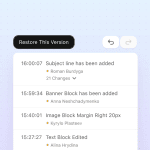
- Version history
Version history addresses a different part of the process; it helps to track changes. The team can see previous versions of an email, understand how the creative evolved, and return to an earlier version when needed. This provides a clearer record of revisions and makes it easier to recover from unwanted changes.

Together, these tools keep different parts of the collaboration process in one place: comments make feedback more precise, previews support complete creative review, real-time collaboration enables simultaneous work, and version history keeps changes traceable.
Build once, create again: How modular email design helps Anvanda stay consistent without getting boring
Efficiency creates another challenge for an established eCommerce brand: How do you reuse what works without making every email look the same?
For Anvanda, consistency matters. Customers should be able to recognize the brand across campaigns. However, that does not mean every promotion should follow an identical structure.
We want consistency without becoming boring. Having reusable structures and components makes it easier to maintain our brand standards, but we’re still able to create campaigns that feel different from one another.
Daria Ropela,
BE addresses this by separating the reusable foundation from the creative idea built on top of it.
Reusable building blocks
The design team works with established components, reusable structures, and recurring elements. Instead of rebuilding the technical foundation of every email from scratch, the team can start with elements that already work for the brand.
If we already have an email structure that works well, we can reuse that foundation and focus on developing a new hook, copy, imagery, and CTA rather than rebuilding everything from scratch. What could otherwise become a lengthy design task becomes a much simpler creative iteration.
Ben Erdelyi,
This is particularly useful for recurring promotional or seasonal campaigns. Previous emails can become a starting point for a new campaign without simply being copied and sent again.

(Source: Email by BE Email Marketing for Anvanda)
Creativity stays on top
Once the foundation is in place, the team can focus its creative effort where it matters most. This gives the team more room to develop the campaign idea rather than spending time rebuilding the same production elements.
For example, when a campaign format has already proven useful, BE can reuse its underlying structure while developing a new hook, copy, imagery, and CTA around a different promotion or message.

(Source: Email by BE Email Marketing for Anvanda)
Brand consistency without using the same template
This approach helps Anvanda maintain a recognizable visual identity without forcing every campaign into the same template.
The goal is not to make every email identical; it is to make the production system consistent enough that the creative team can spend more time making each campaign feel different.
There are elements that appear repeatedly across Anvanda emails, but we still want every campaign to have its own idea and personality. Being able to reuse the underlying building blocks while changing the creative gives us a good balance between efficiency and originality.
Ben Erdelyi,
That balance is what makes modular production valuable for the brand. Stripo provides a reusable foundation; the creative layer remains flexible enough for BE to keep developing new ideas.

(Source: Email by BE Email Marketing for Anvanda)
Modular design makes email production more efficient, but its value goes beyond saving time on individual campaigns. For BE and Anvanda, reusable structures also make it easier to build on ideas that have already worked.
When a campaign performs well, the team does not have to start from scratch the next time they want to explore a similar format.
This is particularly useful for recurring promotions and seasonal campaigns. Instead of rebuilding the technical foundation each time, BE can reuse elements from previous campaigns and focus on what needs to be different: the offer, message, creative concept, imagery, or CTA.

Results: Faster production, cleaner collaboration, and stronger engagement
The impact of the workflow extends beyond the time it takes to build an email. Both BE and Anvanda point to improvements across production, collaboration, and campaign execution.
A more efficient production process
With the workflow centered on the actual email, both teams spend less time managing the production process. The workflow reduces handoffs, misunderstandings, unnecessary rounds of revision, and administrative work while making feedback and approvals faster and clearer. Reusable structures and components also help the team move from campaign concept to approved creative more efficiently.
The result is a workflow where more of the team’s time can go into the campaign itself rather than coordinating the work around it.
Consistency without repetition
The same workflow also helps Anvanda maintain its brand standards across campaigns.
Reusable structures and established design elements give the team a consistent production foundation. At the same time, the agency can change the creative direction from one campaign to another, so the emails remain recognizable without becoming repetitive.
Stronger engagement through better execution
Both Anvanda and BE report stronger engagement and improvement in click performance over time.
However, neither team attributes that improvement to Stripo alone. Email performance depends on the broader campaign strategy, including the product, offer, targeting, creative concept, copy, and audience.
BE specifically points to stronger hooks, clearer CTAs, different creative concepts, and tighter alignment between copy and design as factors that can improve campaign performance.
We’ve seen stronger engagement, including improvement in click rate. The workflow isn’t the only reason; creative, targeting, products, offers, and strategy all matter, but better production makes it easier to execute those things properly and test what works.
Daria Ropela,
During 2026, they saw an increase in click rate. That matters, because clicks show that subscribers aren’t simply opening the message; the creative and offer are actually getting them to take the next step.

(Source: Data from Anvanda)
Stripo’s role is practical: it makes it easier for the team to efficiently execute and test these ideas. The team can spend less time rebuilding or coordinating revisions and more time refining the elements that influence email performance.
Wrapping up
For BE Email Marketing and Anvanda, efficient email production is not about making the creative process more rigid; it is about building a system that gives the team more room to focus on the creative work.
Strategy comes first. Copy and concepts define the campaign. Stripo connects creative work to production, provides both teams with a shared environment for review, and provides a reusable foundation for future campaigns. Klaviyo then takes over for sending, automation, and campaign management.
Within that system, Stripo serves several roles: a bridge between copy and Klaviyo, a shared creative environment, a collaboration layer, a reusable production foundation, and a way to iterate on successful ideas faster.
For a brand with a strong personality, such as Anvanda, that balance is particularly important. Production can become more systematic without making the emails more predictable.
0 comments