
Email marketing for coaches: How to build trust and grow your client base


You may be doing an excellent job as a coach, but maintaining a steady flow of clients is not always easy. We have an idea that can help change that, and it’s called email marketing.
Email marketing for coaches differs significantly from other industries because personal emotional connection and trust play a central role in relationships with both potential and current clients. Simultaneously, this actually makes your job easier. You always have something meaningful to share in your emails: your approach, ideas, and perspective as both a professional and a person, allowing you to create messages that feel deep and genuinely personal. Many coaches already rely on this powerful tool for relationship building.
In this guide, we share all the essential knowledge needed to run email marketing successfully as a coach, from content ideas and email design tips, to segmentation strategies and performance tracking. You’ll learn how email can make an impact by increasing engagement, nurturing leads, and growing your customer base.
Key takeaways
- Email marketing is a powerful tool for professionals coaching clients and running group coaching programs, enabling them to foster strong relationships, boost engagement, and share valuable information.
- The first steps in building an email marketing strategy include defining your goals and audience, choosing an email marketing platform, segmenting your email list, creating content, analyzing results, and continuously testing and optimizing email campaigns.
- Using email templates for email design saves time that can be redirected toward working with coaching clients and focusing on strategic priorities.
Email marketing for coaches: What it is and how it works in a coaching business
Email marketing for coaches is a communication strategy that enables coaches to connect with both potential and existing clients through targeted, personalized email campaigns.
With a successful email marketing strategy, coaches can:
- promote coaching programs;
- generate leads;
- build relationships, trust, and loyalty;
- drive conversions and sales.
All of this can be achieved by sending personalized, valuable content directly to the specific audience who have opted in to receive emails from you. As a result, they’re already motivated to achieve results and continue working with you.
Email lets you speak to someone again and again and slowly cultivate a relationship with them. They might not convert from your first email, but they might convert from your 10th email. Email basically gives you multiple opportunities to open a conversation with a potential customer. The best way that I found is using social media as an acquisition channel and directing all your traffic to an email list, so that way you will have multiple opportunities to open up a conversation with your potential customer. This helps you build a long-term relationship. Even after they've become a paying customer, you can still give them information that is relevant to them.


(Source: GetResponse)
Engagement statistics for coaches
So, what do average email marketing metrics look like in the coaching industry? Below, we share benchmark data from MailerLite's 2025 research to help you understand how your results compare:
- the median email open rate across all 3.6 million campaigns in their dataset was 43.46%. The open rate indicates the percentage of recipients who opened an email. In the coaching industry, this metric reached 48.07%;
- the click rate (CTR) indicates the percentage of recipients who clicked at least one link in an email. Across all 3.6 million email marketing campaigns, the average click rate was 2.09%. For coaching-related campaigns, the click rate was 1.42%;
- click-to-open rate (CTOR) measures the percentage of recipients who opened an email and clicked a link within it. The median CTOR across all email marketing campaigns was 6.81%, while for the coaching industry, it reached 4.9%;
- the unsubscribe rate indicates how many recipients opted out of your email list. The median unsubscribe rate across all campaigns was 0.22%. In the coaching industry, this metric was slightly higher in 2025, at 0.3%.
Regardless of the numbers you see in your reports, you must remember that a smaller, engaged email list is far more valuable than a large list of subscribers who never open your emails.
Email marketing builds long-term client relationships by creating a more intimate bond with the reader. When you regularly show up in your audience's inbox with tips, stories, insights, and resources, they naturally start viewing you as an authority and the obvious solution to their problems. They're more likely to know, like, and trust you, and ultimately buy from you.
While email is not perfect (deliverability can be a challenge), it has less platform risk than social media. And it has higher ROI potential than paid ads because ad costs are rising. Also, based on my and my clients' data, email tends to convert at a higher rate than social.

How to build an email marketing strategy for coaching programs
If you have never worked with email marketing, this section outlines a step-by-step guide to building a successful email marketing strategy for coaches.
1. Define your goals and target audience
Your goal always depends on your audience and the type of email you’re sending. In a welcome sequence, you introduce yourself to new subscribers and explain your coaching services and expertise. In onboarding emails, you outline your working process and the first steps coaching clients are expected to take.

Here’s an example of a pre-session email that you can send to your new clients.

(Source: GetResponse)
For existing clients, you can send session follow-ups, feedback surveys, or milestone and achievement emails.

(Source: Content Sparks)
You also may have an audience of email subscribers, such as when you send regular digests. These people have been reading your content for some time, but have not yet become paying clients. For this segment, educational emails, newsletters, promotional campaigns, or event invitations work particularly well and help convert prospects.

This is an example of a cold outreach email inviting prospects to coaching, which can be effective if you identify the pain point accurately and reach out at the right time.

(Source: Entrepreneurs HQ)
2. Choose the right email marketing software
The email marketing tool you choose should be easy to use and integrate smoothly with the tools you already rely on in your coaching business. You can learn more about email service providers in this article.
3. Build and segment your email list
To grow your email marketing efforts, you need an email list to whom emails will be sent. You can collect email addresses in several ways: by placing an opt-in form on your website (if you have one), promoting subscriptions through your social media channels, and using lead magnets, which we cover in more detail later.
Once you start building your email list, audience segmentation becomes essential. The better your segmentation, the more relevant your content will be, and the more likely subscribers will be to take the next step in their relationship with you. You can segment contacts into current clients and potential clients, as well as by interests, behavior, and other factors relevant to your coaching practice.
Let me put it this way: My best, longest-term coaching clients have all been on my email list — for anywhere from a few weeks to a few years — before applying to work with me. Email is much more intimate, and allows you to go deeper in sharing your thoughts and beliefs. That’s what the best coaching clients are looking to understand about you and your coaching process to help them determine if you’re the right fit for them.


(Source: GetResponse)
4. Create content that converts
Next comes content creation of individual emails and full email campaigns. Your copy should align with the email types discussed above, include clear and specific calls to action, and use subject lines that are hard to ignore in a crowded inbox.
Email marketing helps coaches connect intentionally and personally with their audience. Over time, consistent, value-packed emails help establish trust and keep the coach top of mind in a way that feels more personal and less performative than most social platforms. Email is where you can show more of your knowledge and personality without competing with so much noise.

5. Design emails using templates
Choose a ready-made template from Stripo’s library of 1,600+ email templates, suitable for any occasion, email type, or campaign goal. Customize it by adding your logo and footer information, then launch your email marketing campaign.
6. Analyze performance and test and optimize campaigns
After running several email campaigns and collecting initial data, begin analyzing key metrics, including open rates, click-through rates, conversion rates, and bounce rates. Device statistics highlight the importance of a mobile-first approach, while the unsubscribe rate helps identify poor targeting or segmentation gaps that need improvement.
Top email marketing strategies for coaches
Email marketing for coaches works best when it’s built on a clear, structured strategy, rather than on one-off campaigns. The most effective email marketing strategies focus on attracting the right audience, guiding new subscribers through their first interactions with your coaching business, and continuously improving performance based on real data. Below are three core strategies that help coaches turn traffic into subscribers, subscribers into coaching clients, and email campaigns into measurable results.
Lead magnets for coaches: How to turn website visitors into subscribers (opt-in forms, landing pages, and social media channels)
To run effective email marketing, you need a list of people who want to hear from you, and lead magnets are one of the best ways to build it. A lead magnet is a small, free product that delivers quick value and demonstrates your expertise in action to potential clients. In exchange, the recipient leaves their email address.
Common lead magnet examples include guides, checklists, mini-courses, free resources, or access to exclusive video content.
You can promote lead magnets on your website, a dedicated landing page, or other marketing channels. Start by defining your ideal client, identifying a problem you can help solve quickly, and choosing the right format through which to present that solution in a way that motivates people to opt in.

Welcome sequence: How to attract new subscribers to your coaching programs
Welcome email sequences typically have the highest engagement rates, so it’s vital to use them strategically. These emails are an excellent opportunity to introduce your coaching process, explain your services, and share client success stories.
Use welcome emails to ask questions and encourage subscribers to reply and share their challenges. This helps you understand whether and how you can help them, and what to offer for the best possible outcome. Welcome sequences are also an effective way to address common concerns and proactively handle objections.
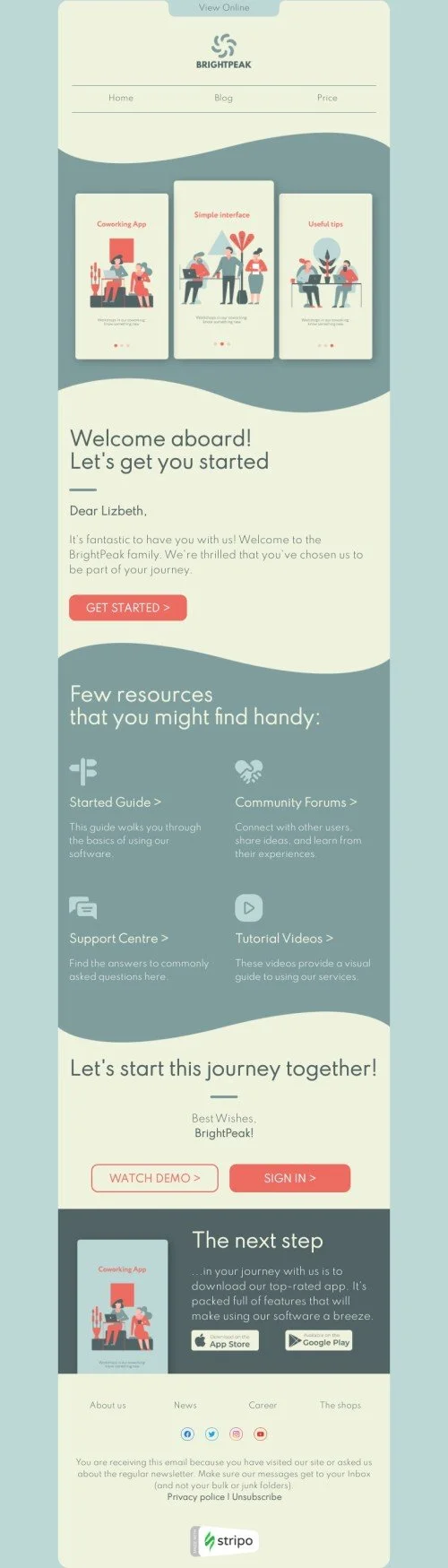
Welcome emails usually have the highest engagement rate with my clients, especially those that involve an incentive.
The reason for this is the way I built the strategy for these emails. I focus mainly on nurturing the subscribers in the first few emails, actually providing real value and things they can try and immediately see a difference, and I end the sequence with an offer that is really good and a service that genuinely solves their problem. The goal is to get them thinking, “if their free stuff is so good… how good is their paid stuff?”
Syed Umair,
Segmentation and performance tracking in email marketing for coaches
As mentioned earlier, audience segmentation helps you deliver targeted content to the target audience at the right time. Segment your email list based on audience characteristics, behaviors, preferences, needs, or any other criteria that make sense for your coaching business.
The next step is performance analysis. Review campaign results regularly, improve what works well, and remove elements that do not deliver results. This data-driven approach allows you to refine your email marketing strategy and achieve consistent, long-term growth.
The answers to what works for your business, with your list and your product catalog, exist in your historical data. So dig into your data. Respect your data. But always continue to test and experiment for net-new breakthroughs that might dwarf even your biggest win to date.
Dylan Bridger,
Common email marketing mistakes business coaches make
Below are some of the most common mistakes other coaches make, as confirmed by our experts.
1. Inconsistent email sequences
Irregular sending creates unclear expectations for email subscribers. Clients who complete signup forms to receive your emails expect consistent value through useful insights, testimonials, client success stories, and a clear explanation of how your process works.
One of the most common email marketing challenges for coaches is inconsistency. They either email too rarely or only reach out when they have something to sell. This can erode the reader’s trust, especially during promotional periods when emails are heavy. Coaches can overcome this by setting a realistic cadence, writing about real issues and challenges their clients are facing, and sharing a bit personally to help connect with readers.
Krystal Strickland,
2. An unstructured workflow and lack of analysis
Metrics are not tracked, and results are not analyzed. Many coaches assume email marketing doesn't work simply because they don't review performance at each stage of the process. Using a reliable email marketing platform can address this issue partially by providing precise analytics and reporting.
3. Ignoring deliverability and technical setup
Even the best copy is worthless if it never reaches the inbox. Proper infrastructure, including sender authentication and deliverability best practices, is the backbone of a successful strategy. Without this technical foundation, your emails are likely being filtered out before they are ever opened. Success requires a proactive approach to your sender reputation to ensure your message actually lands where it belongs.
The most common challenge is deliverability. Sending an email is the easy part, but making sure it doesn't land in the spam folder is the hard part. So I think most coaches face this problem when using email marketing; they don't have the right setup. They don't have the right backend that is ready to send emails. To overcome this, learn about best practices or hire an expert to do it for you.
Syed Umair,
4. Ignoring the potential of automated emails
Not using automation makes it harder to turn email subscribers who read your newsletters into paying clients who use your coaching services. Automated emails help guide subscribers through the journey and support consistent, scalable growth.
One of the biggest mistakes I see coaches make that negatively impacts their results (i.e., conversions) is not running deadline-based promotions. These can be flash sales, new product launches, discounts, or other special offers on existing products, but the point is that conversion really does require a legitimate reason for someone to act now versus later.
Another mistake coaches make with email marketing is assuming that the email is what's completely and solely driving the sale. The quality of the folks on your list and the offer you're presenting them with, and the fit between those two things, is far more important than the email copy or the email idea itself.
Dylan Bridger,
5. Emails that lack personality and storytelling
If your emails sound dry and mechanical, it will be difficult to build a genuine personal connection with potential clients. After all, customers choose you not only for your expertise but also for who you are as a person. If a coach doesn’t express their voice, values, and approach in their emails, clients won’t be able to feel whether you’re the one who can truly help them solve their problem.
Writing emails that are too boring — usually because they’re information-only or templated. You want your emails to feel like they’re coming from a friend — so your subscribers look forward to reading them.
Before I write an email, I think about the one point I want a reader to take away. Then I think about something that I’ve experienced or thought about lately that I can use to teach that takeaway. Then I share it — often by talking it out as if I were writing an email to one of my friends.
Luisa Zhou,
Best practices for designing email templates that drive engagement
Let’s look at what to include in your email templates and which design elements to use to make your email marketing more effective and help you achieve the results you seek in your coaching business.
- Share social proof and case studies
Verified results and real client personal stories are particularly effective when prospects are deciding on a high-ticket purchase or a long-term coaching program. Case studies often describe the initial problem, allowing readers to recognize themselves in the situation and realize that you already have helped others tackle similar challenges. That’s why social proof and case studies should be a regular part of your email campaigns.
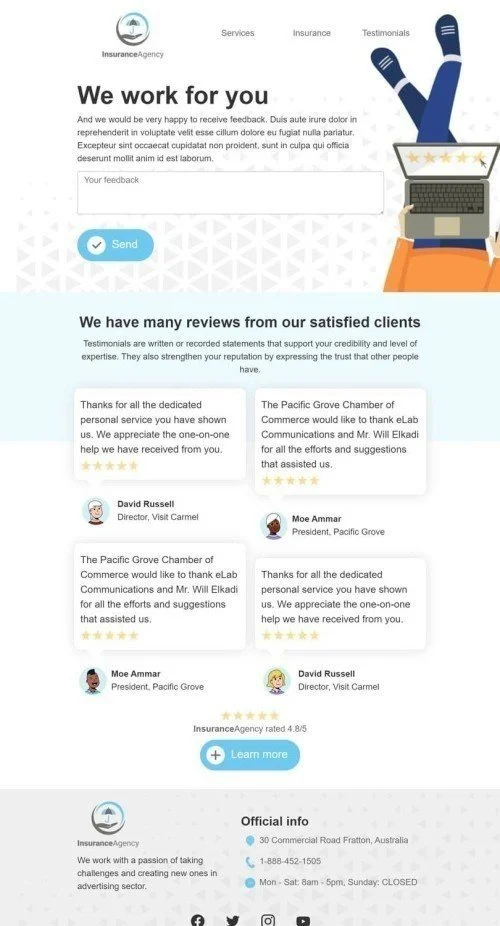
Client case study emails work great for coaches because coaching is inherently an abstract thing to buy, as opposed to an eCommerce product. By telling success stories and illuminating how the results happened, it helps show the reader how they, too, could succeed with your coaching.
Dylan Bridger,
- Apply consistent branding
If you or your company has a logo, brand colors, and specific fonts, use them consistently across your email templates. This turns every email into another brand touchpoint and helps maintain strong brand consistency.
- Lay out your behind-the-scenes preparation process
Explain how you prepare for sessions and what your preparation includes. This helps dispel the common notion that coaching is limited to meetings alone and highlights your work’s depth.
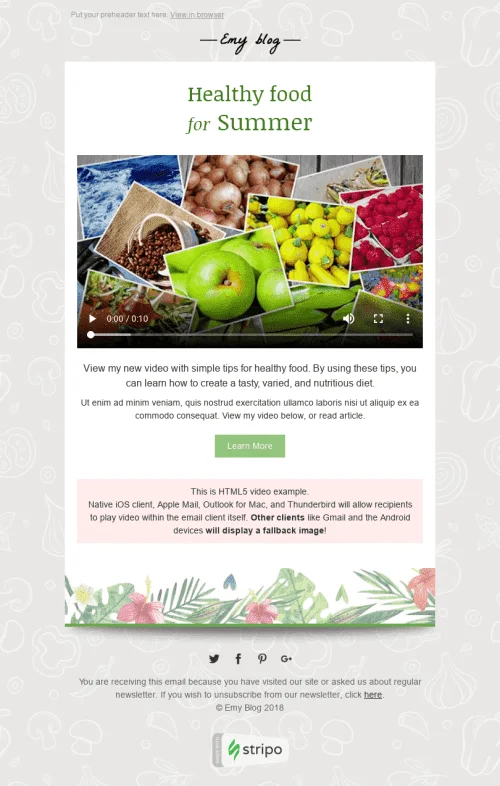
If you have videos of your workday or that explain your methods and approaches, you also can include them in your emails. This is an example of the template for health services.
- Use countdown timers
When promoting upcoming events such as course launches, webinars, or limited-time offers, countdown timers help create urgency and increase engagement.

- Ask questions and send surveys
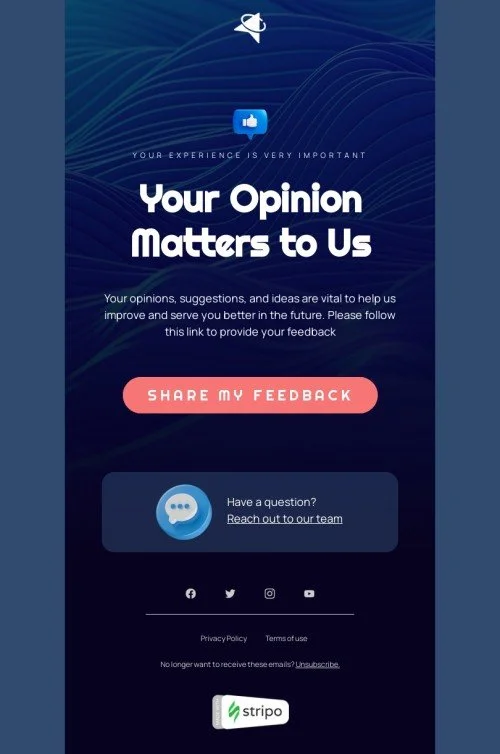
Email templates that invite subscribers to share their opinions or feedback are a great way to collect quick insights and better understand your ideal client.
In my experience, welcome emails and educational emails tend to deliver the highest engagement for coaches. Welcome sequences work well because they set expectations and build trust early, while educational emails help demonstrate expertise without being overly promotional. Coaches often see stronger results when emails focus on helping the reader think differently or solve a small, specific problem, rather than pushing offers too quickly.
Krystal Strickland,
How to optimize email templates for mobile devices
Studies have found that about 64% of people open emails primarily on mobile devices, and more than 50% delete messages that are not mobile-friendly.
That’s why optimizing emails for mobile devices is essential. Always test your campaigns across platforms and screen sizes. In Stripo, you can preview how your email will look on mobile devices directly in the editor.
Mobile optimization includes using a single-column layout that’s easy to read on smartphones, avoiding heavy image usage that slows down loading times, choosing font sizes that remain legible on small screens, and designing buttons large enough to be tapped easily on mobile devices.

Email signatures for coaches: examples and best practices
An email signature is important in any professional communication, but it’s particularly critical if you run your own business and communicate regularly with clients. Depending on whether your signature is more formal and professional or warm and friendly, it can influence how relationships with your audience develop.
Career and business coaches typically use a more professional signature that includes contact details and minimal additional information. Life coaches, health coaches, and coaches in relationship niches may add a personal or distinctive element without it feeling out of place. In any case, whatever you choose to include in your signature, you can create it easily using the Stripo email signature generator.

What are email templates, and why are they essential for email marketing for coaches?
Generally, email templates can be divided into two types. The first type includes ready-made templates available in Stripo that you can use right away. The second type is a custom email framework that you create yourself and reuse multiple times. Examples of ready-made templates are provided throughout this article, but below we focus on the second type.
You can create a separate template for each email type you use and then simply update it with fresh content, i.e., there’s no need to design every email from scratch. Minor adjustments to an existing template are often enough. Core elements such as your logo, header, and footer remain consistent, while you update only the content for a specific email.
Email templates are a great way to create structure and consistency without reinventing the wheel every time. I encourage coaches to use templates for layout and flow, but to keep the writing conversational and aligned with how they naturally speak. Not every email needs to come from scratch, but make sure it’s authentic and human.
Krystal Strickland,
Email templates are significant for coaches because they:
- save a significant amount of time and can cut email production time by more than 3.7 times;
- help keep emails consistent, branded, and easily recognizable;
- drive business growth through automated email sequences;
- provide a direct line to subscribers’ inboxes, unlike social networks, where visibility depends on algorithms;
- enable customization by providing structure; templates allow you to adapt content while preserving the personal, one-on-one feel that’s essential in coaching relationships;
- make it easier to create high-quality emails quickly, freeing up more time for strategy, client work, and other core marketing activities.
How to personalize email templates to connect with your coaching audience
Personalizing email templates for a coaching audience requires balancing efficiency with genuine human connections. The goal is to move away from generic, one-size-fits-all messaging and toward communication that reflects each client’s unique journey, challenges, and goals.
Personalization goes far beyond using a subscriber’s first name in a subject line. It also includes tailoring content to individual needs or progress, celebrating minor (or major) wins, and highlighting key milestones in the coaching journey.
Here are additional ways to personalize your email templates:
- use merge tags strategically. Go beyond first names by using CRM data points, such as the last topic discussed in a session, a client’s niche, or a specific business goal;
- segment by pain points. Create different templates for different challenges, such as confidence, time management, or strategy, and provide valuable content related to specific problems, instead of speaking in general terms;
- define clear next steps. Customize onboarding templates with actionable steps tailored to each coaching service, whether it’s booking a session or completing an intake form.
Language also can be an essential personalization factor. If you work with international clients, sending emails in their native language is easy to implement with Stripo and can improve engagement and trust significantly.

Email templates give you a starting point that's less daunting than staring at a blank page. The power of templates is in the structure, not the exact phrasing or word choices. When you think about an email, it's really just a series of paragraphs designed to achieve a business objective (like driving sales or leads). As you send more emails, you'll start discovering structural patterns among your top performers that should inform how you structure future emails.
For example, you might discover that all your best-selling emails lead with a provocative question. In that case, it might make sense to double down on leading with provocative questions.
These nuances will be unique to your business and audience, but they help to capture the structure of these high-performing elements. Then you can be as authentic as you want within those loose guardrails.
Dylan Bridger,
Each template also can be divided into modules, allowing you to save individual sections and reuse them across different email campaigns. Some modules work for all email types, such as, the header, footer, or email signature. As a result, creating a new email or new template using modules becomes fast and straightforward.
Wrapping up
Email marketing helps coaches build loyal audiences and convert them into customers. A clear strategy supported by segmentation, email automation, and performance analysis turns email campaigns into consistent business results. Email templates simplify and speed up the process, allowing coaches to focus more on long-term growth.


0 comments