Retargeting email campaigns statistics: Benchmarks, ROI & what they mean in 2026


Online shoppers browse your store, add products to their carts, and leave right before they complete the checkout process. This routine behavior costs your business potential income every day. To plug this leak in your sales funnel, you should build automated retargeting campaigns. These campaigns trigger when subscribers leave your website and send them a tailored reminder to complete their purchase.
To build an effective strategy, you need to know the industry standards for open rates, clicks, and conversions. Concrete metrics help you benchmark your own performance, justify your marketing budget, and forecast future sales.
Top 10 retargeting email campaigns statistics every business should know
To help you benchmark your performance and maximize your return on investment, we compiled the most relevant data on open rates, conversions, and subscriber behavior:
- Based on a 2.66% average e-commerce conversion rate, approximately 97.3% of e-commerce website visitors don't complete a purchase.
- Retargeted website visitors are 70% more likely to complete a conversion on a retailer's site than visitors who are not retargeted.
- Although automated retargeting emails account for only 2% of total email volume, they generate 37% of all email-driven sales.
- Three retargeting flows generate 87% of all automated orders.
- Among all automated email campaigns, back-in-stock messages achieve the highest conversion rate, reaching 6.46%.
- Retargeting campaigns that use multiple emails generate 69% more orders than single-email sends.
- Browse abandonment emails achieve a 5.48% click-through rate, outperforming most other automated email campaigns.
- Including product recommendations in triggered emails increases the median click-through rate by 30%.
- Triggered emails featuring product recommendations convert 37% better than those without personalized product suggestions.
- Online shoppers abandon 70.22% of their carts.

(Source: Statista)
What is email retargeting, and how it differs from ad retargeting
Email retargeting sends automated messages to subscribers based on their specific actions on your website. When a recipient drops out of the checkout process, views a new product, or stops interacting with your store, your system detects the behavior.
Instead of sending a generic newsletter to your entire list, you deliver a targeted message to a specific subscriber at the exact moment they show interest. This strategy requires specific tools and differs from traditional online advertising.
Email retargeting vs. display-ad retargeting
Many marketers confuse inbox retargeting with standard web advertising. Although both methods aim to bring visitors back to your website, they use completely different technologies and budgets.
Display-ad retargeting displays visual banners to past website visitors as they browse other sites or social networks. This method relies on third-party tracking networks and browser cookies, which fail when a web browser blocks them. You pay for impressions or clicks, and your message competes with other ads displayed on the screen.
Email retargeting operates exclusively inside the inbox. You communicate with an audience that has explicitly joined your list and permitted you to contact them. You use your first-party data instead of paying an external ad network. This ownership reduces your cost per acquisition and helps you build a direct relationship with the recipient.
How email retargeting works
To send these messages and use email retargeting to re-engage customers, you need to connect your e-commerce store directly to your email service provider. This integration allows the two platforms to share data in real time.
The email software constantly monitors your website traffic and matches visitor sessions to specific email addresses in your database. Once the systems connect, the automated workflow follows a precise sequence.
To understand how a campaign reaches the inbox, review this standard sequence of events:
- You add a tracking script to your store pages to monitor visitor behavior.
- The script identifies subscribers when they log in to their accounts or click a link in a previous email.
- When a subscriber views an item or leaves a cart, the system starts a countdown timer.
- If the timer expires before the subscriber completes the purchase, the system triggers the campaign.
- The email software pulls product images and prices directly from your store catalog into the template. (Note: builders such as Stripo let you configure smart elements to automatically pull and arrange the product image, price, and description the moment you insert the item URL.
- The subscriber receives a personalized message showing the exact items they left behind.
Common terms defined
To evaluate the statistics in this guide and build your own campaigns, you should master these four standard industry terms:
- cart abandonment: A subscriber adds items to their digital shopping cart but exits your store before completing the checkout form;
- browse abandonment: A subscriber views a specific category or product page but leaves without clicking the Add to Cart button;
- win-back campaign: A sequence of automated messages sent to recipients who stopped purchasing from you or stopped opening your emails for a set period;
- trigger: The specific action, such as a page view or an abandoned cart session, that tells your software to send an automated message.
Email retargeting performance benchmarks
Retargeting email templates are triggered by a recent action: an abandoned cart, a product view, or a signup. That timing gives them a built-in advantage over scheduled campaigns, and the numbers below show the size of that advantage.
One caveat before you compare anything to your dashboard: Apple Mail Privacy Protection loads emails in the background and records each one as open. Your reported open rates run higher than reality, so treat opens as a directional signal and judge success by clicks and orders.
Open rate benchmarks
In 2025, campaign open rates grew for the fifth year in a row and reached 30.7%, while automated emails averaged 38%. Retargeting flows sit above both because recipients expect these messages. Some shoppers abandon a cart on purpose and wait for a reminder.
Compare your flows against these numbers:
- automated emails opened 24% more often than scheduled campaigns in 2025;
- abandoned cart emails opened at around 42%;
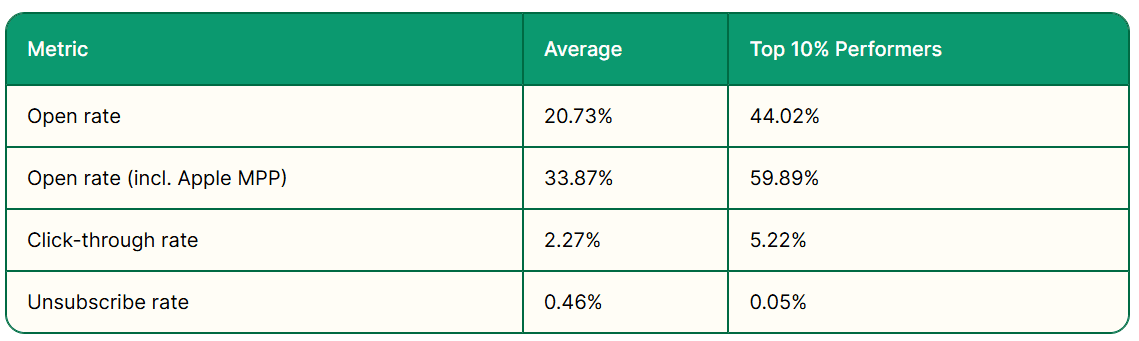
- automation emails averaged 30.63% opens against 20.73% for regular campaigns across 175,000+ senders in 2025;
(Source: Brevo) - a completed purchase worked as the strongest automation trigger: Emails sent after it reached 76.58% opens.

Click-through rate benchmarks
Clicks survive the MPP distortion, which makes them one of the most reliable engagement metrics in 2026. This is also where retargeting separates itself from the newsletter crowd.
Use these click benchmarks as reference points:
- automated emails generated six times the click engagement as campaigns in 2025;
- browse abandonment emails averaged a 5.48% click-through rate, an impressive result for recipients who never added anything to a cart;
- automation emails averaged a 7.39% CTR compared with 2.27% for standard campaigns.
Conversion rate benchmarks
Platforms count conversion in two ways: placed-order rate (buyers among all recipients) and click-to-conversion (buyers among those who click). Check which one your dashboard shows before you compare anything.
Set your 2026 targets against these figures:
- automated emails converted at 1.49% in 2025, while campaign emails converted at 0.08%: a 19-fold difference;
- back-in-stock emails showed the highest placed-order rate of any automation in 2025, at 6.46%;
- the top 10% of welcome flows converted 10.53% of recipients into buyers.
Cart abandonment recovery statistics
When subscribers leave products in their carts, you have a brief window to bring them back before they buy them from a competitor. Your success depends on your industry, your timing, and the performance of your email sequence.
Cart abandonment rate by industry
Different products require different consideration times, which directly changes how often people abandon their carts. High-ticket items experience the highest drop-off rates, while daily essentials see fewer abandoned sessions.
Review how your store compares to these industry averages:
- beauty and personal care shows the highest abandonment of all tracked categories, at 83.01% over the past 12 months;
- pet care and veterinary services sit at the bottom, at 51.29%; pet owners who add food or medication to a cart need it this week;
- fashion, luxury and jewelry, and home and furniture all cluster near 80%, where price, fit uncertainty, and comparison shopping stretch the decision.

(Source: Dynamic Yield eCommerce Benchmarks)
Recovery rate by send timing
Timing is often one of the strongest factors influencing recovery rates. Purchase intent decays quickly, and the data keeps pointing to the same window.
Build your sequence around these timing benchmarks:
- the first reminder performs best within one to three hours after abandonment, while intent stays high;
- client data from a dedicated remarketing vendor point to roughly one hour as the sweet spot, with a caveat: high-value products need a longer consideration window;
- a sequence of three emails produces 69% more orders than a single send;
- season matters too: abandonment peaks in August at 78.77% and drops to its yearly low of 71.36% in December, when shoppers arrive with real intent.
Abandoned-cart email benchmarks
These specific campaigns consistently outperform regular promotional newsletters. Because the recipients already showed direct interest in a product, they open and click these messages at a much higher rate.
Use these benchmarks to evaluate your own campaign performance:
- an abandoned cart email generates $3.59 in revenue per send, and 22.5% of stores already run this automation;
- abandoned cart and welcome emails together produce 76% of all automation-driven orders;
- average revenue per recipient lands at $3.65, while the top 10% of brands pull $28.89, an eightfold difference that comes from timing, cart-value segmentation, and deliverability;
- only 21% of retailers send a second email, and 16% send a third; most brands quit after one send.
ROI & ROAS of retargeting email campaigns
A high return on investment proves the value of email retargeting. When you send messages to subscribers who already know your brand, you spend less money closing each sale. You avoid much of the customer acquisition effort required for cold audiences.
ROAS by vertical: eCommerce, retail, SaaS
Different business models generate different returns on their retargeting efforts. Software companies manage longer sales cycles, while consumer stores capture faster impulse purchases.
Review these average ROAS benchmarks across three major industries:
- retail and e-commerce email ROI averages $45 per dollar spent, the strongest result of any sector;
- B2B SaaS runs a paid ROAS of 3:1 to 5:1 against first-deal revenue; measured against lifetime value, that same 3:1 can become 12:1, as subscription revenue builds over months.

(Source: Foundry’s ROAS Benchmarks by Industry 2026)
Cost efficiency vs. cold campaigns
Cold campaigns force you to spend money finding a few interested buyers among thousands of strangers. Retargeting removes this waste. You communicate with people who have already interacted with your brand.
Compare the exact costs and conversion metrics of warm retargeting and cold acquisition:
- the average cold email earns a 3.43% reply rate: a reply that your sales team still needs to qualify, nurture, and close;
- list quality also affects cold campaigns: campaigns with fewer than 50 recipients average a 5.8% reply rate, nearly triple the 2.1% of large blasts, and verified lists receive roughly twice the reply rate of unverified ones.
Personalization & segmentation statistics
A general email broadcast often fails to engage modern buyers. Customers expect relevance. When you tailor your messages to specific subscriber actions and preferences, you increase your engagement and revenue.
Personalization revenue impact
When customers receive tailored messages based on their activities and interests, they see more value and may buy more often. Instead of sending the same offer to everyone, you should customize content for each recipient.
Review these numbers to find out whether personalized content can increase your sales:
- hyper-personalization, which predicts churn and optimizes content, increases revenue per email by an average of 41%;
- 75% of businesses report increased customer spend from their personalization efforts;
- 88% of consumers say they are more likely to buy when engagement is personalized in real time;
- 71% of consumers abandon purchases when the experience doesn't feel relevant;
- 65% of customers see targeted promotions as a top reason to buy;
- 84% of businesses rate their own personalization efforts as good or excellent, while only 54% of consumers agree.
Behavioral segmentation results
Behavioral segmentation categorizes subscribers based on their specific actions, such as product views, purchase history, and cart abandonment. This approach allows you to send targeted messages at the exact moment a recipient shows interest.
Analyze how behavioral data improve campaign performance:
- behavior-triggered flows generate 41% of email revenue;
- across all flows, the top 10% of brands convert at 4.93% compared with a 1.42% median placed-order rate, and the top 10% of welcome flows convert five times as many recipients as the average;
- a peer-reviewed case study of three e-commerce businesses found that behaviorally segmented campaigns generated $0.86 per email compared with $0.35 for nonsegmented campaigns, with conversion rates of 7.8% versus 3.4%;
- the same study measured the effect on list health: behavioral segmentation cut unsubscribe rates from 0.7% to 0.3%, as relevant messages keep subscribers on the list instead of pushing them toward the exit.
Follow-up cadence & sequence statistics
Sending a single message leaves money on the table. A properly structured sequence builds momentum and gives the subscriber multiple opportunities to return to their cart.
Optimal number of touches
You need to balance persistence with respect for the recipient's inbox. If you send too few messages, you miss sales. If you send too many, you annoy your subscribers and cause spam complaints.
Follow the 2026 industry consensus to determine your exact sequence length:
- 4-6 total sequence steps produce the strongest response rates;
- on average, prospects require 7.4 touches to book a meeting.
Timing & spacing benchmarks
The delay between your emails dictates your success rate. You want to catch the recipient while the product remains fresh in their mind, but you should wait long enough to avoid appearing aggressive.
Try to configure your automation platform using these exact timing intervals:
- for VP and C-suite prospects, use approximately two- to three-day intervals;
- for managers and individual recipients, use 24- to 48-hour intervals;
- run the complete sequence across approximately 20-21 days;
- allow at least one week before judging a sequence, as 62% of responses arrive within that time.
Retargeting email use cases (with benchmark data)
Different subscriber actions require specific retargeting workflows. You trigger different messages based on where the customer leaves your sales funnel.
Browse abandonment recovery
A subscriber views a product page but leaves your store before clicking the Add to Cart button. To capture this interest, you send a browse abandonment email displaying the exact items they viewed. Browse abandonment emails achieve a 42.16% average open rate. These campaigns drive a 10.68% click-to-conversion rate, which demonstrates that shoppers often retain strong purchase intent even before adding items to their carts.

Back-in-stock alerts
When a popular item sells out, you lose immediate sales. You should let customers sign up for alerts directly on the empty product page. When your inventory updates, your system automatically sends a message to those waiting subscribers.
Back-in-stock alerts generate a 6.46% average conversion rate, which makes them one of the highest-converting automations available.

(Source: Email from Your Coca-Cola)
Win-back campaigns
Customers eventually stop buying. Instead of letting them disappear, track the time elapsed since their last purchase. After 60 or 90 days of inactivity, send a win-back sequence to re-engage them. They convert at 2.73%, which brings past buyers back into your active customer base.

Privacy, first-party data & the future of email retargeting
Changes in web privacy laws and browser technologies force marketers to adapt. Traditional tracking methods are failing, which makes inbox-based retargeting more valuable than ever. Email operates on data you own, giving you a distinct advantage over competitors who rely on external advertising networks.
Impact of cookie deprecation
Major web browsers now block third-party cookies by default to comply with strict global privacy regulations such as GDPR and CCPA. This restriction breaks the tracking systems that power standard display-ad retargeting. When external networks cannot track users across different websites, ad performance drops and customer acquisition costs rise.
As regulatory scrutiny intensifies, 14% of email marketers identify data-privacy compliance as a major operational challenge. This pressure forces brands to move away from third-party networks and focus on the channels they directly control.
Shift to first-party data & identity graphs
To survive these privacy changes, businesses must build their own audience databases.
First-party data include any information you collect directly from your customers, such as their purchase history, website behavior, and email engagement:
- 46% of agency marketers report that improving first-party data strategies yields the greatest impact on personalization and campaign performance;
- 43% of B2C marketers say improved targeting accuracy is the top benefit of using owned data over third-party networks.
Deliverability & list hygiene for retargeting sends
Retargeting lists skew cold by design. You email people who browsed, clicked, or abandoned a cart and then went quiet. Deliverability gets harder on that kind of audience, and hygiene becomes the factor that decides whether the send reaches anyone.
Most senders skip the cleanup: 40% of them rarely or never clean their lists. On a cold retargeting segment, that neglect turns into bounces and complaints fast, and both feed straight into your sender reputation.
Gmail sets a hard ceiling you should respect. For bulk senders, Google's guidance requires keeping spam complaint rates below 0.3%. Cross it consistently, and Gmail starts routing your mail to spam, including the campaigns that are already working.
So, clean the segment before you re-engage it. Run it through a verification service, drop the hard bounces, and remove subscribers who stayed silent through a re-engagement attempt. You protect the reputation on which your active campaigns depend.

Best practices to act on these statistics
Data provide the foundation, but your execution determines your actual recovery rate. Use these proven benchmarks to update your automation workflows, adjust your timing schedules, and protect your sender reputation.
To translate these industry benchmarks into daily sales, implement the following four operational changes:
- Expand your single reminders into multistep sequences. Since multi-email flows generate more orders than a single message, you lose revenue if you stop after one attempt. Schedule a sequence that delivers the first reminder shortly after abandonment, follows up the next day, and sends a final urgency-based appeal before the cart expires.
- Embed personalized product recommendations. Triggered messages featuring personalized items convert better than generic layouts. Connect your store catalog to your email template so the system automatically displays the exact items the recipient viewed alongside related products from the same category.
- Launch dedicated browse abandonment and back-in-stock flows. Cart recovery handles only part of your lost traffic, while browse abandonment emails deliver strong click-through engagement. Install tracking scripts on your category pages to capture early purchase intent, and place stock-alert signup forms directly on sold-out item pages to capture immediate interest. To accelerate your setup, choose a ready-to-use option from our library of retargeting email templates.
- Enforce strict list hygiene before re-engagement campaigns. Because inbox providers block bulk senders who accumulate high spam complaint rates, protect your domain. Run your inactive segments through a verification service regularly, filter out invalid addresses, and remove recipients who ignore your win-back sequences.
Wrapping up
Automated retargeting sequences turn lost website traffic into direct sales. By applying these timing and personalization benchmarks, you recover lost revenue. You control the message, you own the data, and you reach subscribers at the exact moment they want to buy.
Take these principles, and build your own recovery sequence today. You can create your next automated campaign directly in the Stripo editor. Use the drag-n-drop tools to add personalized product blocks, adjust your layout for mobile devices, and export the finished template to your sending platform.
FAQ
1. What is a good open rate for retargeting emails?
Retargeting campaigns achieve significantly higher open rates than standard scheduled newsletters. Abandoned cart and browse abandonment emails average around 42% opens. Overall, automated emails average between 30.63% and 38.00% opens, and post-purchase triggers can reach as high as 76.58%.
2. How soon should you send a retargeting email after a visit or abandonment?
You should trigger the first reminder within one to three hours after abandonment while purchase intent remains high. Data indicate that one hour is the sweet spot for most items, though high-value products require a longer consideration window.
3. Is email retargeting the same as remarketing?
The terms are often used interchangeably. In many marketing contexts, email remarketing refers to automated email campaigns that re-engage existing subscribers, while retargeting more commonly refers to paid advertising shown to previous website visitors. The term “email retargeting” bridges these concepts. It tracks subscriber behavior on your website and sends personalized messages straight to the inbox based on those specific actions.
4. Does email retargeting still work without third-party cookies?
Yes. Email retargeting relies on first-party data and explicit subscriber permission. Because you communicate directly through the inbox using your own database, the strategy remains entirely functional when browsers block third-party cookies.
5. How many follow-up emails should a retargeting sequence have?
You should build a sequence containing four to six total steps to produce the highest response rates. Sending a sequence of three emails generates 69% more orders than stopping at a single message.
6. What conversion rate can you realistically expect from retargeting emails?
Automated emails average a 1.49% overall conversion rate. Specific retargeting triggers yield higher returns: Back-in-stock messages reach 6.46%, browse abandonment flows drive a 10.68% click-to-conversion rate, and win-back sequences convert at 2.73%.
0 comments