Email conversion rate statistics: Benchmarks by industry, email type, and what actually drives results in 2026


Ever since the sales funnel was conceptualized in the late 19th century, conversion has become the Holy Grail for marketers worldwide. Email, which arrived a century later, has brought a tectonic shift to brand–customer interaction. However, the conversion rate remains a major benchmark for assessing the efficiency of a company’s marketing strategy.
This article contains the crucial email marketing conversion rate statistics 2026, which have been compiled to help companies understand how good their performance in this field is.
Top 10 email conversion rate statistics every business should know
Let’s begin with the most general numbers related to this vital email index:
- In 2026, 392 billion emails are sent worldwide every day.
- The USA reigns supreme regarding the number of emails people send.
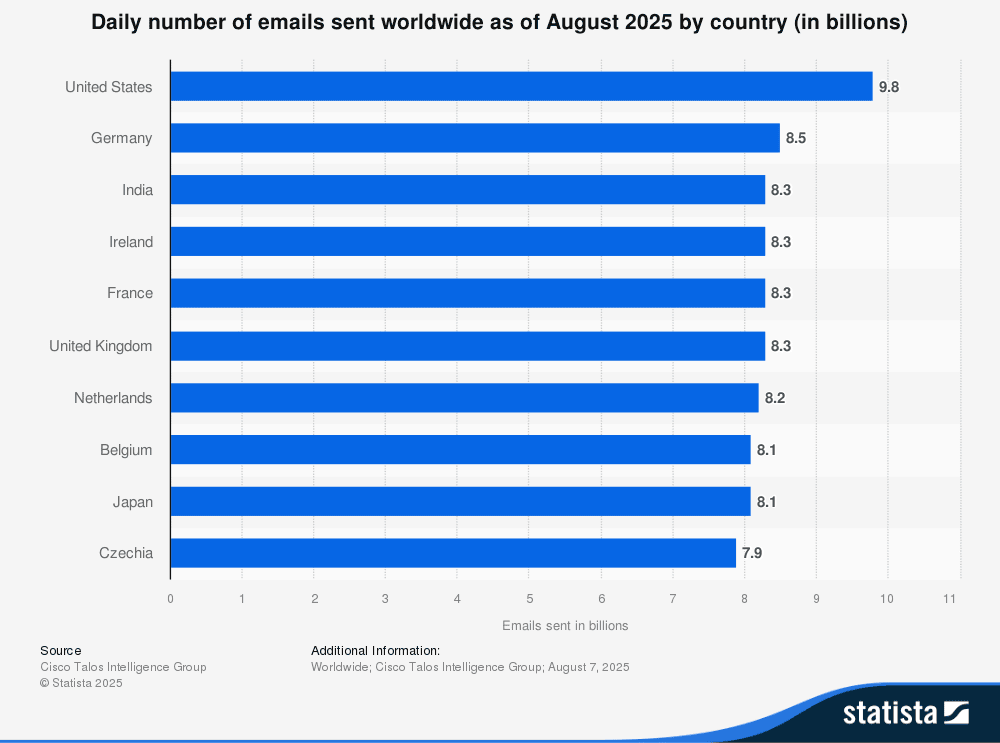
(Source: Statista) - The global number of email users exceeded 4.55 billion last year and is predicted to reach 4.97 billion by 2028.
- 68% of consumers prefer email to be the major communication channel with organizations.
- 81% of small and medium-sized companies choose email as their key customer acquisition touchpoint, whereas in the B2B domain, the share of such players is only 46%.
- 38% of businesses rely on the conversion rate as the principal indicator reflecting email ROI.
- Cold email conversion rate statistics are typically low, rarely exceeding 2% but more frequently equaling 0.2%.
- By tracking how your emails behave, you can double their conversion rate.
- The email marketing platform a company uses affects the conversion rate. It is rather high for Klaviyo users (3-5%), but considerably lower for organizations relying on Mailchimp (1.5-2.8%).
- The presence of 2-5 links in the email yields a 0.56% higher conversion rate than emails with any other number of links, where the index is twice as low.

What is email conversion rate? Definition, formula, and what counts as conversion
First, it is necessary to understand what the conversion rate is.
Email conversion rate formula
The process of determining the conversion rate is not rocket science.

(Source: In-Box)
You find out the number of people who interacted with messages in some way (clicked on the CTA button, subscribed to the newsletter, recovered a cart, downloaded content, you name it) and divide this number of conversions by the total number of emails that have reached the recipient.
Macro vs. micro conversions: What should you be measuring?
You should pay attention to both. While macro conversions reflect the company’s overarching business goals (making a purchase, downloading a piece of software, submitting a lead form, registering for a webinar, etc.), micro conversions display the success of small, incremental steps customers make, moving closer to this bonanza (opening the email and reading it, sharing it on social media, adding an item to the cart, and more).
Email conversion rate vs. CTR vs. CTOR: How they relate
These metrics are the success-defining parameters of email campaigns, but each index characterizes them from different standpoints. The click-through rate (CTR) reflects the efficiency of your messages and the click-to-open rate (CTOR) reveals how engaging your content is, whereas the conversion rate tracks the percentage of engaged people who have gone all the way to the primary goal.

(Source: Monday)
As a rule, the increase of one index improves the others, but that may not always be the case. A high CTOR combined with a low CTR often means the email content is effective, but too few recipients opened the email in the first place. This usually points to an underperforming subject line or preheader rather than weak email content.
What is a good email conversion rate? Benchmarks by industry and email type
Now we can move on to assessing the email conversion rate.
Why “good” depends on how you define conversion
Qualifying a conversion rate as good is subjective because the very term “conversion” is vague and can mean different things depending on the goal of your email campaign. For some use cases, only direct (aka hard) conversions have value, so you will count generated leads, purchases, and event registrations. In others, indirect (or soft) conversions also matter, so email replies, whitepaper downloads, and blog post reads may be counted as conversions.
Email conversion rate benchmarks by industry
Some industry reports cite average email conversion rates of around 31%, but it varies significantly across industries, with consumer electronics topping the chart and the finance sector showing the lowest rates.

(Source: Swym)
Email conversion rate benchmarks by email type
Email marketing conversion rate statistics also vary depending on the type of message you send. Promotional and win-back emails have the lowest index (0.5-2.5%), and welcome and post-purchase emails do slightly better (2-5%), but the most inspiring are cart abandonment email conversion rate statistics: 4-8% on average and up to 18% for top-performing companies.
B2B vs. B2C email conversion rates: A critical distinction
As a rule, conversion rates in the B2C sector (retail, eCommerce, travel and hospitality, etc.) are considerably higher than in the B2B domain (manufacturing, financial services, SaaS, and others). Organizations in the former category report 2-5%, while companies in the latter display 0.8-3%, on average. The difference is explained by the longer customer lifecycle and slower decision-making in B2B; B2C clients are much quicker on the trigger, often making impulse purchases in response to seasonal promotions.
Why is your email conversion rate low? A diagnostic guide
The correlations across basic email campaign KPIs may indicate specific problems.
-
High open rate, low conversions
Such a combination indicates a disconnect between a customer’s expectations and what they eventually see. The content or the subject line seized a person's attention, but what they saw after opening the email proved disappointing. Typically, the culprits are a mismatched landing page (too generic rather than a specific product page), a poor or irrelevant offer, a bewildering multitude of competing choices and links within the email, or an unclear/confusing CTA.
-
High CTR, low conversion rate
Low conversions despite a high CTR show the emails’ ability to attract traffic, but the failure of the post-clicks to close the deal. This may happen due to checkout issues, mobile friction problems, clickbait/overpromising, or targeting the wrong audience.
-
Low open rate
Why don’t potential recipients even bother to open your emails? First of all, they may not have a chance because your emails end up in the spam folder. This occurs when your DNS records (such as DMARC, DKIM, or SPF) are missing or misconfigured, so the sender trust can't be established.
If emails do reach the addressee but remain unopened, the problem may be a weak subject line that lacks personalization (symptomatic of the batch-and-blast approach) or bad timing. Additionally, if you often dispatch to invalid or inactive addresses, ESPs downgrade your sender reputation and qualify your campaigns as spam.
The conversion rate diagnostic table
Whatever problems your email campaigns might have, you should read the symptoms correctly, determine the root causes they reveal, and fix them with robust interventions. Here is the table with the most frequent issues and their resolutions.

(Source: Marketing Edge)
10 proven ways to improve your email conversion rate
The diagnostic decision tree’s first fix recommendations handle various metrics. What about the conversion rate? What should you do to see it soar?
1. Segment your list
Segmentation is the single highest-ROI lever. You should divide your audience according to more than demographics: Past behaviors (such as browsing activity, average order value, purchase types, open rates, and CTRs for previous emails, etc.) enable brands to tap deeply into their audience’s motivations and increase revenue by 760% compared with non-segmented efforts.

2. Design for one CTA
When the recipient has several options to choose from, they feel distracted, hesitate, and may end up making no decision. By providing a single next step, you map out a clear path that is impossible to miss and reduce the customer’s cognitive load, ultimately improving not only the conversion rate but also boosting CTR by 371%.
![Email call to action best practices: The complete guide [2026]](https://live-content-worker.stripocdn.email/media/article/19962/conversions/01kwmgd4fbkn09c2vd2dyb94hs-150x150.png?v=1783099728)
3. Build mobile-first
As surveys reveal, nearly two-thirds of customers open their emails on their mobile devices.

(Source: ZeroBounce)
UX aspects such as fast loading, seamless readability in single-column layouts, effortless navigation, and tap-friendly buttons are vital to your email campaigns achieving high conversion rates.

4. Match the email promise to the landing page
There is nothing more frustrating than following the link in an email hoping to buy a great T-shirt or download an engrossing game, only to be met with a generic page that tells readers about the brand’s benefits. Make sure CTAs lead directly to the product page, bringing consumers within a couple of clicks of closing the deal. Companies that succeed at this report a 200% increase in conversion rate.

5. Personalize beyond the first name
On average, personalization efforts improve email conversion rates by 60%. You can augment this number by amplifying the traditional first-name appeals through setting up behavioral triggers (reaching a milestone, abandoning the cart, etc.), leveraging geolocation targeting, and employing dynamic content blocks that display different elements of the same template to different recipients.

6. Prioritize automated flows over broadcast campaigns
Automated flows are honed to be triggered by customer actions so they deliver highly relevant messages when and where the person is most susceptible to them. By switching from broadcast campaigns to automation, brands may see their conversion rates spike by as much as 340%.

7. A/B test campaigns systematically
Even if your carefully planned email campaign yields fabulous results, that doesn’t mean it will happen every time you launch it. Emails aren't carved in stone; your audience doesn't stay the same indefinitely, either. Make experimenting with different templates, subject lines, CTAs, and other email elements part of your regular marketing strategy. But remember: you should test one variable at a time.
8. Use urgency and scarcity
The notorious FOMO (Fear Of Missing Out) is one of the most powerful drivers stimulating consumers to make purchasing decisions. Emphasizing urgency and hinting at the limited number of items still available can raise conversion rates by at least 15% (some accounts claim up to 35%). However, you should always tell the truth. When exposed, your fake urgency and scarcity statements will outweigh immediate gains by damaging your business reputation in the long run.
9. Measure revenue per email, not just the conversion rate
The conversion rate is indicative of the percentage of email recipients who take action. More telling is revenue per email, as it tells you how much profit each message represents. Like the conversion rate, revenue per email varies significantly across industries. It is the highest in the automotive vertical ($0.16), and organizations in the sector relying on automated workflows report a much greater financial impact (up to $5.47).

10. Reduce friction with interactive emails
Interactive emails exclude the necessity for consumers to visit external websites, allowing them to complete all actions within the inbox. To make this experience seamless, integrate embedded forms into your emails; ensure dynamic content (real-time inventory, up-to-date pricing, countdown timers, etc.) refreshes each time the message is opened; prioritize carousels and accordions over long scrolls and product catalogs; and employ gamification. Such measures can result in a 20-25% improvement in the conversion rate.

How to track email conversions accurately
There is a straightforward three-step algorithm that can serve you as a roadmap for email conversion tracking.
Step 1: UTM parameters
Each link within your emails should be tagged with Urchin Tracking Module (UTM) parameters, such as "source," "medium," and "campaign." These parameters identify platforms, channels, and specific promotions to let your analytics system know which campaign is responsible for traffic.
Step 2: Conversion pixels
Your ad platform or analytics tool (Meta Ads, Google Ads, etc.) provides a conversion tracking snippet that you should configure to track a specific event (for instance, a purchase or a lead form submission). The pixel code should be embedded on the post-conversion (thank-you) page to fire when the action is completed. Never integrate it into the landing page's URL because it will qualify each click there as a conversion, which will considerably inflate your statistics.
Step 3: Attribution windows
Attribution windows reflect the time between opening an email and a subsequent conversion, allowing experts to attribute it to this very email. To let it help you track conversions accurately, you should choose a timeframe for a specific use case (the standard window for eCommerce is 5-7 days, whereas in the B2B realm or for big-ticket purchases, it may be up to a month), screen automated bot traffic to avoid click count inflation, and account for multiple touchpoints to rule out double-counting.
Email open rates in 2026: Why this metric is no longer reliable on its own
In 2021, Apple launched its Mail Privacy Protection (MPP) protocol, which has brought about a tectonic shift in how email performance indices are treated.
How Apple MPP inflated open rates
Before MPP was introduced, email open rate was easy to determine. The email was counted as opened after the recipient actually opened it. MPP has allowed the system to preload images within the email and track its pixels. As a result of this procedure, an email was marked as opened regardless of whether the recipient even saw it in their inbox.
Naturally, such a mechanism significantly warped email open rates, inflating them by 10-30%. Since this metric was rendered unreliable, digitally driven businesses had to switch to other benchmarks (CTR, conversion rate, revenue per email, deliverability rate, etc.) to gauge the efficiency of their email marketing efforts more accurately.

Average email open rates by industry
With an average email open rate hovering above 42%, this index varies across verticals.

(Source: HubSpot)
Looking at the figures, you should bear in mind the MPP caveat and factor in the open rate inflation caused by Apple’s innovation.
Wrapping up
Turning an individual from a prospect to a customer (aka conversion) is what every business works for, and the conversion rate reflects the success of the strategies an organization employs to achieve it. If you are a digital-first brand, email marketing statistics across various verticals serve as reliable benchmarks for assessing your performance against your competitors’ and as guidelines for improving your approaches in this domain. High-end software will help you increase conversions and maximize the ROI of your email marketing efforts.
FAQ
1. What is the average email conversion rate?
Some industry reports cite average email conversion rates of around 31%, but this figure typically refers to any predefined conversion goal, not necessarily a purchase. Depending on your objective (such as a sale, registration, download, or form submission), your conversion rate may be significantly higher or lower.
2. What is a good email conversion rate for eCommerce?
While the average conversion rate for eCommerce organizations stays between 1.5% and 3%, a good index falls within the 3.5-5% margin. Anything above 6% is considered excellent.
3. Why is my email open rate high but conversion rate low?
This means that the email subject line was good at grabbing the recipient’s attention, but after what they saw next, they lost interest in completing the conversion. Possible reasons include a substandard landing page experience, poor rendering on mobile, content mismatch, a weak value proposition, or an inadequate CTA.
4. Is a 2% email conversion rate good?
A 2% conversion rate can be considered regular, since it falls within the standard margin of 2% to 5%. That said, you should bear in mind that email conversion rates vary considerably depending on the industry and message type (welcome, promotional, win-back, cart abandonment, post-purchase, etc.).
5. How do I calculate email conversion rate?
You should divide the total number of conversions for a given period by the number of emails delivered to recipients. Make sure you exclude bounced or undelivered emails from your calculations.
6. What is the difference between email CTR and conversion rate?
The click-through rate (CTR) reflects the initial success of emails, revealing the percentage of recipients who followed a link in the email. The conversion rate is a better indicator of ROI because it measures how many consumers completed the desired action (made a purchase, downloaded the app, registered for an event, you name it).
0 comments