


A dentist I’ve been visiting for over seven years once told me, when I asked what he does to increase patient flow in his dental practice, “Why would I do anything if I’m already fully booked two months in advance?”
However, a lack of an effective email marketing strategy is a risky approach no matter how skilled you are. Patients may move, choose a clinic closer to home, complete their treatment, or seek a narrow specialist. There are countless reasons why they might switch dentists.
That’s why it’s in a dentist’s best interest to have not only a two-month waiting list but also their own subscriber base: potential patients who read your emails, trust you, and stay connected even when they’re not planning a visit anytime soon.
This is where email marketing for dentists comes in. Not as a tool for “selling discounts” but as a structured patient communication strategy that combines relevant content, consistent email design, and automation to build trust, reduce missed appointments, and help your dental practice remain their first choice.
Key takeaways
- Email marketing for dentists is an essential marketing tool for building and maintaining long-term relationships with patients while promoting dental services.
- Dental email marketing campaigns can include various types of emails, such as appointment reminders, post-treatment follow-ups, educational emails, promotional emails, dental newsletters, and patient testimonials.
- To begin email marketing for dentists, you need to define your goals and target audience, choose an email marketing platform, build and segment your email list, create email content, design your messages using ready-made templates to reduce email production time, launch your campaign, and analyze the results.
- Common mistakes dentists make include sending emails without segmentation, ignoring analytics and mobile optimization, being inconsistent or over-emailing their contacts, and failing to implement a patient retention strategy.
What is dentist email marketing and how does it work?
Email marketing is a digital tool that allows dentists to send targeted messages to existing and prospective patients with the goal of attracting new patients, promoting services, and strengthening patient loyalty.
In many ways, email marketing functions as a clinic’s own media channel, enabling direct communication with patients and subscribers. It includes all the core components we will discuss below: a patient database, an effective email marketing strategy, automation workflows, and performance tracking.

Email marketing for dentists is not a one-time email campaign but an ongoing patient communication system that operates alongside daily appointments and in-clinic interactions.
Why email marketing is essential for effective patient communication and practice growth
Email marketing is vital for dentists because it:
- helps you keep the practice top of mind and consistently reminds patients about your clinic. Yes, you only email people who have opted in or given consent during their visit, but staying visible still matters;
- increases brand recognition in the dental industry;
- lowers marketing costs, since email is usually more cost-effective than paid ads, contextual advertising, and other marketing channels;
- allows you to quickly inform current patients about scheduling changes, new services, or special offers;
- helps manage bookings while reducing no-shows through appointment reminders, follow-ups, and confirmations;
- enables structured patient communication beyond the office visit and helps maintain patient relationships between appointments;
- simplifies personalized treatment follow-ups (keeping patients informed about what was treated and when, and sharing X-rays, other important documents, post-treatment care instructions, and precautions).
Email is the only marketing tactic where a dental practice can consistently show up in a patient’s life without fighting an algorithm or paying for every impression.
When email is done well, it doesn’t even feel like marketing. It reinforces familiarity with the doctor, explains the “why” behind treatment, and sets expectations long before a patient sits in the chair again. It’s just patient communication, but it’s critical. When you use email consistently, you build confidence, and confidence leads to follow-through, keeping appointments, accepting treatment, and staying loyal to the practice instead of shopping around.
At Pro Impressions Marketing, we see email work best when it’s leveraged as an integral part of the patient experience. If it’s just blasting out promotional junk, it won’t work, but a patient who regularly hears from their dentist about preventive care, changes at the practice, or even just a friendly check-in, feels remembered. Remembered patients feel valued, and they tend to come back and refer their friends, family, and co-workers.

Best types of marketing emails for dentists
Let’s explore the main types of marketing emails dental practices can send their patients.
- Appointment reminder emails
These are reminder messages that include the appointment date and time, your clinic’s address, the scheduled procedure, and its expected duration.
If patients need to follow specific pre-appointment instructions before the visit, those details can also be included in the email. Sending appointment reminders is most effective when done at least three times: three weeks, one week, and 24 hours before the appointment.
Example of an appointment reminder for a dental practice
Subject line: Appointment reminder: {Appointment date} at {clinic name}
Dear {patient name},
This is a friendly reminder of your upcoming dental appointment. We look forward to seeing you and to providing the highest level of care.
Appointment details:
Date: {appointment date} Time: {appointment time} Duration: {estimated duration} Location: {clinic address} Dentist: Dr. {doctor name} Procedure: {type of appointment, if applicable}
Before your visit:
Please arrive 10-15 minutes early to allow time for check-in.
Bring your ID, insurance card, and any updated medical information.
If you are undergoing a specific procedure, follow the preparation instructions provided previously.
Complete any required online forms in advance, if applicable.
If you are experiencing discomfort, dental pain, or have questions about your treatment, feel free to contact us before your appointment.
To confirm your visit, please click below:
[Confirm my appointment]
If you need to reschedule, kindly notify us at least {cancellation policy timeframe} in advance to avoid cancellation fees. You can reach us at {phone number} or reply directly to this email.
We look forward to helping you maintain a healthy smile.
Best regards, {Clinic name} {Phone number} {Website URL}

- Post-treatment follow-ups
In healthcare, post-treatment emails with care instructions and recommendations after a specific procedure are extremely valuable. You likely explain everything to the patient while they are still in the dental chair. However, they may be in discomfort, rushing back to work, or simply focused on getting through the anesthesia period. So it’s unlikely they will remember every detail.
An email gives them something they can return to at any time to check what they should and shouldn’t do today, tomorrow, or over the next week.

- Educational emails
People have many concerns about their dental health, from choosing the right toothbrush to understanding whether braces are appropriate for them.
You can educate patients in small, digestible portions by sharing practical insights and dental hygiene tips. Avoid overly technical explanations but mention that more detailed guidance and personalized recommendations are always available during a consultation.

(Source: Milled)
- Dental newsletters
Newsletters can serve as regular digests featuring short updates and announcements in dental email marketing.
While an educational email might focus on a specific topic (e.g., “Today we’re talking about braces”), a newsletter can combine multiple updates, such as introducing a new dentist, announcing a new type of available braces, and reminding patients why regular oral health check-ups matter.
This format helps you maintain consistent communication without overwhelming readers.

(Source: Vennagage)
- Promotional emails
Dentists can and even should send targeted promotional emails. The key is not making them the core of your email strategy.
Through these messages, patients learn about new services, updated treatment options, or products recommended by a dentist they trust. Promotional campaigns should inform and add value rather than feel overly sales-driven.
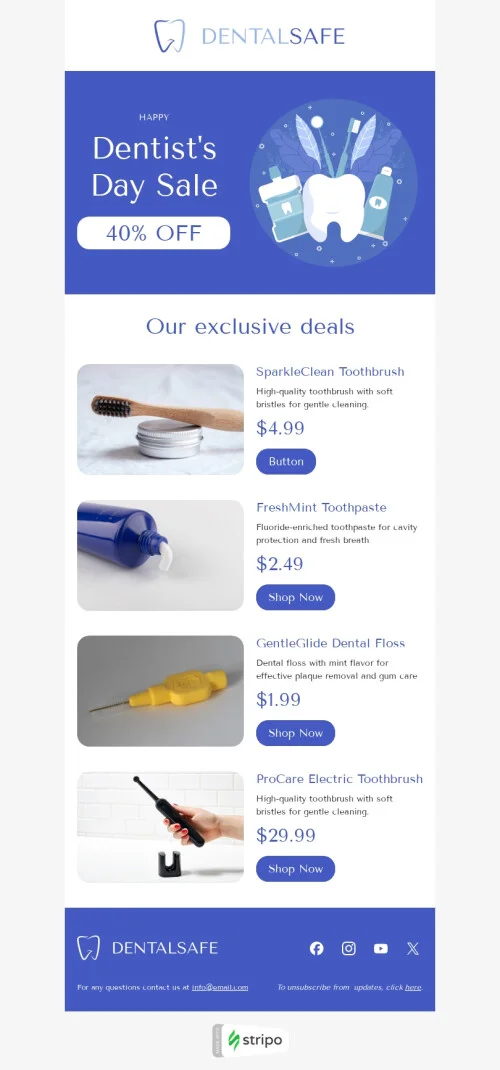
You can also add reviews and testimonials to your promotional emails, as patient feedback is a powerful marketing tool. People want to understand why others choose a particular healthcare provider. These forms of social proof can become the final push that encourages someone to schedule an appointment. Make it a habit to collect testimonials and periodically share them with your subscribers.

(Source: Milled)
- Referral program emails
In the dental industry, as in healthcare overall, patient satisfaction plays a crucial role. People rely on reviews and recommendations when choosing a trusted healthcare provider.
You can encourage existing patients to refer your dental practice to friends or colleagues. Referral program emails help keep patients engaged while turning their positive experience into a growth channel for your clinic.
To make the offer more appealing and increase participation, consider providing an incentive, such as a discount on a specific procedure or another valuable benefit.
Example of a referral program email for a dental practice
Subject line: Share a smile: Refer a friend and get rewarded
Dear {patient name},
At {clinic name}, we truly value your trust. If you’ve had a positive experience with us, we’d love for you to share it with your friends and family.
That’s why we’re introducing our referral program.
Here’s how it works:
- Refer a friend, family member, or colleague to our clinic.
- When they book and complete their first appointment, they receive {new patient benefit}.
- As a thank you, you receive {referral reward}.
There’s no limit to how many people you can refer. The more smiles you share, the more rewards you earn.
How to participate:
Share this link: {referral link}
Or ask your referral to mention your name when booking.
Or forward this email directly to someone who may be looking for a trusted dentist.
[Refer a friend]
Thank you for being a part of our dental community. Your recommendations help us grow and continue providing high-quality care.
If you have any questions about the program, feel free to contact us at {phone number} or reply to this email.
Warm regards, {Clinic name} {Phone number} {Website URL}
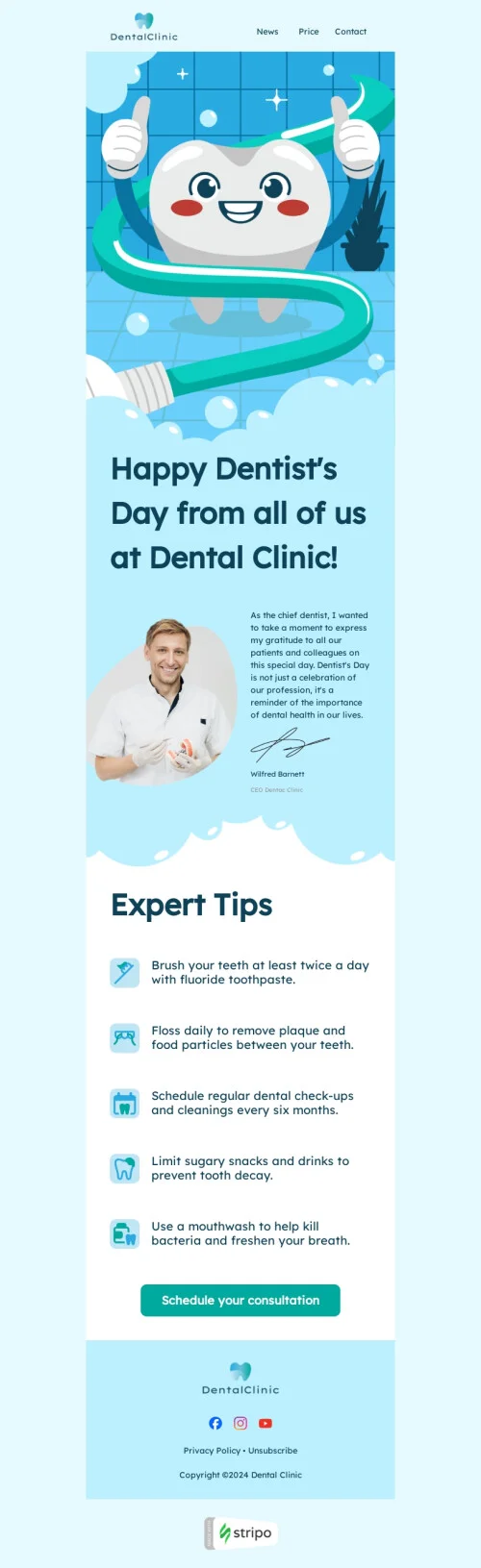
- Holiday promotional emails
This is a type of email that shouldn’t be overused but can be highly effective when it is timely and relevant. Consider which holidays or seasonal moments naturally connect to your services and oral health in general, and then test these campaigns to evaluate their performance and boost patient engagement.
How to create an effective dental email marketing strategy
We’ll share several dental email marketing strategy ideas you can implement to make your email marketing efforts more effective in your dental practice.
- A well-designed welcome sequence
When someone subscribes to your mailing list, they should immediately enter an automated welcome flow. In these first emails, you can explain how often they will hear from you and what type of content to expect: clinic updates, dental hygiene tips, special offers, or discounts for loyal patients.
You can also invite subscribers to indicate their interests, such as dental hygiene, braces, or implants, or ask when was the last time they had a professional cleaning. This will help you segment your target audience more accurately and deliver more relevant content. Offering a small incentive, such as a discount on the first visit within the next month, can further encourage engagement.
Map your patient journey and embed key touchpoints into your welcome sequence to guide subscribers from interest to action.

- Trigger emails as the foundation of consistent patient communication
Trigger emails are automated messages sent in response to specific actions, timeframes, or dates. For example, a cleaning reminder can be automatically sent if your system shows that a patient’s last hygiene visit was over six months ago. If a website visitor clicks on a “Book a consultation” pop-up, they can instantly receive an email with available dates and time slots.
Because these emails are timely and highly relevant, they typically generate strong open rates, click-through rates, and conversions.

(Source: Stripo template)
- Educational emails as part of your patient retention strategy
Educational content helps position your dental practice as the first choice when a patient experiences a dental health issue. Building loyalty requires consistent effort. Send useful, engaging emails that answer common patient questions and provide practical guidance.
Strengthen brand recognition by incorporating your clinic’s visual identity (colors and logo), consistent design elements, and small, memorable touches, such as a friendly dental-themed sign-off at the end of each message.
People don't need much to remember you. Avoid overwhelming them with unnecessary information. Instead, deliver helpful and relevant content at the right time. It really is that simple.

(Source: Milled)
- Promotional emails tied to clinic events
Promotional campaigns can either be a separate category in your marketing strategy, that you send periodically, or a subtle and integrated element within your regular campaigns.
When done thoughtfully and without being overly aggressive, promotions can inform patients about new services or limited-time offers while maintaining a professional tone and providing useful information.
The complete roadmap to launching email marketing for your dental practice
Where should you begin if you’ve never worked with email marketing before? Below is a simple step-by-step framework to help you get started with email marketing for dentists.
1. Define your goal and success metrics
Start by identifying your email initiative’s objective and the specific KPIs you will use to measure results.
For a dental email marketing campaign, goals may include:
- promoting seasonal services, such as teeth whitening, before the wedding season. Success metric: 10 booked procedures with new patients within a month;
- increasing hygiene appointment attendance among existing patients who haven’t visited in over a year. Successful email marketing campaign: 15 scheduled cleanings within 2 months;
- generating consultations for high-value procedures like dental implants or orthodontic treatment. Success metric: 5 consultation bookings within 3 months.
Clear goals help you design focused campaigns instead of sending generic emails.
2. Choose the right email marketing platform
Selecting a reliable platform is critical. A strong solution ensures patient data protection and compliance, automation features for behavior-based messages, built-in reporting and analytics, and easy campaign management. In our article about email service providers, you can learn more about what platforms exist and the advantages and disadvantages of each one.
3. Build and grow your email list
How can you ethically collect email addresses from current and prospective patients?
- ask for an email address when patients complete a booking form. Clearly explain what they will receive: appointment reminders, oral health tips, or exclusive offers;
- add subscription pop-ups or embedded forms to your website;
- promote lead magnets in other marketing channels in exchange for an email address. These may include educational guides, oral hygiene checklists, or a discount on selected services. All of these methods can attract potential patients.

Always collect emails responsibly. Obtain explicit consent before sending promotional messages, comply with data protection regulations, and include an unsubscribe option in every email so that clients can unsubscribe at any time.
4. Segment your audience
If you already have an email list, divide it into smaller groups based on meaningful criteria, such as type of treatment received, patient history, date of last visit, expressed interest in a specific procedure (e.g., they were interested in getting braces, but never did so), and family status (e.g., patients with children).
Segmentation allows you to deliver targeted messages to different patient segments. Some examples include a hygiene reminder to patients who haven’t had a cleaning in over six months, or an announcement about a new pediatric healthcare professional to families with children.
Treatment-based segmentation works extremely well. Lifecycle segmentation also matters. Active patients don’t love getting emails that make them feel like you think they are new patients. Overdue patients and inactive patients all need different conversations. Practice management software often makes this kind of segmentation doable.
Jonathan Fashbaugh,
If you do everything right, it becomes a win-win situation: the patient receives the information they need, and you gain loyal patients.

5. Use personalization in dental email marketing
Segmentation partially personalizes your email campaigns. However, you can always include the recipient’s name, their last procedure, or any other information you have about them to make the email feel more tailored. Including the recipient’s name in the subject line can boost response rates to an average of 43.41%, well above typical industry standards.
Experiment with subject lines using our AI subject line generator.
Automation and personalization are key to email marketing success and are such a complement to marketing that all modern practices are leveraging them. They see the best results by using email to respond to patient behavior like missed appointments, completed treatments, or long gaps between visits rather than sticking to a static calendar.
Jonathan Fashbaugh,
6. Create engaging email content and design
You can design emails from scratch or use pre-built healthcare templates to speed up production.
Focus on clear, action-oriented calls to action, interactive elements to increase engagement, consistent headers and footers to strengthen brand recognition, and reusable modules to maintain visual consistency and save time. It is not difficult to do this, especially with modular email design.
With Stripo, you can build your own library of modules. These can include ready-made headers, footers, email signatures, etc. To do this, select the element/section you want to reuse and save it as a module. The saved module will then appear in the modules section of your account and can be reused in future campaigns.

Most importantly, ensure mobile responsiveness. Data show that around 64% of people primarily check their email on mobile devices, and over half will delete a message if it isn’t optimized for mobile viewing.
Mobile optimization is not optional, as it directly impacts deliverability, engagement, and conversions.
7. Test your emails and subject lines
Have you completed all the previous steps? If so, don’t be afraid to click “Send” and launch your email campaign. Then look at the results, at what worked and what didn't.
Experiment with different subject lines, various sending times, alternative personalization approaches, and different versions of the same email for different patient segments. The more data you collect, the more accurately you can refine future campaigns.
8. Track key metrics
In the early stages, focus on core performance indicators, such as open rate, click-through rate, conversion rate, bounce rate, and unsubscribe rate.
Tracking these key performance metrics helps you understand what resonates with patients and to continuously improve your email marketing performance.
Email marketing best practices for patient engagement and patient retention
What rules help your email campaigns attract subscribers and convert them into patients?
-
Keep emails concise
Avoid overly long emails. Even valuable content becomes hard to read when it feels overwhelming. Focus on a few key points, supporting visuals (images or GIFs), and links to videos or additional resources when needed.
Most topics are not urgent in dental email marketing. This means you can break up complex information into a series of emails and deliver it gradually rather than try to cover everything in one message.
(Source: Milled)
-
Good timing matters
Timing directly affects open rates and engagement. Analyze when your emails are typically opened and read (these timeframes may differ) and schedule your campaigns accordingly.
Also, consider that different email types perform better at various times. Appointment reminders should not be sent late at night the day before the visit. Educational newsletters may perform better mid-week. Optimize timing based on data rather than assumptions.
-
Use clear, simple language
Avoid complex medical terminology. Your patients didn’t attend medical school, and unfamiliar terms may create anxiety. For many people, dental visits are already associated with childhood stress. Your emails should feel clear, predictable, and reassuring. Plain language builds trust and reduces fear.
-
Choose campaigns over one-off emails
In many cases, ongoing email campaigns tend to deliver better results than one-off emails, as consistent communication keeps your practice visible and reinforces patient relationships over time. Regular communication allows you to stay top of mind, share educational content, dispel myths, reduce fear around dental care, and gently entertain.
Train your patients to expect and read your newsletter regularly, just like brushing teeth.
Common mistakes dentists make in email marketing campaigns
Making mistakes is not a problem if you identify and fix them. But which errors are better avoided from the start?
1. Mass emailing without segmentation
Sending the same email to your entire database is a weak marketing strategy. When subscribers receive irrelevant content several times in a row, they are likely to mark your emails as spam, and you risk losing a potential patient.
A high number of spam complaints can also damage your domain reputation and affect overall deliverability.

2. Ignoring analytics
Collecting analytics and tracking key metrics is only half the job. The other half is analyzing that data and adjusting your campaigns accordingly.
Email performance data act as a virtual assistant for marketers. Even if the numbers are disappointing, they provide insight into what needs improvement, which approaches to test, and how to optimize for better results. Sustainable growth is impossible without data-driven decisions.
3. Over-emailing
A well-structured email series performs better than a single message, but excessive emailing turns into spam. The optimal sending frequency depends on your analytics, seasonality, and your dental practice’s specific needs.
4. Inconsistency in frequency
Alongside over-emailing, inconsistency is another issue that can negatively impact your email marketing results. For example, sending three emails per year, on a patient’s birthday, on New Year’s, and when tomorrow’s appointment schedule is empty, will not build long-term engagement.
Your communication should be regular and balanced. An example would be monthly educational content or a digest, a hygiene cleaning reminder every six months, and updates about new services, new doctors, or oral care tips every two months.
This is only a framework. The most effective strategy will always depend on your clinic’s target audience and goals.
The biggest mistake I see is inconsistency. Offices either send nothing for months or suddenly send three emails in a week. Both patterns train patients to ignore future emails.
Content is another problem. Too many emails are practice-centered instead of patient-centered. Patients don’t need updates about office policies unless those updates affect them. Patients will engage with content that deals with topics they care about, like comfort, clarity, cost, and outcomes.
The fix isn’t complicated. Decide what role email plays, pick a realistic cadence, and commit to making your content useful. If an email doesn’t answer a patient’s question, reduce anxiety, or help them make a better decision, it probably shouldn’t be sent.
Jonathan Fashbaugh,
5. Ignoring mobile optimization
This point deserves repetition because it directly affects engagement and conversions. Always optimize emails for smartphones.
In Stripo, you can preview how your email will look on mobile during the design stage. Use this functionality to prevent layout issues before sending.

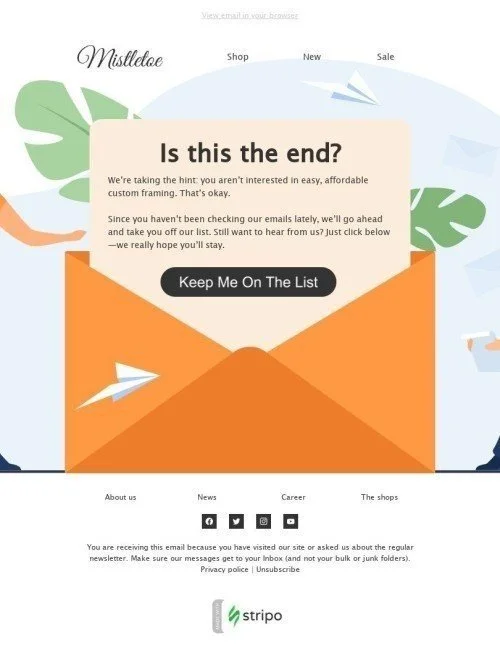
6. Not trying to win back old patients
Some patients may not visit your clinic for over a year for various reasons. However, re-engagement and patient retention are within your control.
Consider sending a reminder that it has been a while since their last cleaning, an update about new services at your clinic, or the joking question, “Is this really the end?” You know best which option is optimal. Retaining a former patient is significantly easier and more cost-effective than acquiring a new one. Do not miss that opportunity.
Wrapping up
Email marketing for dentists isn’t about one-off emails to fill the dentist’s schedule but a well-planned, systematic communication strategy that supports patient retention, reduces no-shows, and keeps your practice top of mind between visits.
Start refining your email marketing efforts today. When done strategically, email becomes a powerful tool for building trust, improving patient engagement, and supporting sustainable practice growth.


0 comments