Gift card email: Examples, templates, and best practices for 2026


Many brands treat gift cards as a holiday campaign rather than an always-on marketing channel, making gift card emails just another seasonal tool instead of a year-round benefit. In reality, gift cards have dozens of uses: they can help bring back abandoned customers, increase average order value, reward loyal customers, and solve the problem of last-minute purchases.
In this guide, you’ll learn how to create gift card emails that look professional and drive sales, how to deliver digital gift cards, and how to make redemption easy for recipients.
Key takeaways
- The global gift card market reached $1.12 trillion in 2025 and is on track to more than double by 2035. Digital cards are the fastest-growing segment.
- Gift card emails come in two categories: a promotional campaign that sells the card, and a transactional email that delivers it. Both play an important role in the customer journey.
- When designing gift card emails, pay attention to these essentials: a clear subject line, a bright and emotionally engaging hero visual, a range of gift card values to suit different budgets, and a simple redemption process explained in plain language so recipients never have to guess what to do next.
- Deliverability is often a challenge for gift card emails. Gift card language and image-heavy content can trigger spam filters, causing the email to end up in the spam folder. To reduce this risk, follow email design best practices, use descriptive alt text, and maintain a healthy balance between text and images.
What is a gift card email?
A gift card email is any email in which the gift card is the primary offer or product. It can explain what the gift card offers, promote it, deliver it to the recipient, or sell it. Most gift card emails fall into one of two categories: promotional or transactional.
Gift card campaigns are flexible. You can use them for various purposes, such as promoting holiday or seasonal offers, launching a new collection, or rewarding customers with bonuses and thank-you gifts.

(Source: Stripo)
Promotional vs. transactional gift card emails
Promotional gift card emails are designed to promote or sell a gift card. Brands usually send them before holidays, during sales, or as part of a customer retention campaign. The success of these campaigns is measured by clicks and the revenue they generate.

Transactional gift card emails deliver the gift card itself. As soon as someone makes a purchase, this email sends the recipient the gift card code and instructions for using it. The main metric here is redemption rate. Transactional gift card emails also tend to have higher open rates because recipients expect to receive them after a gift card purchase.

Email marketers should use both types of gift card emails.
Why gift card email marketing is worth it
The gift card market is already massive, and it continues to grow. The numbers tell the story.
Gift card market size and growth
Digital gift cards are driving much of this growth. In 2025, the global market was already worth $1.12 trillion, and forecasts suggest that it could more than double by 2035, reaching between $2.7 trillion and $4.2 trillion.
global gift card market size in 2025.
The B2B segment is growing just as quickly. According to Precedence Research, the corporate gift card market is growing by more than 14% annually as businesses use gift cards to reward employees and express gratitude to customers.
Gift card email performance benchmarks
The data back up this growth:
- 44% of shoppers spend more than the amounts on their gift cards, showing that gift cards encourage additional spending;
- 55% of consumers said a gift card encouraged them to try a new business or place, according to the TSG and Bank of America 2026 U.S. Consumer Gift Card Study. This makes gift cards an effective customer acquisition tool;
- among the reasons shoppers choose a digital card over a physical one were instant delivery (70%), ease of sharing (51%), and ease of purchasing (49%). This information is based on the 22nd Annual Prepaid Consumer Insights Survey from Fiserv;
- 57% of customers have also encountered gift card fraud, which has added skepticism and caution around gift card purchases. Businesses should invest in fraud prevention and clearly explain how they protect gift card purchases. Customer trust depends on it.
Types of gift cards you can send by email
Gift cards can be divided into several types. Before creating an email, decide which type of card you’ll be working with, as this will affect the copy, the redemption process, and, in some cases, the legal terms.
Open-loop vs. closed-loop
Closed-loop gift cards are issued by a specific brand or retailer. The sender purchases a gift card from that business, and the recipient can redeem it only with that brand or store. The redemption process is simple because everything happens within that company’s own ecosystem.

(Source: Email Love)
Open-loop gift cards have a Visa or Mastercard logo and can be used anywhere that accepts cards from that payment network. They give recipients greater freedom to spend them, but they also come with additional terms, including expiration dates and possible fees.
Emails for this type of gift card should clearly explain these details, along with how the card can be used online and in-store. Otherwise, you may end up with a frustrated recipient and spend time answering questions and resolving complaints because someone couldn’t redeem the gift card due to missing or unclear information.
Digital (eGift) vs. physical delivery
Gift cards also differ in how they’re delivered: either digitally or physically. Digital gift cards are delivered by email within minutes after purchase, allowing recipients to redeem them right away. Physical gift cards are shipped by regular mail in a gift envelope. Recipients get a tangible card that they can hold and use in person.
The TSG and Bank of America 2026 U.S. Consumer Gift Card Study found that gift card preferences vary by occasion. While 36% of consumers purchase only physical gift cards and 13% only digital ones, 27% choose between the two depending on the situation.

(Source: Stripo)
Anatomy of a high-converting gift card email
Most successful gift card emails have a few elements in common. Here’s what to check before you send.
Subject line
The subject line is your first opportunity to convince someone to open the email. Focus on the value the recipient gets and mention the occasion when it makes sense. If the gift card has a visible dollar amount, include it in the subject line.
Here are a few subject line examples for different occasions:
- first-time buyer: “Here’s a $10 gift card to try us out”;
- product launch: “Meet [Product Name], with a gift card on us”;
- re-engagement: “Long time, no click. Here’s $20 to come back”;
- basket boost: “Spend $100, get a $30 gift card back.”
Avoid excessive capitalization and exclamation marks because they can increase the risk of your email being flagged as spam. Experiment with different subject lines using Stripo’s AI subject line generator.

(Source: Email Love)
Hero visual and branding
The hero image sets the emotional tone of your email. People like it when an email and its gift card design are relevant to the occasion it’s being sent for, rather than just a standard promotional message in your brand colors.
If you’re sending a gift card for a specific occasion, that occasion should be immediately recognizable to the recipient before they even start reading the email. At the same time, include your logo, brand colors, and brand fonts to reinforce your identity and assure recipients that the email is authentic. This also builds on the trust they already have in your brand.

(Source: Email Love)
Denominations and price points
Give people a choice. Showing multiple gift card value options broadens your audience. A customer may not buy a $500 gift card, but they’re more likely to consider the $25 or $50 option than leave without making a purchase.

CTA and the redemption path
Don’t hide your CTA button. It should be easy to spot, and the button text should clearly explain what happens next. If the email delivers a gift card, the CTA should lead to the activation page, and the activation instructions should be written in clear, simple language.

(Source: Email Love)
Personalization: Message, photo, video
The ability to personalize a gift card is no longer a nice extra. It has become an expected part of the customer experience. Let buyers add a short message or even a photo to the email gift card.
If that level of personalization isn’t possible, include the recipient’s name to make the email feel more special, rather than a generic message sent to your entire mailing list.

12 gift card email examples to inspire your campaign
If you’re looking for a template to send a gift card to someone, this hand-picked set spans eCommerce giants and small indie brands. Each one does something worth stealing.
1. Sell emotion through images
The hero image shows a father carrying a child on his shoulders. It instantly brings back memories of childhood and time spent with dads. It also references a phrase many parents often say: “I don’t need anything.”
The email continues the story by reminding readers that, although their dads taught them not to procrastinate, life doesn’t always go as planned. If you didn’t buy a Father’s Day gift in time, a gift card lets Dad choose exactly what he wants.

(Source: Milled)
2. Suggest ways to spend a gift card
Shein’s example works well as a gift card email template for larger eCommerce stores with multiple categories. They mix Mother’s Day activity ideas with an invitation to explore Mother’s Day gifts, encouraging kids to find something for their moms. Showing gift ideas alongside the gift card reduces decision fatigue. Customers can immediately connect the gift card with products they might buy.

(Source: Email newsletter examples)
3. Emphasize the freedom to choose
In a dark, luxury design, Violet Grey reminds subscribers of one of the biggest benefits of a gift card: the freedom to choose what they actually want. People have enough dust-collecting presents on their shelves to appreciate that. The email also complements the customer’s taste, making them feel recognized for their good judgment. Receiving a compliment like that makes the experience even more enjoyable.

(Source: Email Love)
4. Show the value of convenience
Whether your customer forgot to buy a gift for someone on their long list of family and friends, or received a last-minute invitation, a digital gift card is a good solution. It’s quick to buy, easy to send, and arrives within minutes.
A gift card is also a practical choice because it reduces the risk of buying something the recipient doesn’t want. Instead, they can choose something they’ll genuinely enjoy and use.

(Source: Stripo)
5. Stress novelty for a new product
PetPlate encourages subscribers to place their first orders by offering a discount with a gift card. This approach lowers the barrier to entry for new customers and gives them an extra reason to try the product for the first time. The offer feels like an invitation to discover something new rather than just another discount.

(Source: Email Love)
6. Encourage customers to use their gift cards
If a gift card was delivered some time ago and the recipient hasn’t used it yet, send a reminder. SOKO GLAM does this effectively by reminding customers that they have a gift card while also highlighting the products they can use it on. Seeing those products again may remind recipients that it’s time to restock a favorite item or finally make a purchase.

(Source: Milled)
7. Promote gift cards for last-minute shoppers
There’s nothing fancy here, just a beautifully designed, minimalist digital card and a few short lines about the universal relevance of such a gift.
You can turn last-minute shopping panic into a marketing opportunity. Acknowledging that people sometimes forget to buy gifts creates an authentic, problem-focused message that resonates more deeply than traditional sales pitches.

(Source: Email Love)
8. Highlight instant gift card delivery
Even if the gift wasn’t purchased in advance, no one will notice. Instant gift card delivery makes last-minute gifting feel just as thoughtful and well planned. Emphasize fast delivery throughout the email, from the subject line to the CTA.

(Source: Email Love)
9. Offer a solution to their problem
Not many people love shopping, let alone shopping for someone else and risking getting it wrong. Gift cards remove that fear. The Material campaign speaks directly to that fear and offers a way to avoid it. The campaign works because it acknowledges a common pain point before presenting the solution.

(Source: Email Love)
10. Motivate the choices that come with the purchase
Reading this email takes you to places you could go with Dad in a car like the one featured. The customer hasn’t even bought the gift card yet, but they’re already daydreaming about the trip. That’s exactly the kind of emotional response a great email should create. It’s certainly more memorable than another shirt that Dad won’t even remember in a few weeks.

(Source: Email Love)
11. Use gift cards to boost the average order
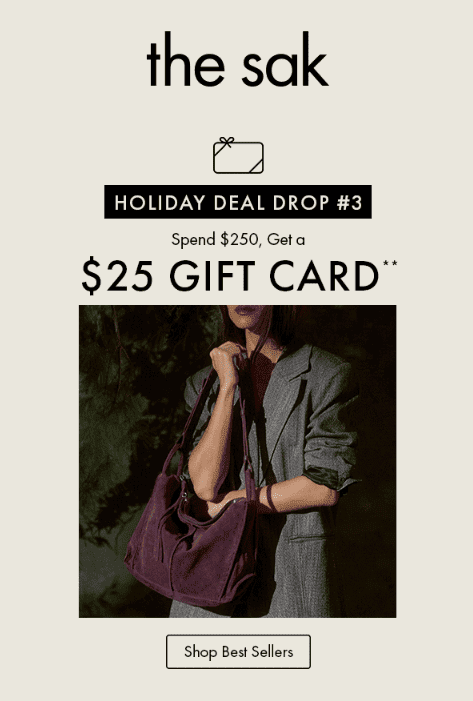
If your loyal customers have room to increase their average order value, use gift cards as an incentive tied to a minimum purchase. Abercrombie & Fitch offered tiered gift vouchers based on customers’ spending. The message is simple: spend more and get a discount. This encourages larger orders while giving customers an extra reason to come back.

(Source: Email Love)
12. Plant awareness for later
Any company with a newsletter can run gift cards as an evergreen campaign or as part of the onboarding flow. Even if you know a customer’s birthday, you don’t know their friends’ and family’s birthdays, so you’re missing sales if that customer doesn’t know you offer digital cards. Build the awareness and wait for it to pay off.

(Source: Email Love)
When to send gift card emails: Occasions and timing
The time and occasion of sending a gift card email are just as important as the subject line.
Best occasions
It’s worth sending gift card emails based on your customers’ behavior. Trigger them after a specific action on your website or when someone hasn’t made a purchase for a while, and you want to bring them back.
Traditional holiday gift card emails work just as well. People often forget to buy Christmas or New Year gifts, and a last-minute reminder can help them solve the problem in minutes.
Holiday shopping starts much earlier now, and people often start buying winter gifts in the fall. So, analyze whether this seasonal shift applies to your industry. If it does, create a sequence of holiday gift card emails and launch it earlier than you normally would.

Keep gift card templates ready before these dates arrive:

Keep in mind that during major holidays, customers receive similar gift card emails from many brands. Look for opportunities to stand out by sending your campaign when their inbox is less crowded.
For example, a pajama brand could send such a campaign on Wear Your Pajamas to Work Day. You can search for non-obvious holidays that fit your brand for a whole year in advance at the Stripo email marketing calendar.
Best send timing
Digital gift cards are a last-minute shopper’s best friend. Customers often choose an email gift card over a physical one when there’s no longer enough time for shipping. Keep sending “Still time to gift” campaigns until the very last day before the occasion, when physical gifts are no longer competing with you.
At the same time, offer scheduled delivery for customers who shop early. Let them choose a future delivery date so the gift card arrives exactly when they want it. This feature appeals to organized shoppers while still supporting last-minute buyers.

(Source: Email Love)

Campaign types that work
Here are a few gift card campaigns you can include in your email marketing strategy:
- first-purchase nudge: Offer a small gift card to help new subscribers overcome hesitation about their first orders;
- sale invite: Add a gift card to an existing discount to make the offer even more appealing;
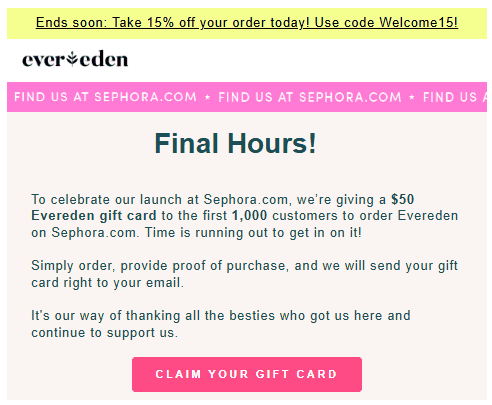
(Source: Email Love) - product launch: Pair a gift card with a new release to encourage early purchases;
- re-engagement: Win back inactive customers with a gift card incentive;
- basket boost: Offer a gift card redeemable only after a minimum purchase amount, increasing average order value.
(Source: Email Love)


Using gift cards as rewards and incentives
Gift cards make excellent rewards for both companies and employees. For businesses, they’re easier to organize than branded mugs, hoodies, or other physical gifts, and they require far less time and effort to manage.
Recipients also benefit because they have the freedom to choose something they actually want. In some cases, a gift card can even encourage specific actions, such as achieving the best performance of the month or completing a survey.
If your company runs an incentive program, treat the gift card email as a planned campaign rather than a simple notification. A personalized, branded email will look nicer and work better than a plain-text message with just the code. A gift card email is an opportunity to strengthen long-term relationships with employees or customers, so it deserves the same attention as any other customer communication.
Delivering the card: The transactional gift card email
This is one of the few emails that recipients are actually waiting for, making them highly likely to open. Yet many brands put surprisingly little thought into it.
What to include in a delivery or confirmation email
Include the following elements to make your email clear, trustworthy, and easy to use:
- a personalized subject line;
- the gift card balance or value;
- the gift card code;
- terms of use: expiration date, commission, if any, and the ability to use the card online or in-store;
- clear redemption instructions written in simple language;
- call to action to encourage the recipient to redeem the gift card;
- contact details for support in case the recipient has questions or needs help;
- a personal message from the sender, if one was included with the purchase;
- a recognizable sender name and email address that clearly match your brand.

Setting it up in your platform
The way transactional gift card emails are triggered depends on your sending platform or gift card system. In most cases, the delivery email is sent automatically after a gift card is purchased.
Build your template in Stripo once and add merge tags for the gift card code, balance, recipient name, and any other dynamic fields your platform supports. When the purchase is complete, your sending platform populates these fields with the correct data before sending the email.

Why gift card emails land in spam
Gift card emails often end up in the spam folder, and there are several reasons why.
The first is the content of such emails. Content that promises gifts or free money, has a heavy image-to-text ratio, or is packed with links can all increase your spam score. So, stick to a text-to-image balance, always add alt text to images, and avoid using link shorteners.
Gift card emails are also a common target for scammers, which makes mailbox providers more cautious with this type of message. Make sure your domain is authenticated with SPF, DKIM, and DMARC, and offer one-click unsubscribe. It also helps to build a recognizable brand presence by using a consistent sender name and avoiding overly urgent language that scammers usually use.
Accessibility and dark mode for gift card emails
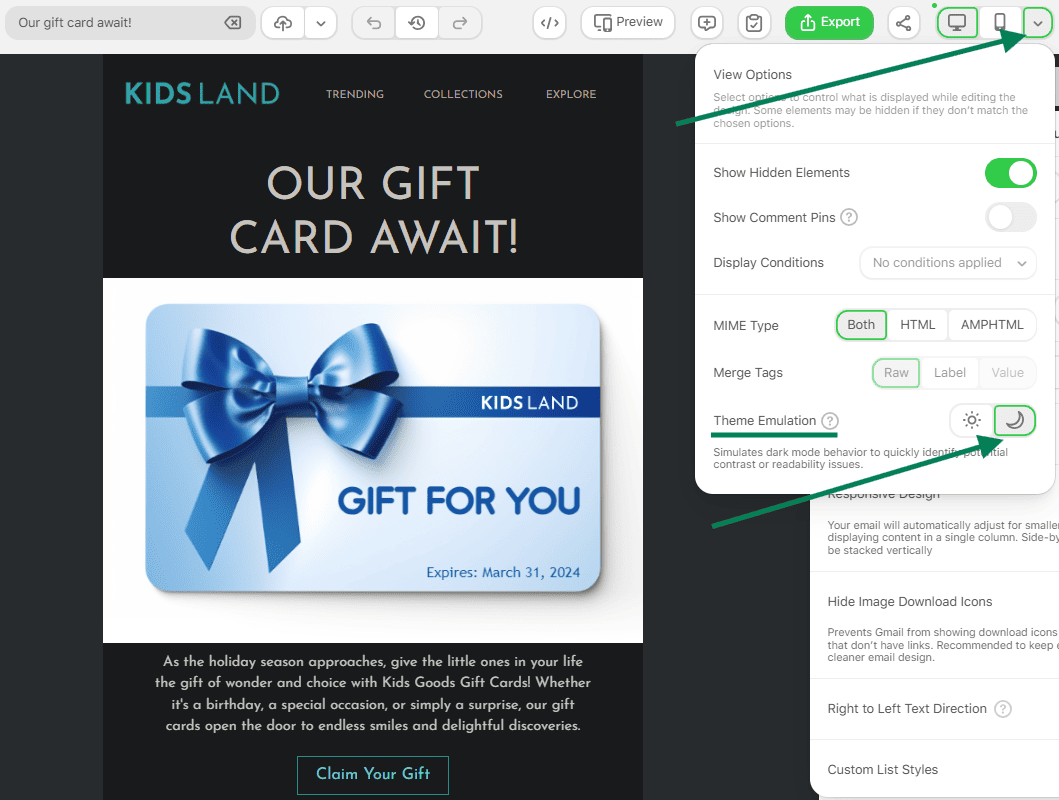
A gift card email that doesn’t display properly in dark mode is a wasted send. When subscribers open your email in dark mode, background colors may invert, contrast may break, and a gift card code on a light banner may disappear against a dark background.
To avoid these issues, test your email in both light and dark mode before sending it. In Stripo, you can do this during the design stage with the dark mode preview.
Choose colors and logos that work well in both themes. Your logo should have a transparent background, and the most important part of the email, the gift card code block, should maintain sufficient contrast in both light and dark modes.
All emails should be accessible, regardless of their purpose or content. Add alt text to all images so your message remains legible even if images fail to load or are blocked. Use readable font sizes, maintain sufficient color contrast, and avoid embedding important text into images.
You can check your email for accessibility with the Stripo accessibility checker.

How to create a gift card email in Stripo
You can build a gift card email template in Stripo without writing code. At a high level:
- Start from one of Stripo’s pre-built templates, including ready-made gift card designs, or from a blank template.
- Use the drag-n-drop editor to arrange your hero image, price points, CTA button, and other information.
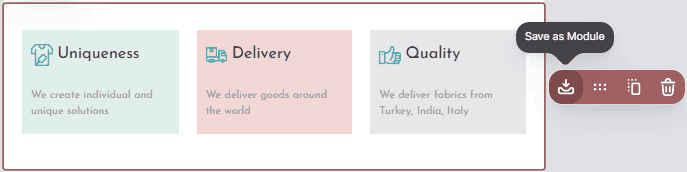
- Save your branded header, footer, and gift card block as Modules so you can reuse them across every campaign.
- Add dynamic tags for code, balance, and recipient name so that the delivery email is populated per order.
- Preview your design in dark mode and test renderings across email clients via Email on Acid integration before export.
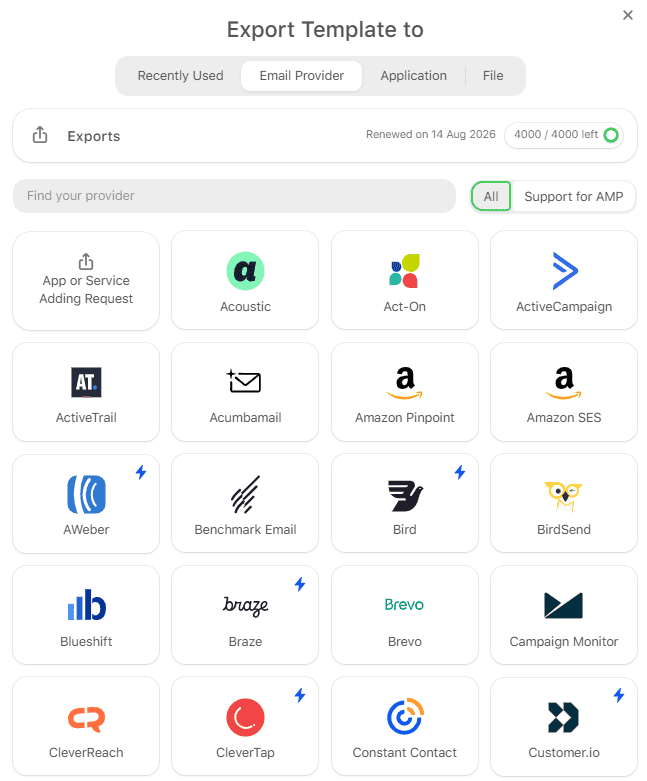
- Export to your ESP with a single click via Stripo’s integrations.


Wrapping up
The gift card market continues to grow, and digital gift cards are expected to be a major driver in 2026. The global market has surpassed $1.12 trillion, and digital gift cards are outpacing physical ones. The biggest gains will go to brands that pay equal attention to both parts of the process: the campaign that promotes and sells gift cards and the transactional email that delivers them.
Get the fundamentals right. Write a clear subject line, design an attractive gift card that matches the occasion, provide a simple redemption process, and offer price options for different budgets. Make sure your gift card design is dark-mode-safe and that your email is accessible to all customers.
When done well, gift card emails become more than a seasonal marketing tactic. They become a reliable channel that drives sales and customer engagement year-round.
FAQ
1. What’s the difference between a gift card email and a discount email?
A discount email promotes products that customers can buy from a brand or store at a reduced price for a limited time. A gift card email gives the recipient a fixed amount of credit that can be spent on products from a particular brand or retailer whenever the card is redeemed, subject to its terms. Unlike a discount, a gift card can also be purchased as a gift for someone else.
Gift cards also tend to increase the average order value, as 44% of recipients spend more than the card’s value.
2. Are gift card emails safe to send and receive?
Yes, as long as they’re set up correctly. If you send gift card emails, authenticate your domain with SPF, DKIM, and DMARC, and use a recognizable sender name so recipients can distinguish your messages from phishing or scam emails.
3. Why didn’t my recipient receive the gift card email?
There are several possible reasons. The email could’ve ended up in the spam or Promotions tab, or been blocked due to authentication or reputation issues. The recipient’s address could be incorrect, or their mailbox may be full and unable to accept new messages. Check each of these possibilities one by one to identify the cause.
4. Do eGift cards expire?
It depends on the card, its terms and conditions, and local laws. Make the expiration date and any other usage restrictions clearly visible in the gift card delivery email so recipients know exactly how and when they can redeem the card.
5. What’s the difference between open-loop and closed-loop gift cards?
A closed-loop card can only be used at the specific store or brand that issued the card. Open-loop cards work anywhere the network indicated on the card is accepted, usually Visa or Mastercard. Such cards give recipients greater flexibility in how they use them, but they may also come with additional terms, such as expiration dates or fees.
6. How do I redeem a gift card from an email?
The gift card delivery email should include instructions for activating your digital card. If the card can be used online, you’ll need to enter the code before payment. For in-store use, you’ll need to scan or show the card on your phone to the merchant.
7. Can I schedule a gift card email for a future date?
Usually, yes. Most gift card systems let you schedule the delivery of a digital gift card for a future date. This allows the gift to arrive on the recipient’s birthday, a holiday, or another chosen date or event.
0 comments